






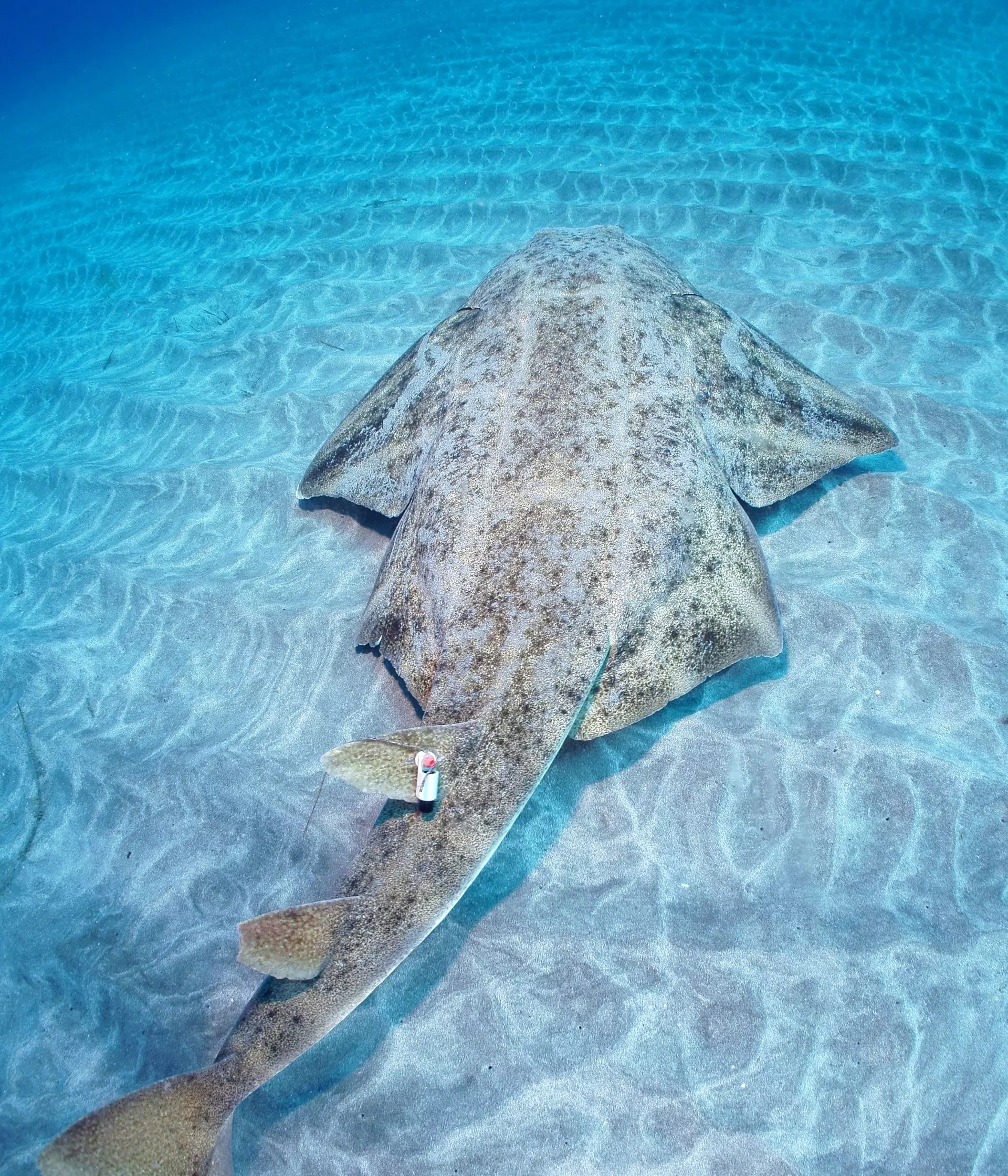
New research from ZSL and partners studying angelsharks in waters around the Canary Islands found that in the face of rising temperatures, female angelsharks are avoiding important breeding grounds when waters become too warm - with potentially severe ramifications for the future of this highly threatened shark.
The paper, published today in Global Change Biology, highlights how during a period of unusually high sea temperatures in 2022, female angelsharks were largely absent from mating grounds within La Graciosa Marine Reserve - the largest marine reserve in Spain, and one of the main strongholds for the species.
However, while the warmer waters deterred the female angelsharks, males returned to the breeding sites as usual, in search of potential mates.
The scientists behind the paper warn that this mismatch in behaviour of male and female angelsharks could disrupt the reproduction of the species, and highlights how climate change is already impacting vulnerable marine species as they adjust their behaviour to accommodate a rapidly changing environment.
Dr Lucy Mead, lead author of the study and researcher at our Institute of Zoology and Lancaster University said: “The fact that environmental extremes are driving differing male and female arrival times at coastal mating sites is of particular concern for this Critically Endangered species.
"It seems that male angelsharks prioritise mating even when conditions are unfavourable, while females prioritise staying within their preferred temperature range.”

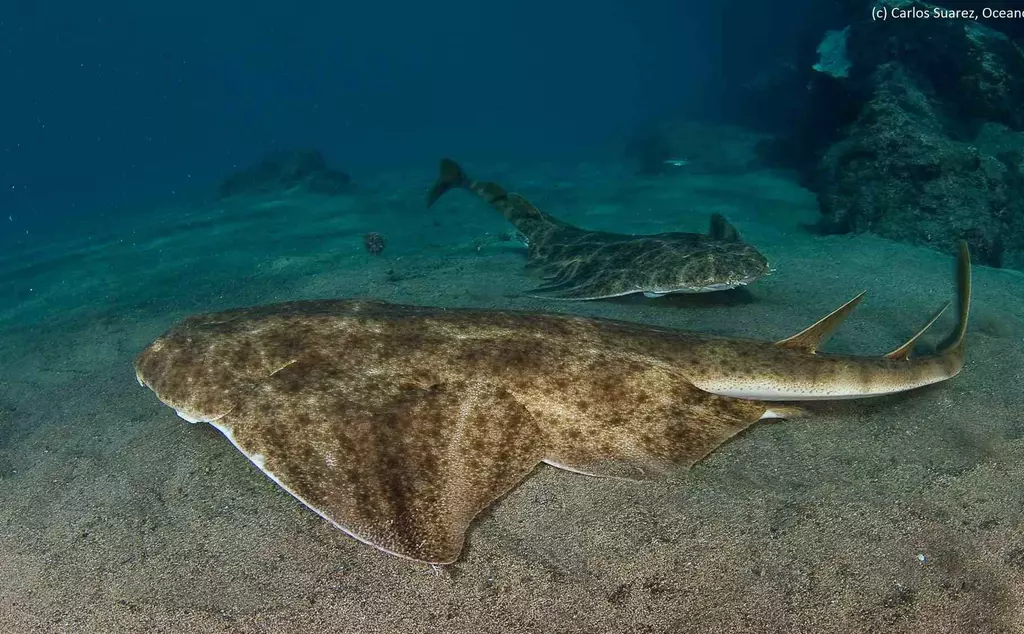


What are angelsharks?
Angelsharks (also known by their scientific name Squatina squatina) are one of three species of angel shark found in the Eastern Atlantic and Mediterranean Sea.
They have been listed as Critically Endangered on the IUCN Red List since 2006, and are the fifth most Evolutionarily Distinct and Globally Endangered (EDGE) shark species, representing a unique branch of the tree of life at high risk of disappearing globally.
They are speckled, caramel-coloured flattened sharks that can grow up to 2.4m long. This appearance makes angelsharks extremely well camouflaged and perfectly adapted to their sandy seabed environment. They are usually spotted swimming close to the sea bottom, or buried within the sand, resting and waiting for prey to swim overhead.
Rising temperatures in the Canary Islands
The research team studied angelsharks around the Canary Islands used acoustic tracking. This involves using electronic tags to monitor their movement. The team tagged and monitored more than 100 angelsharks between 2018 and 2023, and linked these data to changes in environmental conditions in the region.
During 2022, sea surface temperatures in the study area rose to more than 23.8°C and remained above 22.5°C for nearly three times longer than in previous years. The usual autumn and winter mating season for angelsharks was unusually warm, with this warmth persisting throughout the entire mating season.


In previous years, both the numbers of male and female angelsharks in the reserve consistently peaked in November and December each year. However, in 2022 male angelshark numbers peaked as usual, but female numbers remained low all year round.
The study showed that female angelshark presence is strongly linked to temperature, and that 22.5°C may be an approximate upper thermal limit for females.
Male and female sharks respond differently to climate change
The scientists believe that the reason female angelsharks are prioritising staying cool over mating is likely due to their biology and reproductive behaviour.
Lucy explained: “Angelsharks – as with most other sharks – are ectothermic, which means their body temperature directly depends on surrounding water temperatures.”
Angelsharks give birth to live young, with an estimated gestation time of 8-10 months. This reproductive process is energetically costly, and means that females have a greater need to regulate their metabolic processes. As with many other shark species, this makes females more sensitive to temperature than males. These differences in energetic cost and reproductive requirements mean that male angelsharks can prioritise mating even when conditions are unfavourable, whereas females will prioritise staying within their preferred temperature range.


The future of Critically Endangered angelsharks
The Canary Islands are a critical area for angelsharks, with adults and juveniles alike being regularly sighted in its waters, making them a flagship species for the local dive industry.
The islands are at the southern extreme of the angelshark distribution, meaning that they are already at the warmer end of tolerable temperatures for the species. During the five-year monitoring period, the scientists observed a general upward trend in peak sea surface temperatures, and an increase in the number of days with temperatures above 22.5°C, from 30 days in 2019 to 85 days in 2022.
Lucy added: “With significant warming projected here, our concern is that key areas may become inhospitable for females. Crucially, these findings have important implications for how we conserve this highly threatened species in a warming world."
"Climate change impacts in the ocean tend to be ‘out of sight, out of mind, but just as heatwaves and wildfires are becoming more frequent on land, so are extreme events in the oceans.”
The work was conducted as part of our ongoing work studying and protecting angelsharks through the Angel Shark Project – whether that’s tracking movement of sharks off the Spanish coast or engaging with local communities in Wales. The findings of this study will be fed into the team’s plans as they work to recover this species from the brink of extinction.
The research was co-led by Lancaster University and the Angel Shark Project: Canary Islands (a collaboration between Leibniz Institute for the Analysis of Biodiversity Change, Universidad de Las Palmas de Gran Canaria and ZSL), and supported by Shark Conservation Fund, Oceanário de Lisboa, Gobierno de Canarias, Loro Parque Fundación, Save Our Seas Foundation, Ocean Tracking Network, WWF Netherlands, Deutsche Elasmobranchier Gesellschaft, Queen Mary University of London, and the Natural Environment Research Council.
From working with local communities to wildlife health monitoring, as the original science-led conservation charity we are leading a fight for wildlife across the globe. Together we can make a difference, join us on our journey to build a better future.