







26 March 2026
Our work spans the landscapes where commodities are produced and the financial systems that shape those supply chains.
In just 50 years, human activity has driven a nearly three-quarters decline in global vertebrate populations, a trend with direct implications for the ecosystems and economies we depend on, given that more than half of global GDP is tied to nature. The pressures behind this loss are tangled in how we produce, trade and finance everyday commodities.
Turning nature risk into opportunity
We believe the very systems that drive biodiversity loss also have the potential to reverse it.
That's where our Sustainable Business and Finance programme – the SBF team – comes in. We sit at the intersection of conservation science and the engines of commerce and capital, working to shift how decisions are made across supply chains and financial systems. That could be done in a lot of ways. From improving how biodiversity is measured and monitored, strengthening traceability in high-risk supply chains, to shaping finance to deliver nature-positive outcomes for ecosystems and the communities that depend on them.
This year marks our 200th anniversary year, and it also happens to be Women's History Month. So we're exploring what this work looks like through the lens of some of the women on the SBF team.
Dr Mirjam Hazenbosch - Integrating biodiversity into business decision-making
Mirjam leads our Sustainable Business work, overseeing the full lifecycle of projects, from proposal development and programme management through to delivery and learning. Her main area of expertise is biodiversity risk assessment and monitoring, so much of her work involves translating ecological data into something that can sit within business decisions.
One example is her work with Google, in collaboration with the Monitoring and Tech team and HogWatch team, looking at how nature can be improved in and around data centre sites. This combines research with on-site monitoring, turning ecological insight into practical actions that can be embedded into how sites are managed. It reflects a broader shift underway that biodiversity is no longer only something companies report on, but something they are increasingly expected to measure, manage and act on in practice.
Dr Claire Salisbury - Building the foundations for biodiversity and climate finance
Claire brings her background in tropical forest biodiversity to her work as a Sustainable Finance Project Manager, with a focus on how to measure, monitor and verify nature outcomes in the context of private investment. She currently works on the SPIN project, a short, research-focused initiative exploring how science, evidence and technology can help improve the design, implementation and outcomes of projects that aim to attract private investment in nature.

Her involvement ranges from coordinating a workshop in Gorongosa National Park, Mozambique, on herbivore impacts on fire regimes and carbon, to supporting discussions led by technical experts within the SPIN team on developing scientifically robust approaches to measuring biodiversity change for biodiversity crediting frameworks.
Annabelle Dodson - Improving timber traceability in global supply chains
Annabelle works at the point where forests meet global markets. As a Project Manager in the team, her role spans managing partnerships to working directly in forest landscapes.

She is currently contributing to the development of World Forest ID's scientific reference library of African timber species, designed to verify where wood products come from. By collecting samples in the forest and analysing their chemical and isotopic signatures, the work allows timber to be tested against a verified dataset.
For companies and regulators, this adds an independent check on whether sourcing claims hold up. As expectations around traceability and due diligence increase, this kind of verification is becoming an important part of maintaining supply chain integrity.
Bronwyn Trafford - Linking spatial data with on-the-ground insight
Bronwyn joined the SBF team as a Spatial Data Advisor, initially focusing on spatial analysis of tropical deforestation in commodity supply chains. Her work has included presenting these insights to large financial institutions, helping them better understand exposure to deforestation risk and how it can be managed.

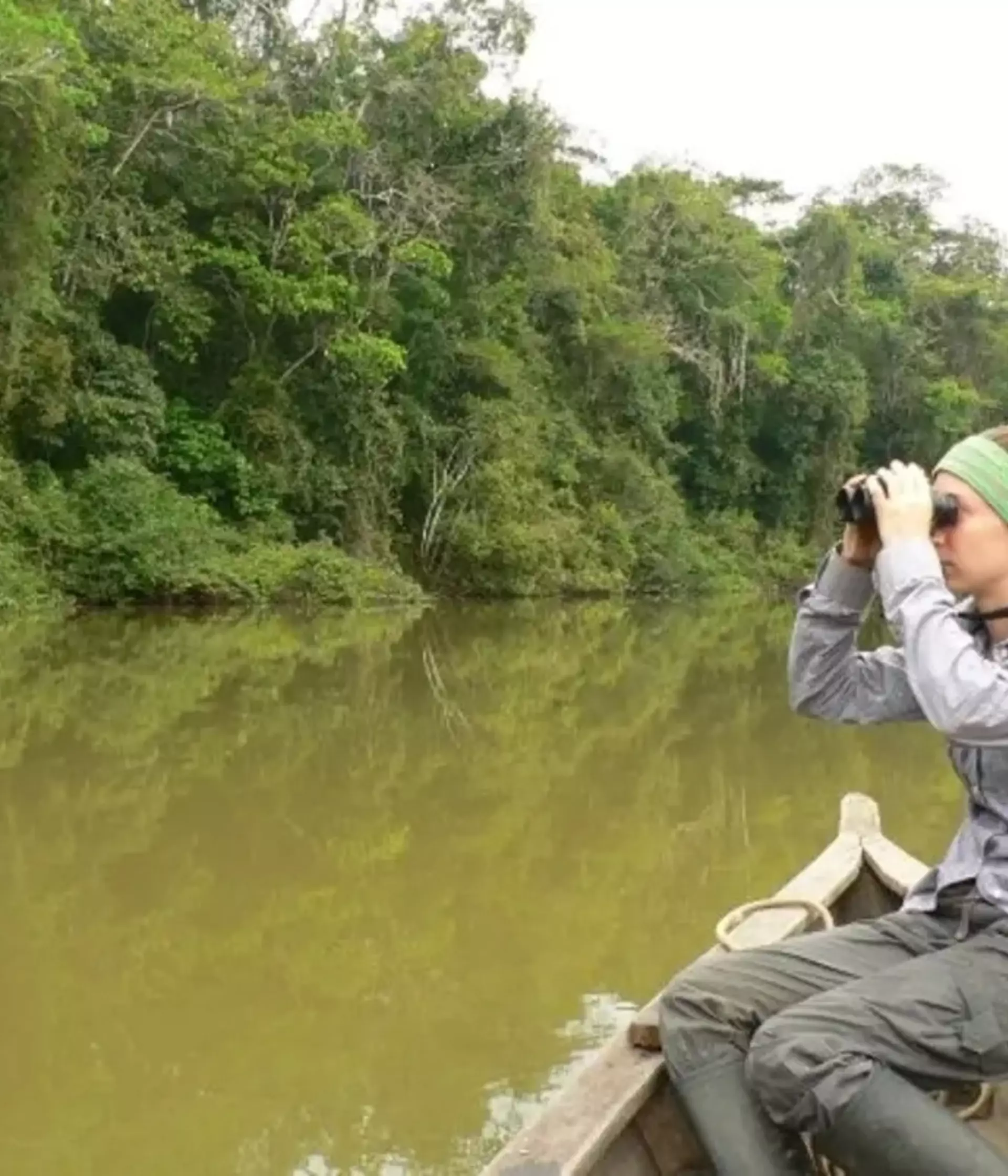
Since then, she has drawn more on her background in ecology and biodiversity monitoring, contributing to projects that assess organisational capacity and design landscape and species restoration initiatives, including work linked to nature outcome bonds in Mozambique and Madagascar. She has also supported scoping studies for voluntary carbon projects in Cameroon and Mozambique, alongside building capacity with in-country partners. This combination of spatial analysis and experience working directly in landscapes has taken her to some of Africa’s more remote environments – from navigating the Ivindo River in Gabon to observing lemurs in northern Madagascar – reinforcing how important it is to connect data with what actually happens on-site.
Eleanor Spencer - Monitoring biodiversity in company-managed conservation areas
Eleanor’s role encompasses technical and strategic aspects of working with businesses to improve their impacts for ecosystems and people, and includes a focus on forest-risk commodity sectors such as palm oil. A lot of her work revolves around encouraging and facilitating companies through these value chains to set and implement stronger sustainability policies, and improve conservation practices, to ultimately protect tropical forest ecosystems. She also represents our organisation in broader sector-relevant external discussions and groups, such as the Roundtable on Sustainable Palm Oil (RSPO).

Her current work includes directly engaging with some of these companies to improve their wildlife monitoring and supporting better protection of species and habitats in their conservation areas. This work is done with collaboration with our experts and with local partner NGOs, and spans both practical and more theoretical aspects of biodiversity monitoring – ranging from support in conservation planning concepts through to training on camera trapping and data analysis. Supporting companies to embed scientifically rigorous approaches is important to strengthen conservation efforts across the millions of hectares of company-managed land within tropical forest landscapes.


Imogen and Eleanor on a site visit
Imogen Fanning - Turning EUDR into practical guidance for supply chains and finance
Imogen works on the practical challenges of turning the EU Deforestation Regulation into something that can be used by the people who need to act on it - from financial institutions to companies and wider supply chain actors. Her work focuses on translating a complex regulation into clearer, more usable guidance on due diligence, legality, traceability, and supply chain risk.
She has helped develop training and tools to support more informed conversations around EUDR readiness, whether that is with banks and investors engaging clients, or with businesses trying to understand what compliant sourcing looks like in practice. This includes work on the legality side of EUDR, helping clarify what evidence supply chain actors should seek, how to review it, and where the limits of that evidence lie.
By drawing out the practical implications of EUDR for different sectors and users, her work helps move discussions beyond high-level awareness and towards more grounded decision-making on compliance, risk, and implementation.
Bridget Adams - Designing finance for coexistence and ecosystem restoration
Bridget works on developing and applying financial approaches that support conservation outcomes, with a focus on mobilising private sector investment into nature. With a background in climate and nature finance, she undertakes the design of projects across Africa and Asia, working on blended finance models and outcome bonds to support ecosystem restoration and human-wildlife coexistence. In 2025, she also joined the High-Level Climate Champions Team as a Youth Fellow for Finance (Nature). She worked closely with the team to accelerate action, collaboration and to mobilise finance for nature-positive solutions, supporting the COP30 Action Agenda.

Her work is currently focused in Kenya, where she is supporting the design of an outcomes-based financing mechanism to address human-wildlife conflict. As climate and land-use change bring people and wildlife into closer contact, the risks to both communities and species are increasing. Through the Outcomes Accelerator, she is exploring new approaches, including insurance-based models, to better support coexistence.
Rachel Poluan - Shaping how sustainability is communicated to decision-makers
Rachel works across communications within the team, focusing on how the team’s work is communicated to private sector audiences. This involves translating complex topics, from deforestation risk to biodiversity and sustainable finance, into practical content that can support stronger awareness and engagement. Through communications outputs, training materials and events, her role helps bring nature into business discussions and decision-making.

Her interest in this work has been shaped by an awareness of environmental and biodiversity challenges, and how they are communicated and acted on. She began by supporting communications for SPOTT, building a deeper understanding of forest-risk commodities, and now works across a range of content and engagement activities to support how the team’s sustainable business and finance work is understood and used by companies and financial institutions.
Sally Gray - New leadership for the SBF team
The team continues to evolve, with Sally Gray joining as the new Head of Sustainable Business and Finance. Her role will focus on bringing the best of our innovation and scientific insight and drive our mission to embed nature recovery into the heart of private sector markets, finance and partnerships. With the support of the SBF team she will be focused on building transformational partnerships with major organisations, ensuring our expertise shape business and investment models; and mobilise over £100million in private and public finance for nature by 2030.

Sally has spent over 25 years helping organisations think differently about sustainability, people and purpose – working across consulting, finance and mission-driven sectors. Along the way, she's held senior roles at EY – where she led their sustainable finance strategy and helped shape their presence at COP26, advised a range of public and private sector clients, and supported work in the non-profit space. It's this blend of commercial experience and mission-led focus that she now brings to the team.
Work with us to build a nature-positive future
Taken together, these roles show how this work comes together in practice - from working with companies to improve biodiversity management, to strengthening traceability in supply chains, applying spatial data to understand risk, and developing finance approaches that support conservation outcomes. While each focus is different, they are all part of the same effort to influence the systems that shape how nature is used and managed. As part of Women’s History Month, this piece offers a snapshot of the expertise and perspectives contributing to this work, and of the women helping to drive it forward.
Looking ahead
As we mark 200 years of conservation, we're focused on what comes next, which is partnering with businesses and financial institutions to turn nature from a risk into a foundation for resilient, responsible growth.
Work with us to deliver nature-positive outcomes
We partner with businesses and financial institutions to manage nature-related risks, strengthen supply chains, and develop practical solutions that deliver measurable outcomes for biodiversity and people.