




1 September 2026
From iconic logos and pioneering architecture to travel posters and even the humble lawnmower, our influence extends far beyond science and conservation.
Discover how two centuries of wildlife have inspired generations of designers and creative thinkers.
Discover our interactive timeline
More than a zoo
For 200 years, ZSL has been a place of scientific discovery.
But alongside groundbreaking research and conservation work, our conservation Zoos have left their mark on another part of British life - design.
Since opening the world’s first scientific zoo in 1828, our animals, buildings and landscapes have inspired artists, architects, engineers and illustrators. From Victorian travel posters and children’s books to modernist masterpieces and globally recognised logos, ZSL’s influence can be found in places that many people would never expect.
It is a legacy born from the same spirit of curiosity that drove our founders. When Sir Stamford Raffles established ZSL in 1826, he envisaged a place where people could observe and understand living animals in new ways. Two centuries later, that spirit of enquiry continues to inspire not only science, but also creativity.
A poster child for London
Long before social media campaigns and digital advertising, London Zoo was one of the capital’s most recognisable destinations.
Throughout the twentieth century, London Transport commissioned some of Britain’s leading artists and illustrators to encourage Londoners to visit Regent’s Park. Their striking posters transformed journeys to the Zoo into part of the city’s cultural life.
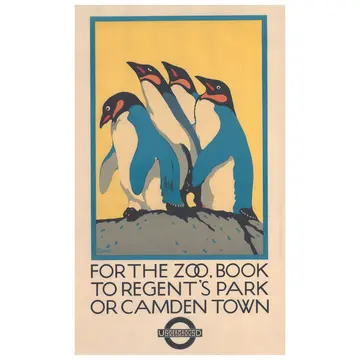
In 1921, artist Charles Paine created one of the most enduring designs: four stylised penguins marching across a bright yellow background, accompanied by directions from Regent’s Park and Camden Town stations. More than a century later, the poster remains instantly recognisable and has become an icon of London’s golden age of transport design.
This official London Transport Museum print was issued to the London Underground in 1921
Other posters celebrated giraffes, zebras, big cats and the excitement of a day at the Zoo, reflecting changing artistic movements and London’s fascination with wildlife. In 1935, Russian-born illustrator Rojan produced an elegant poster promoting tram travel to London Zoo, capturing the Zoo’s growing place in the city’s cultural identity.
These posters did more than advertise a day out. They helped establish London Zoo as part of the fabric of the capital itself. And to mark ZSL's 200th anniversary, the London Transport Museum commissioned a new London Zoo poster for 2026: featuring a tower of giraffes in the famous Giraffe House, this new design by Eliza Southwood joins a long history of iconic transport art.


London Zoo’s giraffes star in a London Underground poster
Browse our collection of Official London Transport Museum posters
The penguin that launched a publisher
Few logos are as instantly recognisable as the black-and-white penguin that appears on millions of books around the world. But less people know that its origins lie at London Zoo.
In 1935, Edward Young, a young designer working for Allen Lane’s newly founded publishing company, was sent to London Zoo in search of inspiration. Sketchbook in hand, he studied the Zoo’s penguins before returning to create what would become the original Penguin Books logo.
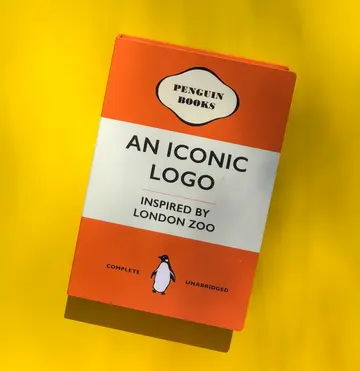
Our history with the Penguin Books logo is featured in our 200 exhibition, which visitors can explore at both London and Whipsnade Zoos until the end of 2026.
The image has evolved over the decades, but Young’s simple, bold design endures as one of the most successful pieces of branding ever created.
It's a surprising link to a place that has inspired storytellers for generations. After all, London Zoo was at the time already linked to one literary giant: A. A. Milne’s son, Christopher Robin, named his teddy bear after Winnie, the black bear he loved visiting at the Zoo, inspiring the creation of Winnie-the-Pooh.
Designing conservation
ZSL’s influence on visual culture extends far beyond books.
In 1958, Chi Chi the giant panda arrived at London Zoo and quickly became one of Britain’s most beloved animals. But her impact reached far further than Regent’s Park. When conservationists came together to create what would become the World Wide Fund for Nature (WWF), Chi Chi provided the inspiration for the organisation’s now world-famous panda logo.
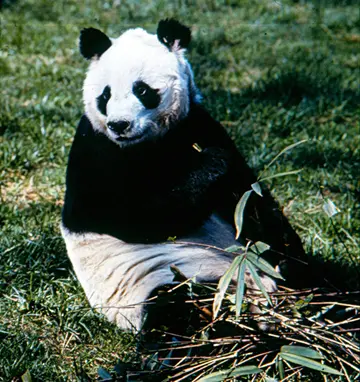
Chi Chi the giant panda
Simple, memorable and instantly recognisable, the emblem has become one of the most powerful symbols of conservation in the world.
That connection captures something fundamental about ZSL’s history: our ability to help people build emotional connections with wildlife. Over two centuries, the animals in our care have inspired artists, writers, campaigners and scientists alike, impacting not only how people see wildlife, but how they choose to protect it.
The zoo that shaped modern architecture
Perhaps nowhere is ZSL’s influence on design more visible than in the buildings that transformed twentieth-century architecture.
At London Zoo, modernism arrived in concrete. Completed in 1934, the Lubetkin Penguin Pool remains one of Britain’s most celebrated examples of modernist architecture. Designed by Berthold Lubetkin and the Tecton Group, the Grade I-listed structure combined dramatic aesthetics with cutting-edge engineering. Its famous interlocking spiral ramps appeared to float effortlessly above the water, creating an elegant stage on which visitors could observe the penguins.
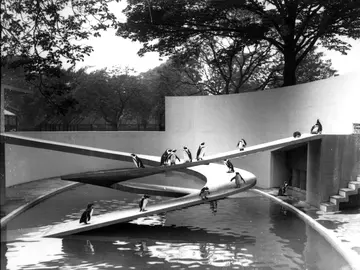
The Grade I-listed Lubetkin Penguin Pool at London Zoo
To realise Lubetkin’s vision, ZSL commissioned the young engineer Ove Arup, who would later become one of the most influential structural engineers of the twentieth century. The Penguin Pool was among the earliest buildings to demonstrate the expressive possibilities of reinforced concrete, helping to establish techniques that would later shape Britain’s post-war infrastructure – and even paved the way for multi-storey carparks.
The pool itself became a landmark of the International Modernist movement and remains one of the Zoo’s most photographed structures.
It was not an isolated experiment.
The Gorilla House, completed in 1933, marked Lubetkin’s first commission for ZSL, while later projects, including the Snowdon Aviary (now Monkey Valley), continued the Zoo’s tradition of architectural innovation. Across Regent’s Park and Whipsnade, ZSL has repeatedly served as a testing ground for new ideas.
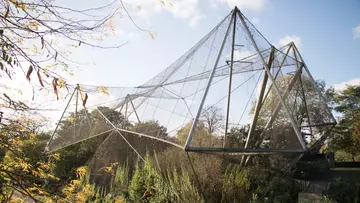
The Snowdon Aviary at London Zoo, which is now home to a troop of colobus monkeys
Just as importantly, these structures reveal how our understanding of animal welfare has evolved. Today, the Penguin Pool stands not as a model enclosure, but as a monument to a particular moment in architectural history and a reminder that both science and design must continue to adapt and evolve.
Mowing the lawn, scientifically
Even the neatly trimmed lawns that have long framed London Zoo’s historic buildings tell a story of innovation.
In 1831, just a few years after ZSL was founded, we tested one of the world’s earliest lawnmowers: Edwin Budding’s revolutionary new grass cutting machine. Budding had patented his invention only a year earlier, adapting technology used in textile mills to create a device capable of producing smooth, consistent lawns.
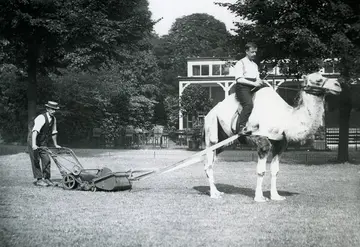
Keeper Fred Perry with the world's first camel drawn lawnmower in 1913
Being used on such a public stage meant people took notice. The mower eventually transformed landscape design, replacing the scythe and making possible the carefully maintained green spaces that became synonymous with Victorian parks, sports grounds and gardens. It also reflected ZSL’s willingness to embrace new technologies in pursuit of scientific ambition.
The lawns that visitors enjoy today at our Zoos owe something to that same culture of experimentation.
A lion carved into the landscape
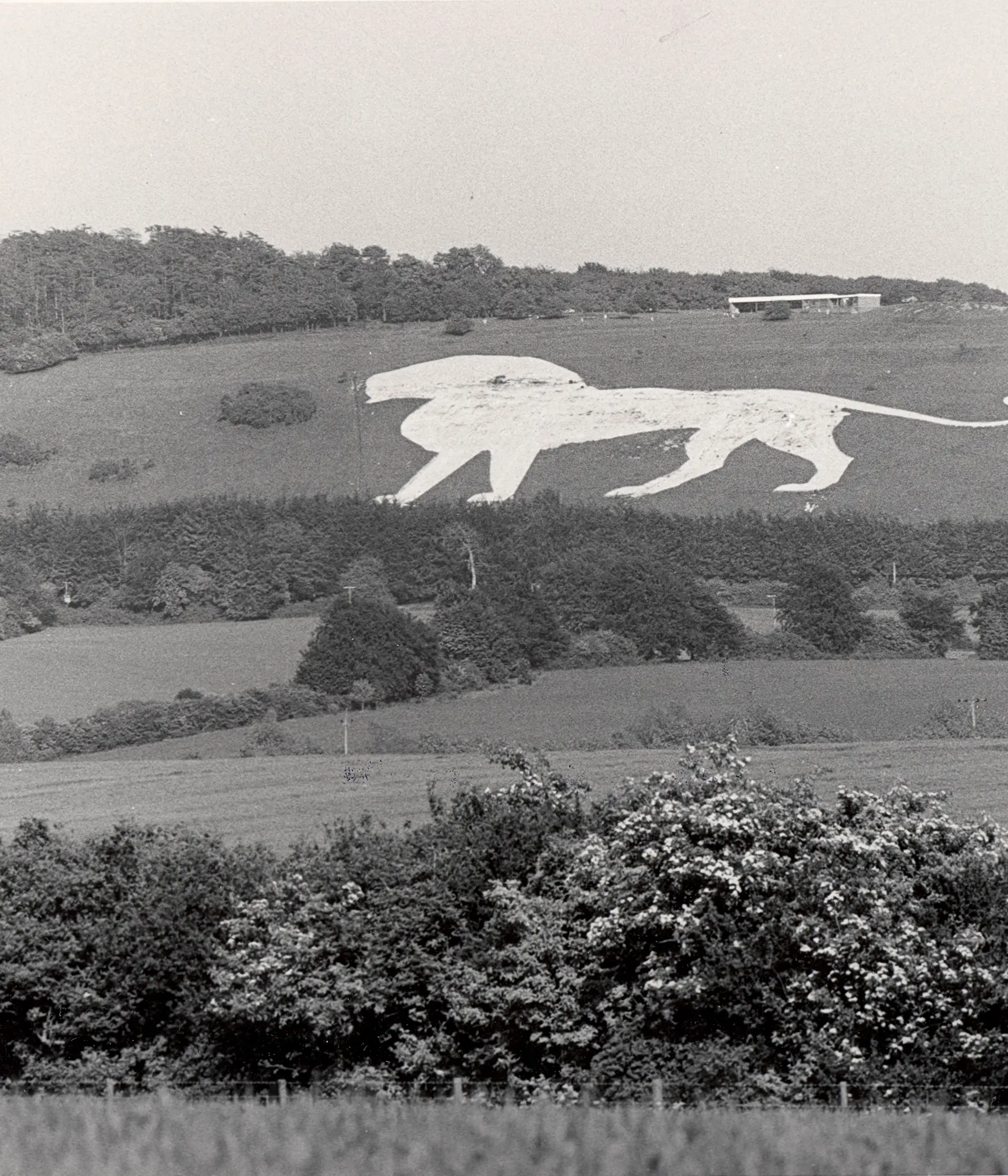
Few examples capture our impact on British design quite as dramatically as the Whipsnade White Lion. High above Whipsnade, one of Britain's most striking works of public art has become an enduring symbol of ZSL influence.
Carved into the chalk hillside, the giant figure stretches almost 480 feet across Bison Hill and has watched over the surrounding countryside since 1933. Visible for miles around – and even from the air – the lion was conceived as both an artwork and an advertisement for ZSL's newest venture: the world's first open zoo, Whipsnade Zoo.
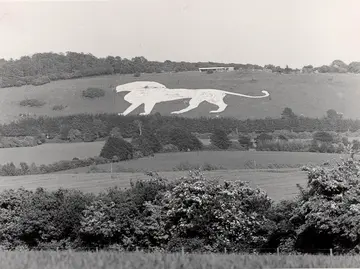
The White Lion was carved out of the hillside between 1931 to 1933
The White Lion emerged during a period of radical thinking at ZSL. Under the leadership of Secretary Sir Peter Chalmers Mitchell, the Society was reimagining what a zoo could be, moving away from the Victorian smaller menageries of the nineteenth century and towards larger, more naturalistic spaces for animals. That vision led to the creation of Whipsnade Zoo in 1931, an ambitious new wildlife park set among the rolling hills of Bedfordshire.
The lion quickly became a landmark. More than a signpost to the Zoo, it embodied the optimism of an institution looking to the future. During the Second World War, the figure was deliberately camouflaged to prevent it from serving as a navigational aid to enemy aircraft, before later being restored by generations of staff, volunteers and local residents.
Today, the White Lion remains one of the largest chalk hill figures in the United Kingdom and one of ZSL's most recognisable symbols. Part artwork, part piece of landscape design and part expression of institutional ambition. For nearly a century, it has shaped the very landscape around it and is a beloved part of the local community.
Designing conservation
The tools that protect wildlife are designed too – and few people have shaped conservation more profoundly than ZSL scientist Dame Georgina Mace.
When we think about design, we often picture buildings, logos or works of art. But some of the most influential designs aren't physical objects at all. They're systems: frameworks that help people make decisions, understand complex problems and take action.
For conservation, one of the most important of these is the International Union for Conservation of Nature (IUCN) Red List of Threatened Species: the global standard used to assess the extinction risk facing thousands of animals, plants and fungi. First established in 1964, the Red List has become one of the most influential tools in environmental decision-making, guiding conservation policy, scientific research and international agreements around the world.
ZSL has played a central role in its development through Professor Dame Georgina Mace, one of the most influential conservation biologists of her generation. Having joined ZSL in 1986 and later becoming Director of Science at the Institute of Zoology, Georgina led the development of the modern Red List criteria, fundamentally changing how extinction risk is assessed and how species are prioritised for conservation worldwide.
Before Georgina's work, the Red List relied heavily on opinion and nominations, making it difficult to compare extinction risks consistently across different species and habitats. Working with colleagues at ZSL and the IUCN in the late 1980s and early 1990s, Georgina helped create a rigorous, evidence-based framework using transparent, quantitative criteria based on measurable evidence to assess extinction risk.


Georgina led the development of the modern Red List criteria
Influential women in ZSL's history
The impact of that redesign can't be overstated. The modern criteria underpinning categories we recognise today – from Vulnerable and Endangered to Critically Endangered – emerged from work that began in meeting rooms at ZSL, transforming the Red List into the world's most trusted barometer of biodiversity.
Georgina understood that conservation depends not only on scientific discovery, but on creating tools that enable people to act. Throughout her career, she championed the idea that robust evidence and clear communication could drive political and social change. The Red List criteria she helped design went on to underpin international biodiversity targets, conservation planning and environmental policy around the world.
Alongside ZSL's better-known contributions to architecture, graphic design and engineering, just as Berthold Lubetkin reimagined what a zoo building could be, Georgina reimagined how conservation itself could be measured. Both understood that good design is about more than aesthetics: it's about creating structures that endure, adapt and change the way people think.
Designing the future
Design has always been woven through our story. It can be found in the curve of a modernist ramp, in the pages of a paperback, in the silhouette of a panda, and in the posters that once encouraged Londoners to take the Underground to Regent’s Park.
Good design does more than shape the world around us - it changes how we think about it. For 200 years, ZSL has helped people see wildlife differently. Sometimes through science. Sometimes through conservation. And sometimes through art, architecture and design.
As we look towards our third century, that tradition will continue. The challenges facing wildlife have never been greater, but neither has the opportunity for change - and to inspire people to act.
Do you have a story to share?
Our Community Storybook is a space for anyone connected to ZSL – past or present – to share your ZSL memories, moments and milestones. Whether you worked with us, visited our zoos, supported our mission, or simply have a story to tell about us, we’d love you to add your voice.