






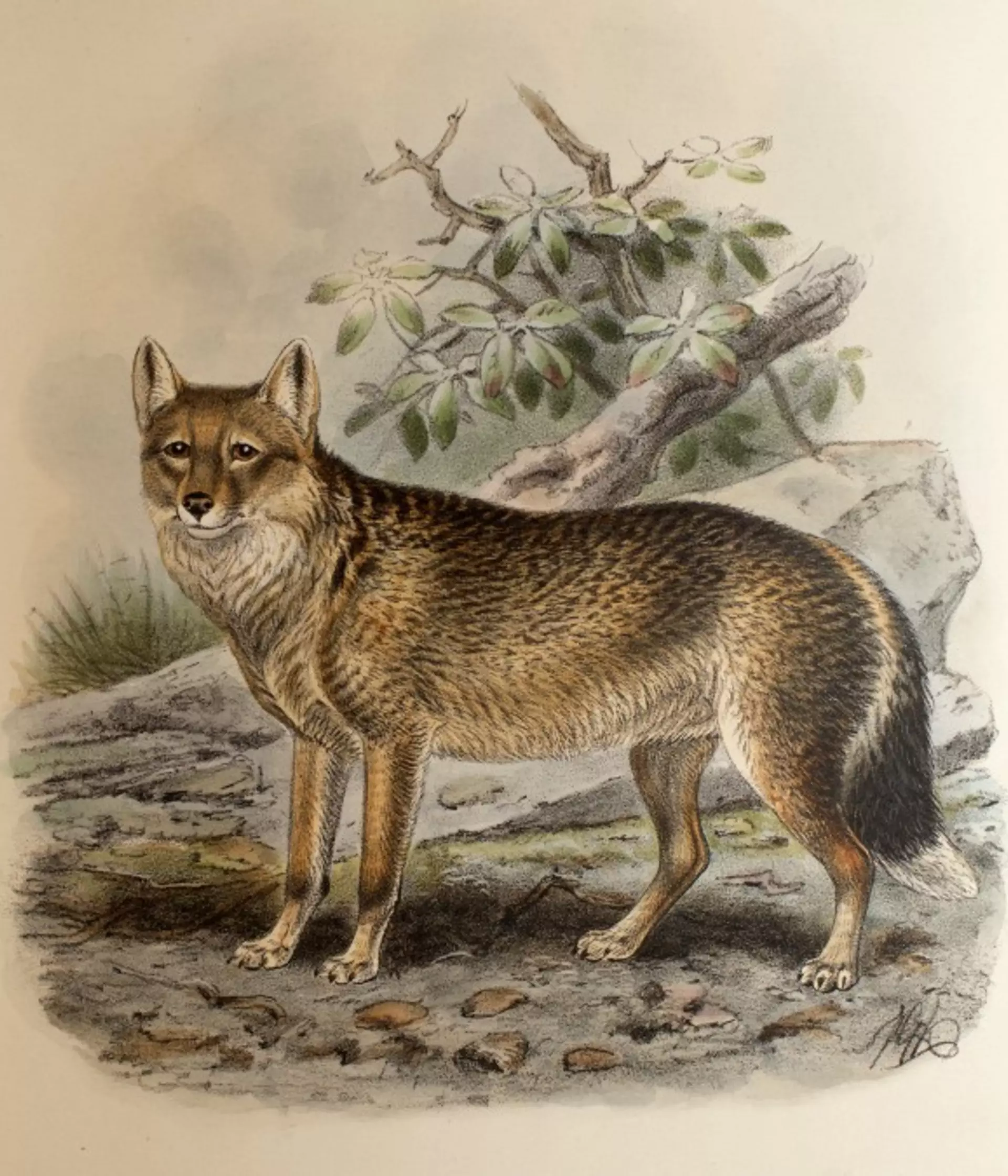
The Falkland Islands’ only native mammal was in fact the last remaining population of a South American species, reveals latest paper from our team of scientists and conservationsts: a discovery with huge implications for conservationists today.
The Falkland Islands wolf was thought to be a unique species found exclusively on the South Atlantic archipelago, but the review suggests it was actually the final population of a South American fox that once lived alongside humans.
Described by Charles Darwin in The Voyage of the Beagle as “a large wolf-like fox”, the now-extinct Falkland Islands wolf was unusually fearless around humans.
Previous genetic analysis suggested it diverged from a South American fox (known as Dusicyon avus) about 16,000 years ago. D. avus was believed to have gone extinct at least 400 years ago, but the new paper, published in the Biological Journal of the Linnean Society, reassesses the data to reveal otherwise.
The new study demonstrates that the Falkland Islands wolf was not a separate species, but was instead the final surviving remnant population of the South American fox, which persisted on these remote Atlantic islands for another 250 years after its disappearance from mainland South America. This finding gives a new perspective on human-caused extinctions, and helps conservationists predict the impact of human activities on wildlife across the globe.
Domesticated foxes and friendly wolves
Archaeological evidence suggests the foxes were once kept as pets by hunter-gatherers in South America, long before domesticated dogs were brought to the region.
This affinity with humans may have driven the foxes to their eventual extinction; Darwin noted how the Falkland Islands wolf was easily approached and hunted by settlers, and by 1876 it has been completely wiped out due to persecution and demand for its fur. The species had already disappeared from much of the islands by the time he travelled there just 40 years before their extinction, leading to his prediction that it would soon “be classed with the dodo, as an animal which has perished from the face of the earth.”


Professor Samuel Turvey, lead author and researcher at our Institute of Zoology, explained: “When settlers from Europe first landed on the shores of the Falklands, they were met by a strangely tame, tawny-coloured wolf-like creature – about the size of a small Labrador. The naivety that ultimately led to its extinction has traditionally been blamed on the wolf’s isolation.
“Just like the famous dodo, it was thought that millennia of evolution sheltered from the fear of any natural predators had resulted in this creature that was completely unafraid of people. But the reality was more complicated – and more tragic. The friendliness that made this canine an easy target for hunters was not due to a lack of contact with humans, but because they once lived alongside us.
“This isn’t just a heartbreaking twist to an already tragic story. The finding fundamentally shifts our understanding of what drove this species to go extinct – and has wider implications for our knowledge of human-caused extinctions today.”
The species is part of a group of medium-sized carnivores known as South American foxes. Most have bushy tails and long, slender faces, resembling the features of ‘true’ foxes, despite the group being more closely related to wolves and jackals.
What is a species?
The emergence of a new animal species can take hundreds of thousands of years, resulting from the accumulation of small genetic differences between each generation. Driven by a mixture of selective pressures and random chance, these tiny shifts in the genetic makeup of an animal population gradually add up – until the group becomes so distinct from other, closely related populations, that they can no longer interbreed.
Samuel added: “Sixteen-thousand years is like the blink of an eye on an evolutionary timescale. It’s comparable to when many British mammals separated from populations of the same species on mainland Europe. New analysis even indicates that D. avus and the Falkland Islands wolf could successfully breed – all of which adds up to suggest the wolves Darwin met were the last survivors of a fox thought to have vanished centuries earlier
“This means only one member of the fox, wolf and dog family has been driven to extinction by humans since the end of the Ice Age, advancing our understanding of how many unique species we have already lost.”


The team behind the paper suggest D. avus should be renamed to the scientific name for the Falkland Islands wolf - Dusicyon australis.
Previous studies have found skeletons of D. avus in prehistoric human graves in South America, with collagen analysis of one skeleton revealing that the fox would have dined alongside prehistoric hunter-gatherers – indicating that these foxes were likely kept as pets. Recent archaeological and paleontological findings also indicate that humans were present on the Falklands Islands long before Europeans arrived in the 17th century, suggesting that the canines were probably brought there by prehistoric settlers from South America.
How the past can help us protect the future
The new understanding that D. avus and the Falkland Islands wolf are the same species not only rewrites the story of their extinction, but also helps the scientists and conservationists working today to secure a future for endangered species globally.
The finding that the Falkland Islands wolf was introduced to the islands also raises the question of how its arrival impacted the historical ecosystems of these islands – and how that has impacted the region’s biodiversity centuries later.
We can’t bring the Falkland Islands wolf back, but its story helps us save the wildlife still with us today.
Samuel said: "By refining our baseline for assessing the vulnerability of species today, this finding allows us to become even better at predicting how threatened species respond to human pressures, and how to plan conservation action as effectively as possible.”
Dr Alexis Mychajliw, researcher at Middlebury College and co-author on the paper, said: “The more we look, the more we find that people have been moving species around for thousands of years. Collaborations between ancient DNA scientists, palaeontologists, and conservation biologists can not only reveal these hidden histories, but also help us better identify conservation priorities that honour these deep legacies of human-environment relationships.
“By reviewing recent ancient DNA studies from a conservation biologist’s perspective and advocating for standardization, our hope is to provide a more accurate barometer of recent extinction.”
Climate change and human activity have pushed our precious planet to its limit, causing the devastating loss of so many habitats and species. From lab to field, hands on and behind the scenes, we’re leading the future of conservation, shaping agendas and influencing change to support better life, health and living for people and wildlife.