







Written by
ZSL
Zoological Society of London
1 June 2026
The intriguing tale linking a ghostly mongoose, a boarder collie, and ZSL's Biobank
Have you ever heard of Gef, the talking mongoose? It’s one of Britain’s most peculiar ghostly tales, and it begins in the Irving family farmhouse on the Isle of Man in 1931. The Irving family heard strange scratching noises coming from behind their walls and soon, those sounds become something far more extraordinary: a voice.
The voice introduced itself as Gef, an 80-year-old mongoose from New Delhi. Invisible yet clearly present, Gef spoke multiple languages, echoed the family’s conversations, and shared stories from far-flung places. Over the years, he became a constant and bizarre companion to James and Margaret Irving, their 13-year-old daughter Voirrey, and the family dog, a border collie. Whether a witty ghost, hoax, or something in between, Gef quickly captured the imagination of local villagers.
As word spread, journalists flocked to the island, eager to investigate the so-called “talking mongoose.” Was the farmhouse haunted, or was it all a clever trick? The story soon gained national attention, appearing in newspapers throughout the 1930s and becoming part of British popular culture. Among those intrigued were paranormal investigators, also known as ghost hunters. In 1935, a psychic researcher visited the Irving home alongside a BBC editor, hoping to gather tangible evidence of Gef’s existence. Their investigation yielded curious results: pawprints and a handful of hairs supposedly belonging to the mysterious creature.
These samples found their way into the hands of respected zoologists. The pawprints were examined by Reginald Pocock from the Natural History Museum, a former superintendent of ZSL, while the hairs were sent to Julian Huxley, then Secretary of ZSL and thereafter a prominent figure in British science. Huxley, in turn, passed the hairs on to F. Martin Duncan, our naturalist and librarian, as well as pioneer wildlife filmmaker.
And here is where the story takes an unexpected turn, from folklore into our very tangible archives.
F. Martin Duncan (1873-1961) was a passionate advocate for natural history and education. Over his lifetime, he amassed an eclectic collection of biological specimens, many prepared as microscopic slides for study and display. In 1957, Duncan donated several boxes of these slides to us, where they quietly became part of our extensive scientific collections.
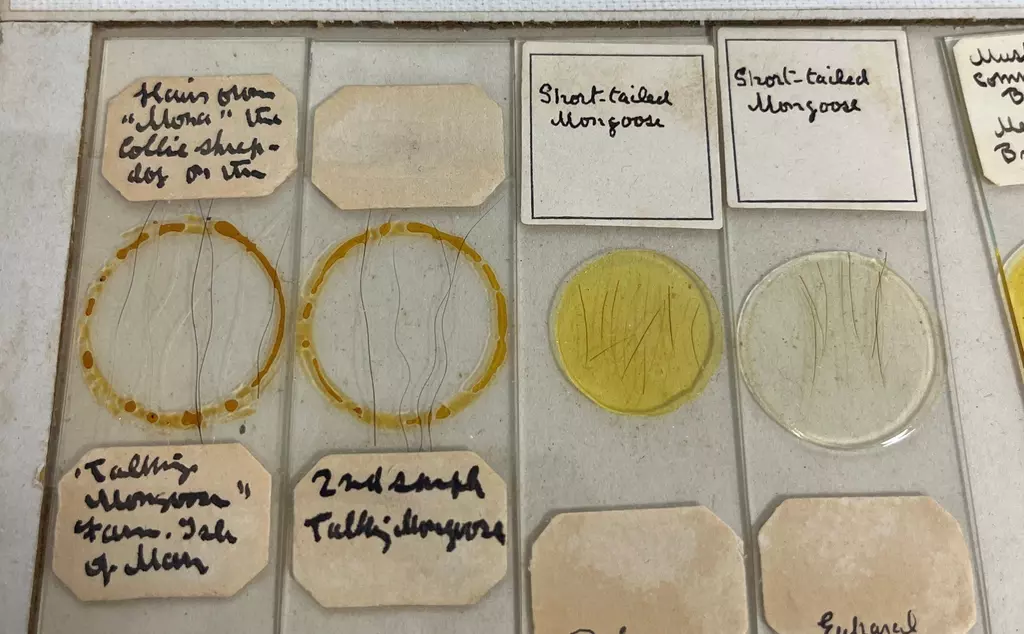
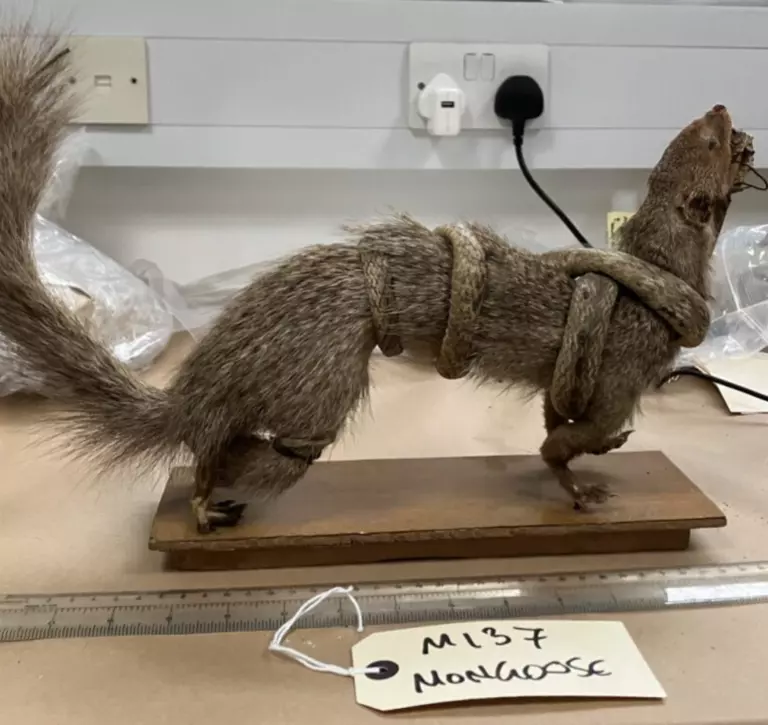
L: Slides depicting "talking mongoose" hairs
Decades later, in 2019, we established our Biobank at the Institute of Zoology: an initiative designed to preserve and catalogue the organisation’s vast biological archive. This includes everything from tissue samples and wildlife DNA to historical specimens collected over nearly two centuries. As part of this effort, staff and volunteers began auditing and digitising older collections, including Duncan’s slides.
What they discovered was astounding.
Among the carefully labelled specimens, and alongside lemur hairs, porcupine quills and platypus venomous glands, was a slide with hairs attributed to Gef, the talking mongoose, which had made it to the 21st century! Here, carefully preserved, was a physical remnant of one of Britain’s most bizarre phenomena: a story that had once captivated the nation and sparked debate across both popular media and scientific circles.
Of course, modern analysis casts doubt on Gef’s story. Though the hairs have not undergone genetic testing, their appearance suggests a far more familiar origin, most likely that of a domestic dog such as a border collie...
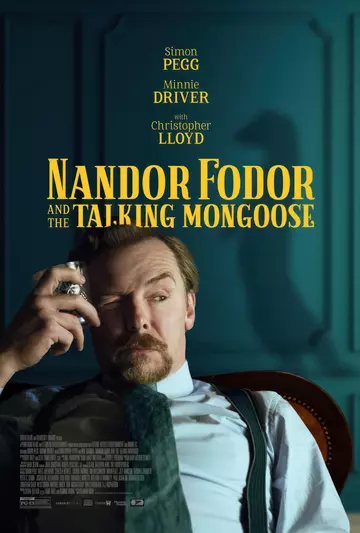
Yet to dismiss the story entirely would be to overlook its cultural significance. Gef is more than a curiosity; he is part of a rich tradition of British storytelling, where the strange and the scientific often intersect. His tale has inspired fiction, investigations, and even the 2023 comedy film “Nandor Fodor and the Talking Mongoose”, featuring Simon Pegg.
For us at ZSL, Gef’s slide represents something equally valuable: a reminder that scientific collections do not exist in isolation from the societies that create them. The ZSL Biobank is not only a biological archive but also a living record of human curiosity: of the questions we ask, the mysteries we pursue, and the stories we tell to make sense of the natural world around us.
Today, our Biobank houses thousands of samples, preserved across dry, wet, and frozen collections. Each specimen contributes to ongoing research in conservation, biodiversity, and animal health. At the same time, efforts to digitise and reinterpret these collections are uncovering unexpected connections like this one.
As we celebrate our 200th anniversary, stories like that of Gef invite us to reflect on our Society’s history and remind us that science is not just about certainty and classification, but also about exploration, curiosity, and occasionally, the peculiar in what surrounds us. So, whether Gef was a ghostly visitor, a clever trick, or simply a shaggy dog story, his legacy endures: in folklore, in film, and, quite remarkably, in our biobank.