





Paul Stoker is a volunteer at our conservation charity, within our Biobank at London Zoo.
He moved to London at the age of 29, but his connection to our conservation Zoo began long before that, even before he was born – and it all started with a bag of monkey nuts.
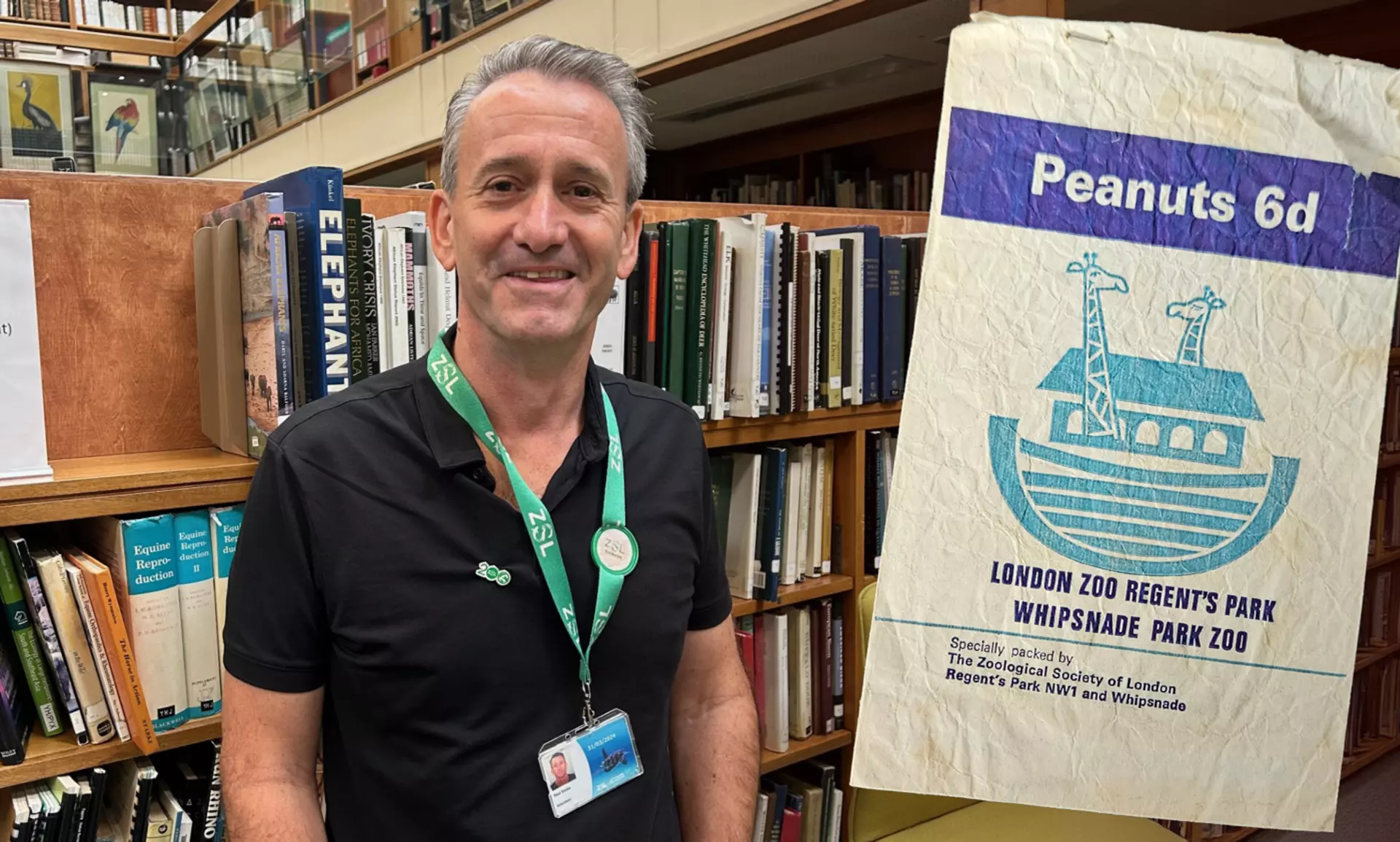
So suddenly, my mum was a little bit ill earlier this year, and went down to visit her and helping her look after her. And she said, "I've got something to show you, look under the bed". She said, "I've got my treasure box". Okay, so I looked under the bed, and there was this box, and what she's got in there was all sorts of stuff she's collected over the years. There was a receipt for her engagement ring. There was the invitation for the wedding. There was my first football boots when I was about three years old. "Actually, there's something in there that I think you'll be interested in", and she's always been interested in my stories about the Zoo since I've been volunteering and hearing about everything that's gone on here. Always been interested. She said, "there's something in there that about the Zoo that you'll be interested in, a little blue and white bag". I rummaged around, and eventually I found this little blue and white bag, and it was pre decimal, and it was a monkey nut bag with ZSL on it. And I said, "What are you doing with this?". "Well", she said, "I've got a bit of a story." A few months before they got married, two 18 year olds, my mum and dad, had a trip up to London. They'd never been to London before, and they went to see the sites, Trafalgar Square, Buckingham Palace, and, of course, London Zoo. They didn't have a lot of money at the time, but they paid to get in, and they saw the animals. And couldn't afford any money for the food for themselves, but they bought a monkey nut bag to feed peanuts to the monkeys, as visitors were encouraged in those days, and a great day. They had really entertaining time and then they took the long journey back to the Kentish coast. On the way back, because they'd not eaten, my mum got a bit peckish and found in her handbag some monkey nuts still left over. So she tucked into those and shared those around, and that was her food for the day. Anyway, my mum, dad went back to their respective houses, and the next morning, my mum woke up she felt a little bit sick. My nan said, "What did you eat yesterday?" "Why, I didn't really eat" My mum said, "just had a few monkey nuts". "Well, you shouldn't have eaten those," My nan said, "those are for the animals, they're not for human consumption. No wonder you feeling sick." So she spent the day in bed and felt a bit poorly, but got a bit better in the evening. Anyway, the next morning, she's still sick, and this carried on for several days. Eventually, my nan said, "You'd better get yourself off to the doctors."
Off she went to the doctor's and much to her surprise, the diagnosis was nothing to do with eating monkey nuts. She was actually three months pregnant. So that was the story of the monkey nuts. They got married a few months later, and then six months after that, I appeared. So the bag was evidence of me being at the Zoo even before I was born on my first visit, even before I became a volunteer. Sadly, my mum passed away a few months after that, and that was the last thing she gave me, was the peanut bag, the ZSL monkey nut bag. But it's a reminder about all the stories used to talk about the Zoo, and when I used to tell her about all the things we learned as part of being a biobank volunteer, stories about the baby gorillas being born, and all the conservation that London Zoo had done all around the world. So prized possession, the last thing my mum gave me, and it says, monkey nut bag.
I've visited the Zoo quite a bit over the years, and the Natural History Museum as well. And I was looking for some volunteer roles as well as teaching maths to primary school kids. I was looking for something where I could put my data skills to expertise. And there it was, something within NHMS ZSL looking for people who understand data. So it was a great fit working with animals and with data. What we're trying to do is to modernise the biobank, to make sure that the data and the dry collection, the frozen collection data, is accessible and searchable for the wider science and research community.
As a visitor it certainly opened my eyes to animals that I never thought I'd be able to see in wildlife I'd never thought I would see over the years. I've been lucky enough to travel to many parts of the world, and the motivation, mostly behind those travels, is to go and see animals in wildlife in their natural habitat. So my early visits as a as a child, and then as a as a young adult, to the Zoo, gave me that inspiration to travel around the world. Some of my most memorable moments, I would say, when we got the chance to feed wallabies, and they took an attraction to my trousers for some reason, and started nibbling those instead of the browse they were meant to eat. So my trousers seemed to be very popular with wallabies.
I never cease to be amazed how many people work for ZSL around the world. Most people know about London Zoo and Whipsnade and those are really just the front windows, the window to the work that IOZ and ZSL do around the world, having people around in Nepal, in the Philippines, in Gabon, all around the world, working on conservation and working to protect wildlife and bring species back, endangered and extinct species back to where they should belong. It's never cease to be amazed how much work happens around the world.
I think every day I come here and work, I learn something new, be it about post mortems, be it about cetacean strandings, and some of the reasons for that. It really does widen my horizons and understanding of wildlife and conservation. I think given what I've learned as a volunteer, it's enabled me to spread the message about the conservation work that the Zoo does and the great work they do around the world for wildlife. Most of my friends and family had no idea at all. They know about London Zoo and Whipsnade, but they really don't know the work. So it's given me that opportunity to spread the word and start those conversations about conservation.
These archive recordings capture personal memories and perspectives. They reflect the way people remember events which may be shaped by time, or differ from other accounts.