








Bridget Adams
Senior Sustainable Finance Analyst
Protecting and restoring nature takes long-term investment
We're exploring new ways to attract private investment to conservation projects that benefit both wildlife, local communities, and investors.
Our Sustainable Business and Finance team works with businesses, investors, conservation experts and local organisations to find practical ways of funding nature recovery. Through this work, we are seeing a growing demand for projects that can demonstrate real outcomes for nature and people.
Why integrity in Nature Finance starts with people


Across the investor, corporate, and policy sectors, there is growing recognition that the most successful conservation projects not only help wildlife but also support local communities, creating wider social and economic benefits. Together, these benefits are sometimes described as a "triple dividend".
Generating these benefits depends on more than finance alone. Projects need strong science, community and local organisations from the outset, and a clear way to measure success.
This thinking sits at the heart of our SPIN (Science for Private Investment in Nature) project, funded by DEFRA and delivered in partnership with the Royal Botanic Gardens Kew, Stantec and Imperative Global. The project is helping to develop ways to measure outcomes, manage risk, and build confidence in conservation projects, as well as defining what high-integrity carbon and emerging biodiversity credit markets really mean.

As part of SPIN, our work on biodiversity credits assessed several established species recovery projects, including Nepal tigers, Cape leopards and Scimitar-horned oryx, to explore what high-integrity biodiversity credits could look like in practice. It is tackling some of the hardest questions in nature finance: what should actually be measured, how to make sure conservation activity makes a genuine difference, and how both species recovery and the communities involved benefit.

Conservation finance can be complex, but we’ve previously developed a high-integrity, world-first conservation Outcome Bond. The Wildlife Conservation Bond, also known as the Rhino Bond was issued by the World Bank in 2022. This Bond is channelling approximately USD $8 million into two South African Parks over 5 years, with payments to investors linked to the growth in rhino populations.
Developing Outcome Bonds for wildlife and people
Outcome Bonds are "pay-for-success" models that provide upfront funding for conservation, with investors receiving a return only if the project achieves its pre-agreed conservation goals. Initially, investors will forego their interest payments, allowing more funds to be directed towards on-the-ground conservation costs, such as ranger training, over the life of the project.
Because investors take on project-performance risk, they want to see that these models have an extensive project design and evidence that these outcomes are possible before funds are sent. The Rhino Bond underwent three years of feasibility assessment, and the same approach is guiding our work on Mangrove Restoration and Human-Wildlife Coexistence Outcome Bonds.
Linking nature recovery to community benefits
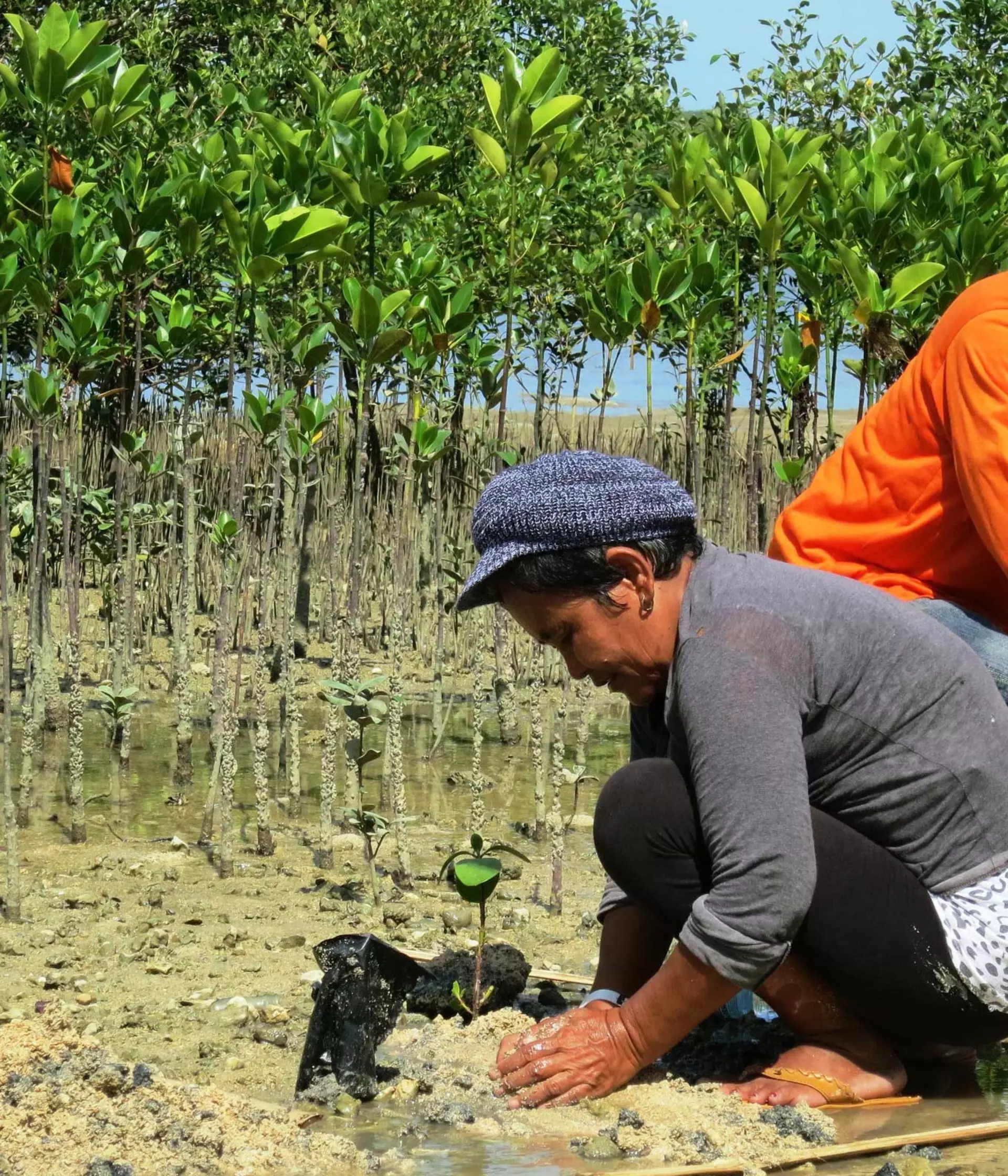
We’re working on a Mangrove Restoration Outcome Bond that builds on lessons from the Rhino Bond and more than a decade of our mangrove conservation work in the Philippines, where over 900 hectares of abandoned fishpond mangroves have been restored and protected in partnership with local communities and government agencies.
Mangrove restoration presents a particularly strong opportunity for nature finance because it supports biodiversity, protects coastlines and stores substantially more carbon per hectare than typical tropical forests, whilst helping communities adapt to and mitigate climate change.

In many coastal areas, communities rely on mangrove ecosystems for fishing, aquaculture and small-scale agriculture. This Outcome Bond is being designed with local people from the outset, ensuring conservation activities support livelihoods rather than compete with them.
The developing bond model explores how private investment could help fund community-led restoration across multiple borders in Southeast Asia. Investors would provide upfront funds to support restoration activities, while ecological monitoring and remote sensing would track the restoration of the mangrove forests.

Alongside this, as mangrove ecosystems recover, the carbon they store can be measured, verified against strict guidelines, and used to create blue carbon removal credits that are sold to a predetermined buyer. A portion of the sale proceeds is returned to investors, with the remainder returned to communities, providing incentives for the long-term local stewardship and protection of these important ecosystems.
This means investors are not simply funding tree planting.
They are investing in long-term ecosystem recovery with measurable outcomes across carbon storage, biodiversity, and community participation.
Defining success beyond ecosystem recovery
Human-wildlife conflict is one of the most pressing conservation challenges of our time. As human populations grow and natural habitats shrink, people and wildlife are increasingly sharing the same spaces, with serious consequences for both. Crop and livestock losses can devastate household incomes, and injuries or deaths on both sides erode community support to protect these species.

We’re exploring a Human-Wildlife Coexistence (HWCx) Outcome Bond across multiple counties in Kenya, where 60% of wildlife lives outside protected areas. Many animals move through increasingly fragmented wildlife corridors in the community or privately owned lands, bringing people into more regular contact with elephants, lions, hyenas and other wildlife.

The project, working with a coalition of partners, including the Kenya Wildlife Service, the State Department of Wildlife and other local NGOs and conservancy associations, is gathering data to identify outcomes that matter to both people and nature. These include reducing crop damage, strengthening rapid-response systems and preventing serious conflict between people and wildlife. Through this community consultation, the bond design is shaping how success for coexistence can be measured and how conservation can support local needs.
Why high integrity is worth the investment
High-integrity projects may require more time and investment upfront, but they are more likely to deliver lasting results. For investors, that means greater confidence that conservation goals will be achieved and that reported outcomes will withstand scrutiny.
Ultimately, the same factors that make conservation projects more effective – strong science, local partnerships and clear evidence of impact – also make them more investable.
From pioneering the Rhino Bond to restoring mangrove ecosystems alongside coastal communities, our experience shows that successful conservation depends on science, partnerships, and long-term commitment. As interest in nature finance continues to grow, these foundations will be essential to attracting the long-term investment needed to scale conservation efforts.
As we continue to develop Outcome Bond models, we welcome conversations with investors, funders and partners interested in shaping the next generation of nature finance.