






Hainan gibbons are one of the rarest mammals on Earth. At ZSL, our experts are working to bring the primates back from the brink of extinction.
Five facts about Hainan gibbons
- Hainan gibbons are the world’s rarest primate.
- Their singing can be heard up to 2km away!
- They're diurnal, so they're awake during the daytime.
- They're arboreal, meaning they live in the forest canopy.
- They have long fingers and toes to help them grip onto branches.
What do Hainan gibbons look like?
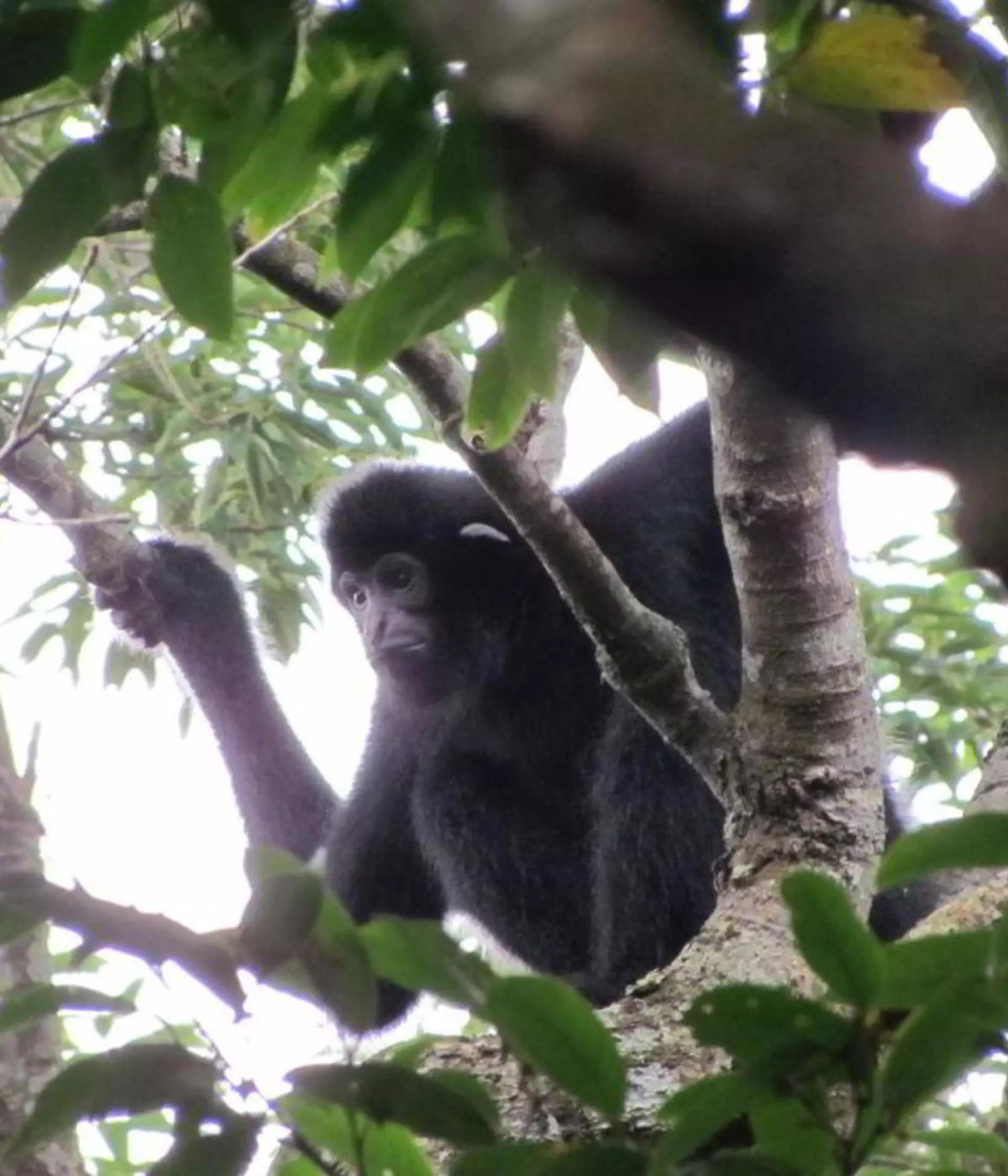
Hainan gibbons (like all gibbons) are apes. Unlike monkeys, they don’t have a tail. Instead, they swing from branch to branch using their strong forearms, which is called brachiation.
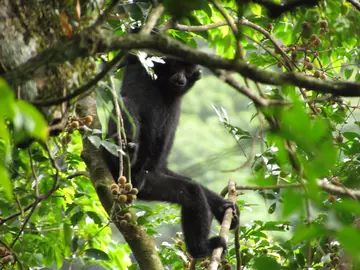
Males and female Hainan gibbons are different colours, known as sexual dichromatism. Males are completely black, sometimes with golden fur around the cheeks, and have a distinct crest on their head.
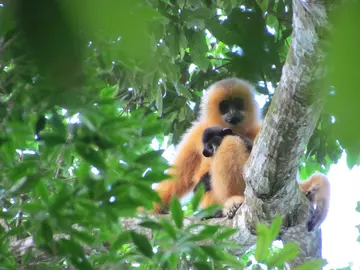
Females have golden or a cream coloured fur, with a black patch on their head.
Both males and females are born with very pale fur, but then both sexes very rapidly develop black fur. As they mature, the males remain black, but then the females become pale again when they reach sexual maturity.
What do Hainan gibbons eat?
Hainan gibbons are primarily frugivores, so they mostly eat fruits like lychees and figs, as well as seeds and sometimes insects.
ZSL is helping to secure a future for the Hainan gibbon
Hainan gibbon conservationWhere do Hainan gibbons live?
Hainan gibbons are endemic to Hainan Island in China. They live in a single patch of forest in Hainan Tropical Rainforest National Park.
What threats do Hainan gibbons face in the wild?
Their population was estimated to be around 2,000 in the 1950s, but it’s now thought that there are only around 45 individuals remaining in the wild, restricted to a small geographic range.
The main problem is that the population is so small that it's at risk of chance events like a typhoon or disease outbreak, or lack of breeding success; and its forest habitat is fragmented so it's difficult for gibbons to expand to new areas and increase their population.
Hainan gibbon conservation