






Gharial
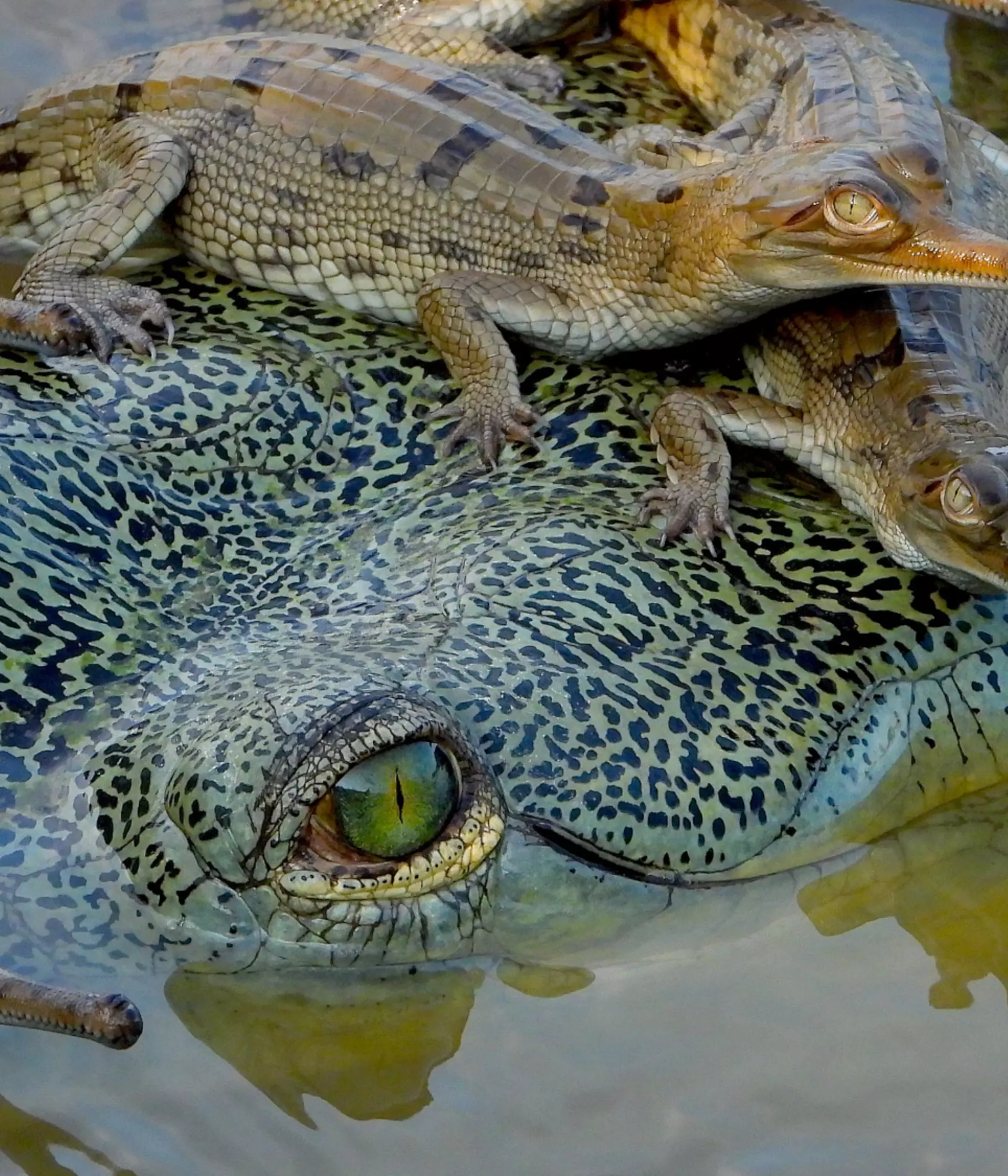
This striking crocodilian, known for their long, thin snout, is on the brink of extinction. There are fewer than 650 adults remaining in the wild.
Their uniqueness, combined with the severe threats they face, places this extraordinary species as the most Evolutionarily Distinct and Globally Endangered (EDGE) crocodilian.
What makes the gharial unique?
Their needle-like snout
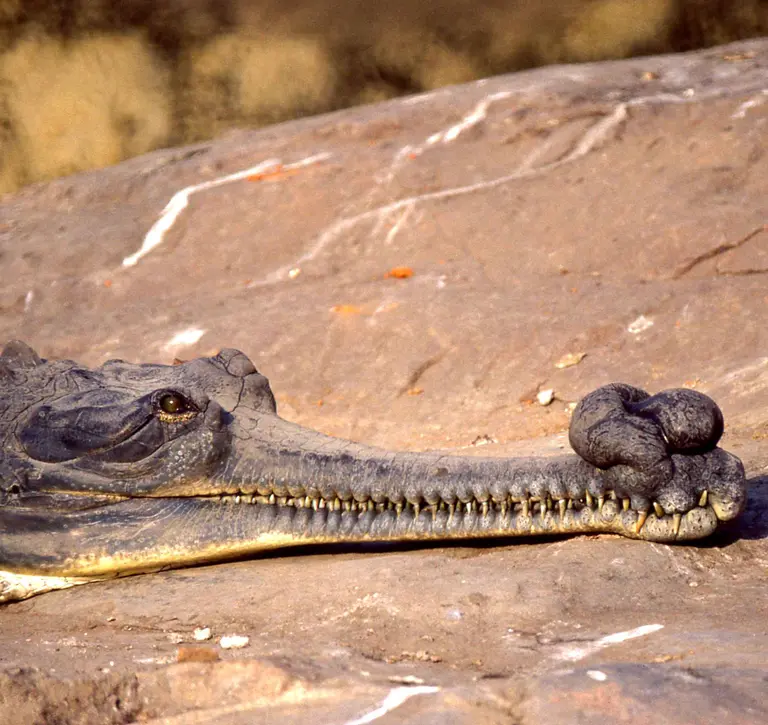
The gharial’s needle-like snout and highly specialised way of life represent one of evolution’s most extraordinary adaptations. With around 110 interlocking teeth, their long snout is perfect for snapping up slippery fish.
Adult male gharials even grow an unusual lumpy bump on the tip of their snout, called a ‘ghara’, named after a traditional Indian pot, which gives the species its name.

Their highly specialised aquatic lifestyle
Gharials have a distinctive swimming style. They can move silently and smoothly in fast-flowing rivers by using their powerful tails to propel themselves, and by holding their legs tucked against their bodies.
While elegant in the water, gharials are far less agile on land. Unlike other crocodile species, they lack the muscle power needed to move efficiently out of the water. Therefore, they spend most of their time in or near water.
Their nesting behaviour
Female gharials nest quite differently from most other crocodilians (crocodiles, alligators, caimans, and gharials). They must make a tough trip on land to reach sandbanks, where they lay their eggs, often alongside other females. In these communal nesting sites, multiple mothers may team up to help protect the eggs and hatchlings.


Their evolutionary distinctiveness
Gharials hold a unique place in the crocodilian family tree. For a long time, people thought they were the only member of the Gavialidae family, but new research shows they share it with the false gharial (Tomistoma schlegelii).
Loading...
Gharial threats
Today, gharials survive only in a handful of severely fragmented populations across India and Nepal, and their numbers have dropped by as much as 98% since the 1940s.
Half of crocodilians are at risk.
HELP US PROTECT THIS SPECIESConstruction and agriculture
Their biggest threat is the massive loss of river habitats. Dam construction has dramatically changed waterways, and because gharials are less mobile on land than other crocodilians, they struggle to reach new rivers. On top of that, farming and livestock grazing have damaged many of their important nesting and basking spots.
Fishing
Fishing pressure is another serious challenge for gharials. Overfishing has reduced the number of fish they rely on almost entirely for food. They also get tangled up and killed in gill nets.
Sand mining
Sand mining is another major problem. Across South Asia, sand is being unsustainably taken out of rivers. This wipes out the sandy riverbanks that gharials depend on for laying eggs and soaking up the sun.
Turning this around will depend on local communities becoming active partners in conservation, drawing on their knowledge to support gharial recovery. But local communities are facing their own challenges and rely heavily on the depleting natural resources, particularly fishing, for their livelihoods.
Protecting gharials
ZSL and its partners are working with local communities to turn these challenges into a win-win for both people and gharials around Chitwan National Park. By working to restore their habitat and food source, we believe the gharials can bounce back, like we saw with the tiger population in Nepal.
To make this happen, ten Gharial Guard Groups have been set up. These community-led conservation teams use their local ecological knowledge to patrol the area and protect gharials from poaching and egg collecting. They’re also helping their communities see why a healthy ecosystem is so important for fishing livelihoods, making sure fishing and other activities are sustainable. As fish numbers and the whole ecosystem recover, both people and gharials would have a steady source of food.
ZSL's EDGE of Existence programme is also overseeing several research and conservation projects on the species:
- Ashish Bashal, Bardia National Park - Nepal
- Ranjana Bhatta, Chitwan National Park - Nepal
- Jailabdeen A, National Chambal Sanctuary - India
Loading...
Across Nepal, our teams are working to protect all kinds of species, such as tigers and rhinos, and behind every conservation success are passionate people making it happen.
Let us bring you closer to nature
Join us now for regular updates from our teams all around the world.