






Prof. Robin Freeman
Lead of the Conservation AI Lab
Philippa Oppenheimer
Postdoctoral Research Associate
Behaviour, biodiversity indicators, prediction, and conservation AI
The Conservation AI Lab is Dr Robin Freeman's academic group at ZSL's Institute of Zoology. The group combine ecology, machine learning, and conservation research to recover meaningful signals from complex ecological data, and turn them into outputs and tools to support timely, evidence-based decisions.
The work of the group spans animal movement and behaviour, biodiversity indicators, camera traps, acoustics, citizen science, and biodiversity forecasting. We treat AI as part of ecological inference, not an end in itself — the goal is to quantify change, identify its drivers, and anticipate what comes next, with outputs that are usable in research, policy, and practice.
Research themes
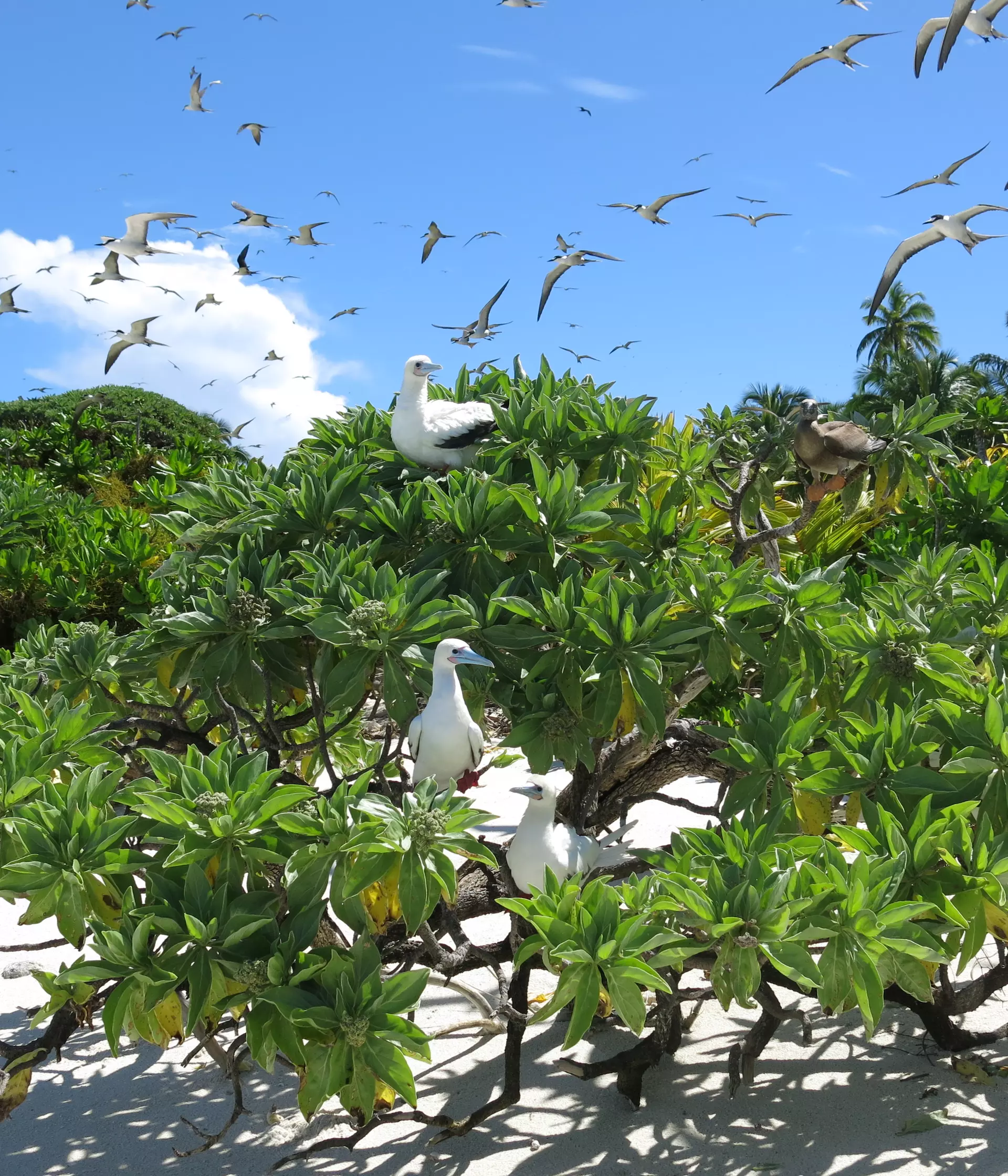
Seabird movement and behaviourInvestigating how environmental variability, social behaviour, and marine management shape movement, foraging, habitat use, and exposure to threats in tropical seabird systems. | Understanding the drivers of global biodiversity changeWe study how land use, climate, exploitation, cumulative pressures, and ecological lags interact to shape wildlife populations across space and time. |
Automatic recognition of individual animalsWe develop computer vision approaches that identify individuals from images and video, supporting scalable wildlife monitoring and more efficient ecological inference. | Predicting trends in global abundanceWe develop models that move from retrospective biodiversity indicators towards leading indicators of future change, linking historical environmental conditions to expected wildlife population trajectories. |
Understanding public awareness of biodiversityWe use digital traces and conservation culturomics to examine how biodiversity is represented, discussed, and valued, helping connect ecological change with public understanding. | Monitoring behaviour in the wildUnderstanding animal behaviour often requires expensive or invasive monitoring technologies. We develop methods that use lightweight biologging devices, acoustic sensors, and machine learning to infer complex behaviours from simple data streams, enabling behaviour to be monitored at larger spatial and temporal scales. |
Social Behaviour and Collective Decision-MakingUnderstanding how interactions between individuals shape movement, foraging, navigation and habitat use in the wild. This work combines biologging, machine learning and network analysis to investigate collective behaviour, information transfer and social structure in species ranging from seabirds and sharks to homing pigeons. |
Swaby et al. (2026) Deep neural networks to predict foraging behaviour: saltwater immersion data can accurately predict diving in seabirds. J R Soc Interface 23(238): 20250172. https://doi.org/10.1098/rsif.2025.0172
Wood et al. (2025) A behavioural approach to key area identification in seabirds. Animal Biotelemetry 13(34). https://doi.org/10.1186/s40317-025-00427-z
Trevail et al. (2023)Tracking seabird migration in the tropical Indian Ocean reveals basin-scale conservation need. Current Biology 33(23): 5247-5256. https://doi.org/10.1016/j.cub.2023.10.060
Capdevila et al. (2026) Halting predicted vertebrate declines requires tackling multiple drivers of biodiversity loss. Science Advances 12(7). https://doi.org/10.1126/sciadv.adx7973
Cornford et al. (2023) Ongoing over-exploitation and delayed responses to environmental change highlight the urgency for action to promote vertebrate recoveries by 2030. Environmental Science 290(1997): 20230464. https://doi.org/10.1098/rspb.2023.0464
Currie et al. (2025) Under pressure: the relationship between vertebrate populations and high-intensity cumulative threats in habitats across Canada. FACETS 10: 1-15. https://doi.org/10.1139/facets-2024-0340
Norman et al. (2023) Can CNN-based species classification generalise across variation in habitat within a camera trap survey? Methods in Ecology and Evolution 14(1): 242-251. https://doi.org/10.1111/2041-210X.14031
da Silva Cerqueira et al. (2025) Automated classification of albatross acoustic behaviour at sea: A free and open-source classifier for seabird sounds. Ecological Informatics 92: 103474. https://doi.org/10.1016/j.ecoinf.2025.103474
Cornford et al. (2023) Ongoing over-exploitation and delayed responses to environmental change highlight the urgency for action to promote vertebrate recoveries by 2030. Proc Biol Sci 290(1997): 20230464. https://doi.org/10.1098/rspb.2023.0464
McRae et al. (2025) The utility of the Living Planet Index as a policy tool and for measuring nature recovery. Philos Trans R Soc Lond B Biol Sci 380(1917): 20230207. https://doi.org/10.1098/rstb.2023.0207
McRae et al. (2025) Maximising time-series inclusion reduces geographic and taxonomic biases in the Living Planet Index. Eco Evo Rxiv (pre-print). https://doi.org/10.32942/X2H06J
Dunn et al. (2025) Commuting in crosswinds and foraging in fast winds: the foraging ecology of a flying fish specialist. Proc Biol Sci 292(2052): 20250774. https://doi.org/10.1098/rspb.2025.0774
Swaby et al. (2026) Deep neural networks to predict foraging behaviour: saltwater immersion data can accurately predict diving in seabirds. J R Soc Interface 23(238): 20250172. https://doi.org/10.1098/rsif.2025.0172
da Silva Cerqueira et al. (2025) Automated classification of albatross acoustic behaviour at sea: A free and open-source classifier for seabird sounds. Ecological Informatics 92: 103474. https://doi.org/10.1016/j.ecoinf.2025.103474
Millard et al (2021) The species awareness index as a conservation culturomics metric for public biodiversity awareness. Conservation Biology 35(2): 472-482. https://doi.org/10.1111/cobi.13701
Johnson et al. (2023) Achieving a real-time online monitoring system for conservation culturomics. Conservation Biology 37(4): e14096. https://doi.org/10.1111/cobi.14096
Crowson et al. (2023) Using geotagged crowdsourced data to assess the diverse socio-cultural values of conservation areas: England as a case study. Ecology & Society 28(4): 28. https://doi.org/10.5751/ES-14330-280428
Cornford et al. (2022) Automated synthesis of biodiversity knowledge requires better tools and standardised research output. Ecography 2022(3): e06068. https://doi.org/10.1111/ecog.06068
Alexander et al. (2026) Sociality and seabird diving: lower dive effort for solitary gannets compared with those in groups and at fishing boats. Marine Ecology Progress Series 778: meps15049. https://doi.org/10.3354/meps15049
Papastamatiou et al. (2020) Multiyear social stability and social information use in reef sharks with diel fission–fusion dynamics. Proc Biol Sci 287(1932): 20201063. https://doi.org/10.1098/rspb.2020.1063
Jacoby et al. (2016) Inferring animal social networks and leadership: applications for passive monitoring arrays. J R Soc Interface 13(124): 20160676. https://doi.org/10.1098/rsif.2016.0676
Freeman et al. (2011) Group decisions and individual differences: route fidelity predicts flight leadership in homing pigeons (Columba livia). Biol Lett 7(1): 63–66. https://doi.org/10.1098/rsbl.2010.0627