





The seabed is home to a diverse array of marine life.
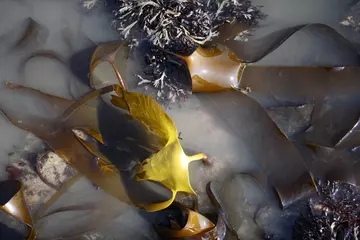
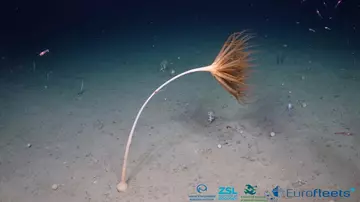
Much of this life is dependant on the habitats formed by both plants and animals such as seaweeds, corals and sponges. Habitats such as kelp forest and coral reefs are important for people too, benefiting fisheries, tourism, coastal defences, and much more.
However, life on the seabed is impacted by a wide variety of human activities including fishing and climate change. Our understanding of these impacts is limited by our fundamental knowledge of these habitats including their distributions, connections and ecology.
We need to restore degraded and lost marine habitats, requiring improving methods of restoration and robust monitoring and reporting of both successes and failures.
Surveys
Chris has been working in the UK, Greenland and other areas, using a range of survey techniques, to study and monitor temperate and polar seabed habitats such as kelp forests, seagrass beds and cold-water coral fields. This information helps to map and describe seabed habitats and assess their vulnerability to activities such as trawling. Chris has worked closely with the fishing industry in Greenland to provide vital information towards sustainability assessments. Chris uses a variety of techniques such as towed cameras, drones and environmental DNA to monitor seabed habitats around the UK for coastal habitat restoration projects.
Projects
- Mapping and monitoring seabed habitats in Greenland
- Coastal habitat restoration & monitoring of seagrass, oysters & saltmarsh in the Greater Thames Estuary, with Transforming the Thames
- Examining the impact of trawling restrictions on the Sussex coast with the Sussex Kelp Recovery Project
- Investigating fisheries bycatch mitigation with Clean Catch UK
- Developing a low-cost towed camera system for deep seabed surveys with the Deep & Cheap project
- Citizen science project to monitor UK kelp habitats with the NHM's underwater forest survey
Chris is also Course Director of the MSc Wild Animal Biology and MSc Wild Animal Health programmes. Please get in touch if you are interested in the courses.
PhD students (past & present)
- Niamh Thorne (2026-) “Optimising native oyster restoration: low-cost monitoring, biodiversity assessment & hydrodynamic modelling to ehnance reef recovery in Essex”. Queen Mary University of London
- Nadia Frontier (2026-) “Marine forests in flux: Macroalgal decomposition ecology and potential for carbon sequestration”. Swansea University
- Wanda Bodnar (2025-) “Urban intertidal habitats of the River Thames: investigating fish utilisation and food web dynamics”. Queen Mary University of London. Co-supervisor
- Amelia Newman (2024-) “Enhancing seagrass growth and resilience for restoration purposes with microbial manipulations”. Imperial College London. Co-supervisor
- Oliver Kippax-Chui (2023-) “Leveraging emerging numerical models from engineering to support coral reef conservation”. Imperial College London
- Nikki Kostur (2024-) “Informing eco-coastal defenses: characterizing the ecology and resilience of epifauna on artificial coastal structures along subtropical urban shores” King's College London.
- Jason Burke (2023-) “Understanding coral connectivity and it’s drivers across the Indian Ocean”. University of Essex
- Madison Bowden-Parry (2022-2026) “Investigating the history of Sussex kelp habitats and their impact on local communities”. University of Exeter
- Marianne Glascott (2022-2026) “The impact of suspended particulate matter on kelp rewilding in Sussex Bay”. University of Sussex
- Rosie Dowell (2020-2024) “Developing environmental DNA (eDNA) as a marine biodiversity monitoring tool in the Indian Ocean” Imperial College London
- Jason Lynch (2020-2024) “A social-ecological approach to understanding the footprint of fisheries on tropical coral reef biodiversity” UCL
- Zoe Dennehy-Carr (2019-2024) “Climate and Speciation in the Mediterranean Biome” University of Reading. Co-supervisor
- Stephen Long (2017-2021) “Sustainable fishing in Greenland: impact of deep-sea trawling on benthic ecosystems”. UCL
- Marc Fernandez (2012-2017) “Habitat Suitability of Oceanic Cetaceans: Comparing Presence-only and Presence/Absence Modelling”. University of Azores