






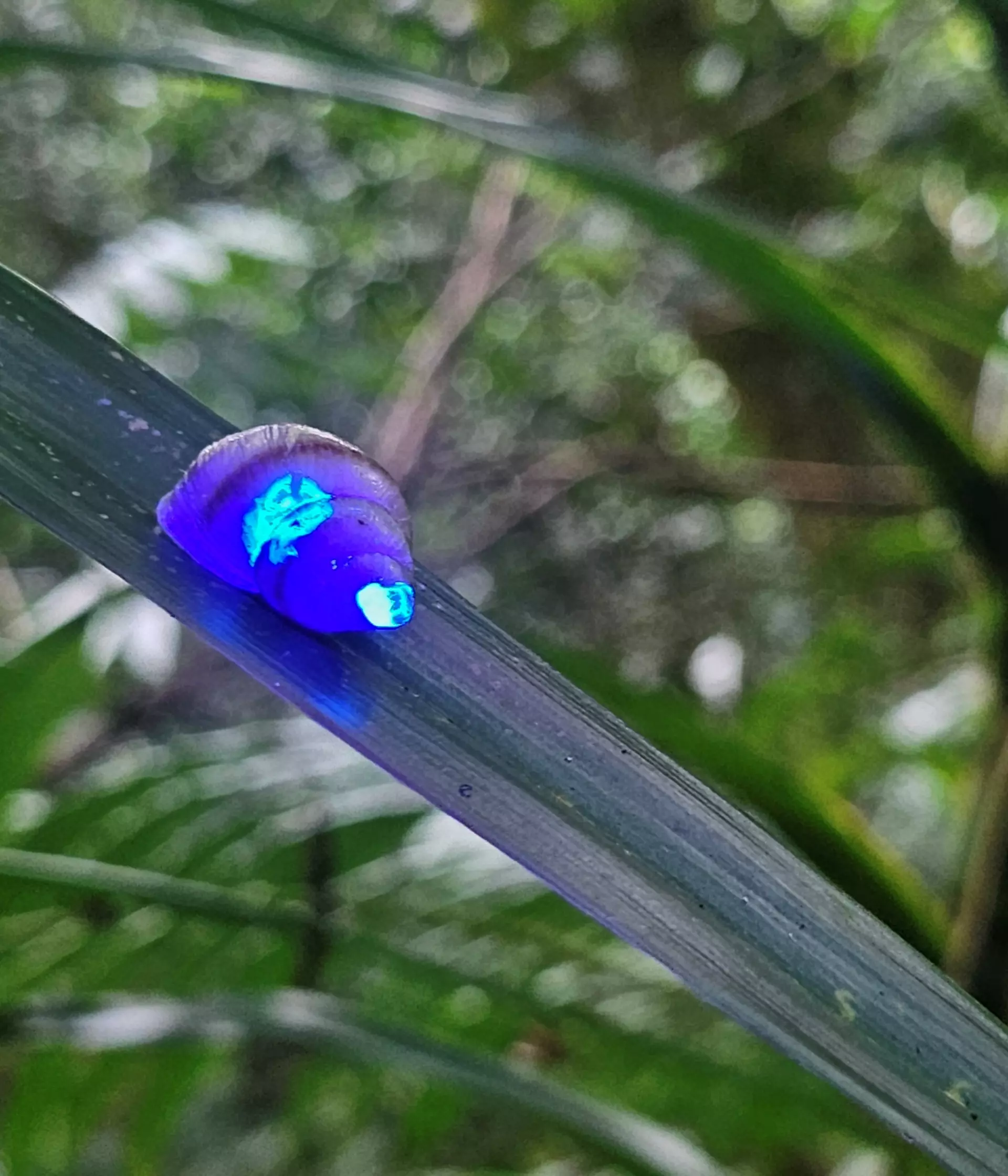
Thousands of 'glow-in-the-dark' snails have been reintroduced to French Polynesia as part of global conservation programme to save the snails from the brink of extinction.
The annual reintroduction of zoo-bred Extinct in the Wild and Critically Endangered Partula snails - including from our London and Whipsnade Zoos - saw nearly 7,000 snails returned to four islands, making it the largest release of the group of finger-nail sized snail species and subspecies to date.
Before release, conservationists dotted the shell of each snail with a small dab of white UV reflective paint, which glows blue under UV light. As the snails are most active at night, the paint helps the team find released snails and monitor the recovery of the species.
During the releases, the team discovered an unmarked, juvenile Partula varia – making it the first wild-born member of this reintroduced snail species to be spotted in over 30 years. This discovery is proof that the Partula species is not only surviving on their native island of Huahine, but that they are successfully breeding – a momentous milestone for the programme.
The exciting find is a promising sign for recovery of the species and comes less than a year after the programme saw the reclassification of another Partula snail species – Partula tohiveana – from Extinct-in-the-Wild to Critically Endangered on the IUCN Red List of Threatened Species, the global assessment of extinction risk.
ZSL’s Senior Curator of Invertebrates, Paul Pearce-Kelly, who leads the international Partula conservation programme, said: “This progress is decades in the making. We are not only celebrating the largest release of Partula snails in history, but also the results of over 30 years of dedicated work by conservation zoos and the French Polynesian government to enable the recovery of these precious snails in the wild.
“Wildlife globally faces unprecedented challenges, and every single species is a precious part of the interconnected web of ecosystems that we all rely on - so today’s news is not only a moment of hope for these snails, but for nature and people globally.”
The team also found the first evidence of wild-born Partula tohiveana living outside of their original release area on their native island of Moorea, indicating that the tropical snails are both continuing to thrive and expanding their range.


The team hope that future surveys and reintroductions will soon lead to more discoveries of wild-born snails – including Partula varia - and allow more species and subspecies to join Partula tohieveana in being downlisted.
Conservation zoos are bringing species back from the brink
The snails were part of carefully managed annual reintroductions, led by ZSL conservationists, which has coordinated the release of almost 40,000 snails over the last ten years.
Eleven species and sub-species of the snails, reared at London and Whipsnade Zoos, Akron Zoo, Bristol Zoological Society, Detroit Zoo, Disney Animal Kingdom, Marwell Wildlife, the Royal Zoological Society of Scotland, Riga Zoo, Saint Louis Zoo, Sedgwick County Zoo, Woodland Park Zoo, Wuppertal Zoo and Zoo Schwerin travelled more than 15,000km to the islands.
Fiona Sach, ZSL’s Zoo Conservation Impact Manager said: “This exciting news demonstrates the power of conservation breeding programmes and carefully planned releases in bringing species back from the edge of extinction. Last year’s downlisting of Partula tohiveana already showed what we can achieve for these species, and we hope that Partula varia and other Partula snails will soon join it as another Extinct-in-the-Wild species successfully thriving in the wild once more.”
Every visit to London and Whipsnade Zoo supports ZSL’s global conservation work, including through the Extinct in the Wild Action Partnership.


How Partula snails were almost lost forever
Also known as Polynesian tree snails, these precious molluscs play an important role in the health of their forest ecosystems; by eating decaying plants and fungi, they help prevent the spread of disease and cycle important nutrients through the food chain.
Wild populations of Partula snails were decimated in the 1980s and early 1990s by the introduction of the invasive and carnivorous rosy wolf snail (Euglandina rosea) to control numbers of the previously introduced African giant land snail (Lissachatina fulica).
The last remaining individuals of 15 Partula species and sub-species were rescued by conservationists in the early 1990s, launching the international programme to recover the breed these snails and recover their wild populations.
Celebrating conservation success stories
Christophe Brocherieux, Environment Project Manager at Environment Department of French Polynesia said: “We are truly proud to be able to contribute to this international programme, the results of which are increasingly exciting year after year.”
Craig Close, senior animal keeper at Edinburgh Zoo said: “It is tremendously exciting to be sending over 2,000 Partula snails back into their native habitat this year. As a wildlife conservation charity, we are incredibly proud to contribute to this vital collaborative breeding programme, which is giving this remarkable species a powerful lifeline. Our achievements with the Partula snail are a testament to the dedication of the teams who began this work decades ago at Edinburgh Zoo, as well as the commitment of our partners who continue to drive the project forward. This is a truly inspiring conservation success story and a compelling reminder of the essential role zoos play in global species recovery.”


Brian Zimmerman, Director of Conservation and Science at Bristol Zoological Society said: “We are extremely proud to have participated in this vital collaborative effort to lead the recovery of several species of Partula snail. As a conservation and education charity working in nine countries across four continents, our involvement is testament to the hard work and expertise of our Ectotherm team at Bristol Zoological Society, who have contributed to the programme with snails bred at our conservation zoo.”
Mark Vasallo, Curator of Amphibians at the Detroit Zoo said: "The Detroit Zoo has continually provided a lifeline for this special invertebrate, when it's very existence was threatened with extinction. Through captive breeding efforts and collaborations with program partners, we have helped bring this species back from the brink of extinction and provided hope for the future of Partula Snails in the wild."
Laura Read, Chief Executive of Marwell Wildlife said: “Marwell has been committed to the Partula snail conservation programme since 2006, and close collaboration with our partners remains vital to safeguarding the health and genetic diversity of these remarkable snails. Achievements like these highlight the strength of partnership and what’s possible when we unite for conservation.”
Kayla Garcia, Zoological Manager of Invertebrates at Saint Louis Zoo said: “I’m incredibly proud of the Saint Louis Zoo’s role in coordinating the U.S. shipment of more than 4,100 Partula nodosa snails for release into the wild this year — the most of this species we have ever released at once in the history of the program. It's inspiring to see each year bring another milestone in this global effort to return these remarkable snails back to their island homes.”
Sabrina Höft, curator at Zoo Schwerin said: “For us at Schwerin Zoo, it is extremely important to strive to protect all species. For a long time, less research was conducted on invertebrates in particular, which has meant that data on the threat status is only available for a fraction of these species. Research is certainly very costly, because many of the animals are not easily visible or live in places that are difficult to access, such as underground. However, habitat loss and pollution affect them just as much as mammals, for example. This makes the project focusing on Partula snails and the successes that have been achieved together all the more valuable. We look forward to continuing to contribute to the breeding and reintroduction of these snails in the future and would like to thank all our partners for their excellent cooperation in this unique project.”
Dr Justin Gerlach, Researcher at Peterhouse Cambridge University said: “These molluscs play an important role in the health of their forest ecosystems, eating decaying plants and fungi, reducing the spread of disease and cycling important nutrients through the food chain. By restoring wild populations we can improve the state of the forests.”
Visitors can see Extinct-in-the-Wild Partula snails and learn about their reintroduction efforts at London Zoo’s Tiny Giants invertebrate house.
ZSL believes nature can recover, and that conservation is most effective when driven by science. We call for science to guide all global decisions on environment and biodiversity and build a healthier future for wildlife, people and the planet.