







Written by

Rob Deaville
CSIP Project Manager
11 September 2026
To celebrate World Dolphin Day we’re going to delve into the intricate, often complicated, logistics that come with responding to stranded dolphins, whales and porpoises as part of the Cetacean Strandings Investigation Programme (CSIP). We’re going to explore three examples of dolphin strandings, to illustrate the varying response requirements, and the factors that underpin them.
A dolphin washes up on the shore – where do we begin?
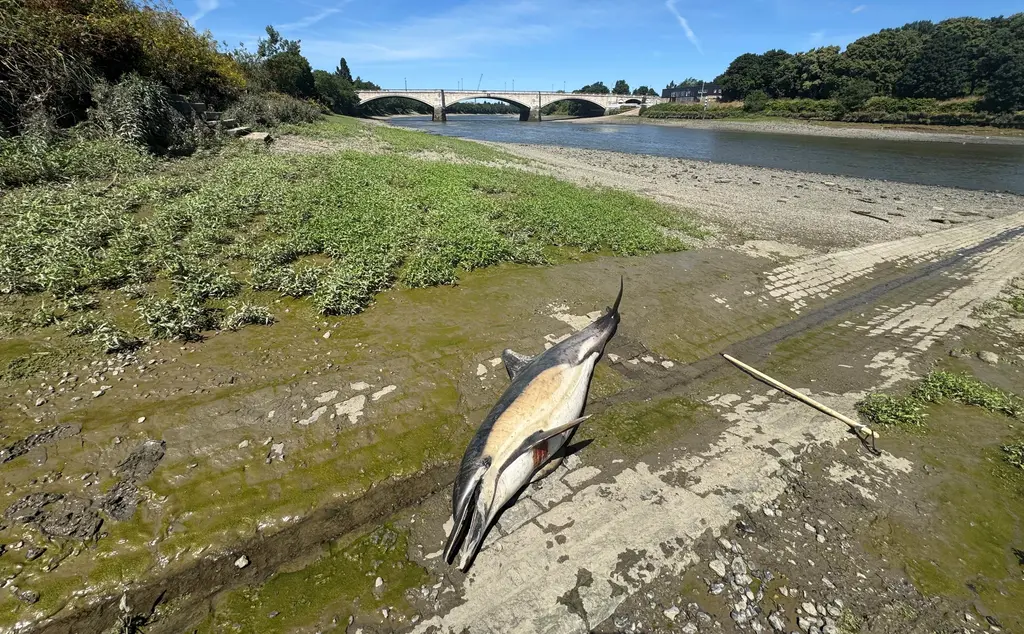
On a warm summers day in July 2026, a short-beaked common dolphin was sighted swimming slowly in shallow waters near the bank of the river Thames at Mortlake. The dolphin unfortunately died and, as the tide receded, the body was left high and dry on the riverbank. So what do we do next? In this instance, as with many strandings responses, serendipity played a part. I was luckily driving into work at ZSL that morning and was able to divert to the site of the stranding.
Even more fortunately, my CSIP colleague Rosie Williams lived nearby and she and her husband agreed to head over and help coordinate with locals on the ground, to assist with recovery. When I arrived (managing to navigate past the brewery truck making a delivery and blocking the road), I found that the dolphin was only a short walk from the vehicle access point. With the help of a group from Tideway Scullers School rowing club, we were able to shift the dolphin onto a tarpaulin, walk it a short distance off the mud, bag it up and then I drove the short distance back to ZSL where the team were waiting to necropsy it. Not only does this example demonstrate the importance of timing, it also shows how valuable volunteers, colleagues and the public are in contributing to the successful recovery of these animals. More information on this stranding can be found here.
Now although the response in this instance was fairly routine, the stranding itself was certainly out of the ordinary. Common dolphins are not normally considered to be resident in the North Sea, let alone within the Thames itself. The common dolphin is a warm water species and over the last decade, we’ve seen a marked change in distribution of common dolphin strandings in the UK, with many more recorded around our shores and increasing numbers found in more northern regions, through the eastern Channel. Small numbers have even begun to be recorded within the previously alien habitat of the North Sea. All of this is consistent with distribution shifts in response to climate change impacts.
Climate change can impact on species in different ways and it’s possible that as common dolphins move into the southern North Sea, they may end up in an unfavourable habitat, which may have a fitness cost and lead to a greater challenge to survive - potentially as in this case. It’s also possible that as they move into novel regions, they may be exposed to changes in anthropogenic stressors, such as chemical pollution exposure, as recent research suggests (Williams et al. 2025).
One killer whale, many hurdles
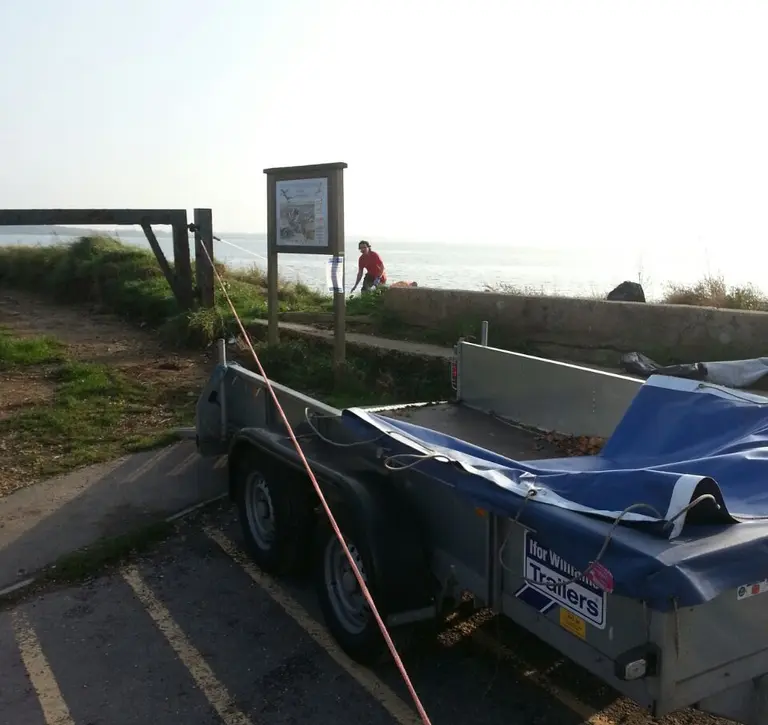
Our next example is rather more complex in nature. In November 2019 we received a report of a killer whale stranding on a sandbank in the Wash off the east England coast. It is important to note that every year we receive numerous reports of cetacean strandings that are described as killer whales and always turn out to be something else. So, I must admit without any photos of this stranding, we assumed it was yet another harbour porpoise and discounted it.
However, late in December 2019, we received photos from an ornithologist working in the area, which confirmed that there was indeed a now rather decomposed killer whale in marshland at the Holbeach Air Weapons Range in Lincolnshire.
The first challenge we faced was a crucial one; how could we possibly access this animal? It was on marshland over a mile from the nearest vehicle access point, and could only be accessed at lowest tides, as the surrounding deep creeks would have been flooded and made them impossible to traverse. Not only that, but it was also on Ministry of Defence land which was an active MoD bombing and air weapons training range.
After discussion with RAF Holbeach, we were able to secure permission to access the site in the New Year and travelled to site on 10th January 2020, which was the earliest window of access. After also notifying Coastguard of our plans, we used a drone to locate the body and then spent the best part of two hours travelling across difficult terrain, with multiple deep muddy creeks forcing us to retrace steps to find better access. More information on the necropsy and what we learnt from it can be found here.
So why did we go to such lengths to try to access the body of a whale which by that point was pretty decomposed? Killer whale strandings are relatively unusual in the UK and even more so in the area the CSIP covers. In the 35 years since CSIP’s inception, we’ve only recorded five killer whale strandings in England and Wales. So, samples from examinations like these, even when they’re in this condition, can be vitally important and help to shed light on the impacts of human pressures. For example, landmark studies such as our 2016 paper, showing that polychlorinated biphenyls (PCBs) continue to cause severe impacts among cetacean top predators in European waters (Jepson et al. 2016).

When one stranding becomes many
Finally, let’s consider strandings response around a mass stranding event (MSE). On the morning of 9th June 2008, a common dolphin was found floating dead in Porth Creek near Falmouth in south Cornwall. Subsequently, reports of agitated and ‘milling’ free swimming dolphins began to come in, and large numbers of stranded common dolphins were reported. It quickly became clear that one of the largest stranding events we’d ever recorded was underway.
Local volunteers from British Divers Marine Life Rescue and the Cornwall Wildlife Trust Marine Strandings Network mobilised and headed to the area and thanks to their significant efforts, many of the live stranded dolphins were successfully refloated and herded back to open water. But at the end of the day, 26 common dolphins had been found dead, scattered across the creek and wider area.
Given the size of the event and the number of dead animals, we decided to mobilise and travel down to Cornwall to conduct necropsies onsite alongside our partners at the Veterinary Laboratories Agency (VLA), from nearby Truro. CSIP partners from Wales also travelled to Cornwall to assist, so by the following day, most of the country’s CSIP network was in the area.

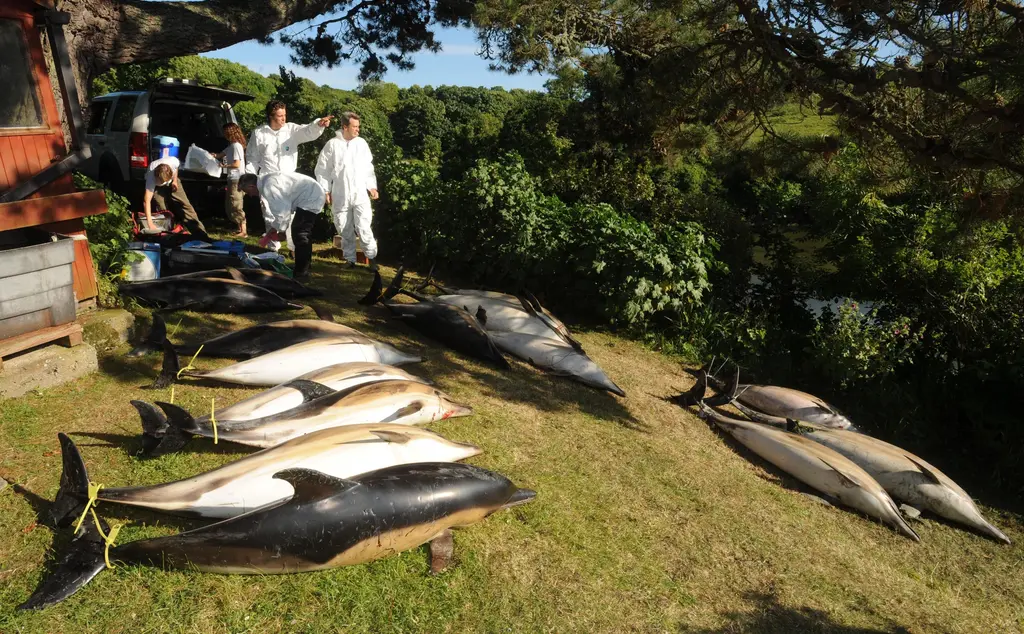
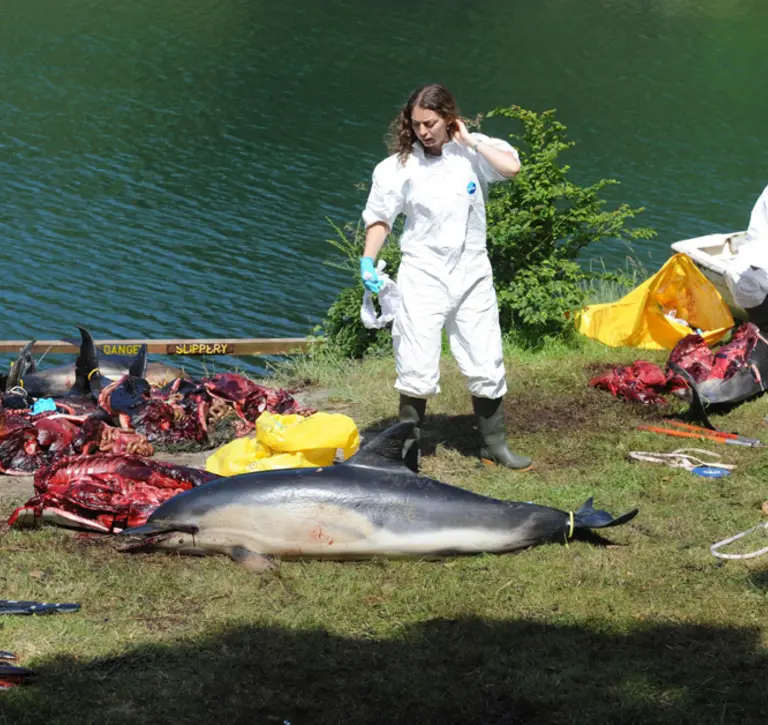
The mass stranding also generated significant media interest and it was rather odd to see live footage of the MSE underway on service station TVs when we stopped to refuel near Bristol. When we arrived, it was a sobering sight to see so many dead common dolphins stacked up by the riverbank. But time was of the essence, with decomposition underway and tides working against us, so we quickly began and started to methodically work our way through all the bodies, carrying out full necropsies and sampling on each one. It was vital to examine all recovered bodies, to ensure we didn’t miss any potentially compromised individuals that may have been a cause of the MSE.
Local volunteer groups recovered the bodies to a central location where we were working and fortunately, the owner of the only house in the area was happy for us to work in his slipway. Even more fortunately, the weather was kind to us and for the next few days, we were able to work our way through most of the bodies without the need for shelter. We had to arrange disposal of bodies after we worked, so this all required careful coordination and planning as work progressed. We also had to conduct numerous media interviews on site- given the high profile of the stranding, most TV networks sent news teams to the stranding location, and we would break off work to keep them updated as examinations progressed.
Following our return to base, as well as conducting the last remaining necropsies, the real work began in terms of the investigation of the possible cause/s of the mass stranding. Investigation of MSEs relies on what you can rule out, to help reveal potential cause and a wide range of ancillary analyses were carried out at ZSL and our partners. The extensive investigation of this, the largest common dolphin mass stranding ever recorded in the UK, concluded that “naval activity was the most probable cause of the Falmouth Bay MSE” (Jepson et al. 2013). This comprehensive investigation of a mass stranding event also set the template for subsequent investigations of further mass strandings that occurred across the UK.
It takes a village
Hopefully this all helps illustrate that stranding events can be complex in nature, and complicated to respond to. The common thread through all of the above examples, however, is the phenomenal response and support of the British public, volunteer groups and agencies across the country. Without their considerable support and assistance, none of our work would be possible and we’re hugely grateful to everyone who’s ever helped us. Thank you to everyone who’s reported strandings to us, assisted with recoveries from beaches and even brought us cups of tea while we work on the beaches!
About CSIP
The CSIP is a collaborative consortium, with ZSL the lead partner, working together with our partners at the Natural History Museum, Marine Environmental Monitoring, the Cornwall Wildlife Trust and the Cornwall Marine Pathology Team and is co-funded by Defra and Welsh Government. We also work closely with our partners in the Scottish Marine Animal Strandings Scheme, which coordinate strandings investigation in Scotland. Its current remit includes the investigation of strandings of cetaceans, seals, marine turtles and some elasmobranch species, with the current contract running to 2031.
This is the fourth in a series of blogs being released over the course of 2026, to coincide with ZSL’s 200th anniversary, and to also mark 35 years of work on strandings investigation by CSIP partners. Watch this space for more information on other blogs and events we hope to run through the year.
Join the fight to save our living world at ZSL
Climate change and human activity have pushed our precious planet to its limit, causing the devastating loss of so many habitats and species. From lab to field, hands on and behind the scenes, we’re leading the future of conservation, shaping agendas and influencing change to support better life, health and living for people and wildlife.