








Written by
Rob Deaville
CSIP Project Manager
5 August 2026
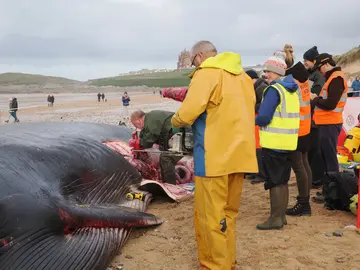
This is the third blog in the series marking the 200th anniversary of ZSL and the 35th anniversary of the foundation of the Cetacean Strandings Investigation Programme (CSIP). In this blog we’re going to consider the issue of bycatch, or the incidental capture of non-target species in fisheries. To explore this further, I’m going to hand over to my CSIP colleague James Barnett, who wrote this blog and who has a paper published today, 13th August 2026, in the journal Diseases of Aquatic Organisms, highlighting the issue of bycatch and other findings in Cornwall stranded common dolphins. James and his team of volunteers coordinate the work of the Cornwall Marine Pathology Team, one of the CSIP partner organisations. Their role within CSIP is the investigation of strandings found around the coast of Cornwall and the Isles of Scilly – and there is no one better placed to talk about the issue of bycatch within CSIP than James.
Bycatch presents the greatest human-caused threat to several cetacean populations.
Globally, bycatch is the greatest direct human threat to the survival of many marine mammal populations, with hundreds of thousands of animals estimated to be caught each year worldwide (Read et al, 2006).
Cornwall: a UK bycatch hotspot
In the UK, Cornwall is recognised as a hotspot for bycatch of cetaceans (whales, dolphins and porpoises). Its waters support a rich diversity of marine life, and this overlaps with intensive commercial fishing activity. I first became aware of this early in my career while working as a vet at the Cornish Seal Sanctuary. At the time, the Cetacean Strandings Investigation Programme (CSIP) was still in its infancy, and the Veterinary Investigation Centre in Truro was carrying out necropsies on stranded marine mammals in Cornwall in partnership with the CSIP. In the first quarter of 1992, CSIP and the centre investigated a mass mortality of common dolphins in southwest England and concluded that most of the necropsied animals—30 of 38—had died as a result of bycatch. This was the first time that a mass mortality of dolphins in European waters was linked to the impact of bycatch and provided one of the most comprehensive assessments of bycatch-associated lesions available at the time (Kuiken et al, 1994).
"Leeney et al. (2008) later showed that 67% of 239 common dolphins and 61% of 142 harbour porpoises necropsied in Cornwall between 1990 and 2006 were victims of bycatch."
I began examining stranded cetaceans in Cornwall in 2008 and it has been a depressing fact throughout my career that bycatch has consistently remained the most frequent cause of death in these animals. Common dolphins have made up an increasingly large proportion of the animals we examine and last year my colleagues and I felt it was important to publish a review of the causes of death in this species to illustrate the continued impact of bycatch on common dolphins off the coasts of Cornwall.
Our review (Barnett et al. 2026) spans 2018 to 2024 and, although the proportion of animals examined where bycatch was diagnosed as the cause of death has fallen from that seen 20 to 30 years ago, it still remains concerningly high at 39% of the 175 common dolphins necropsied.


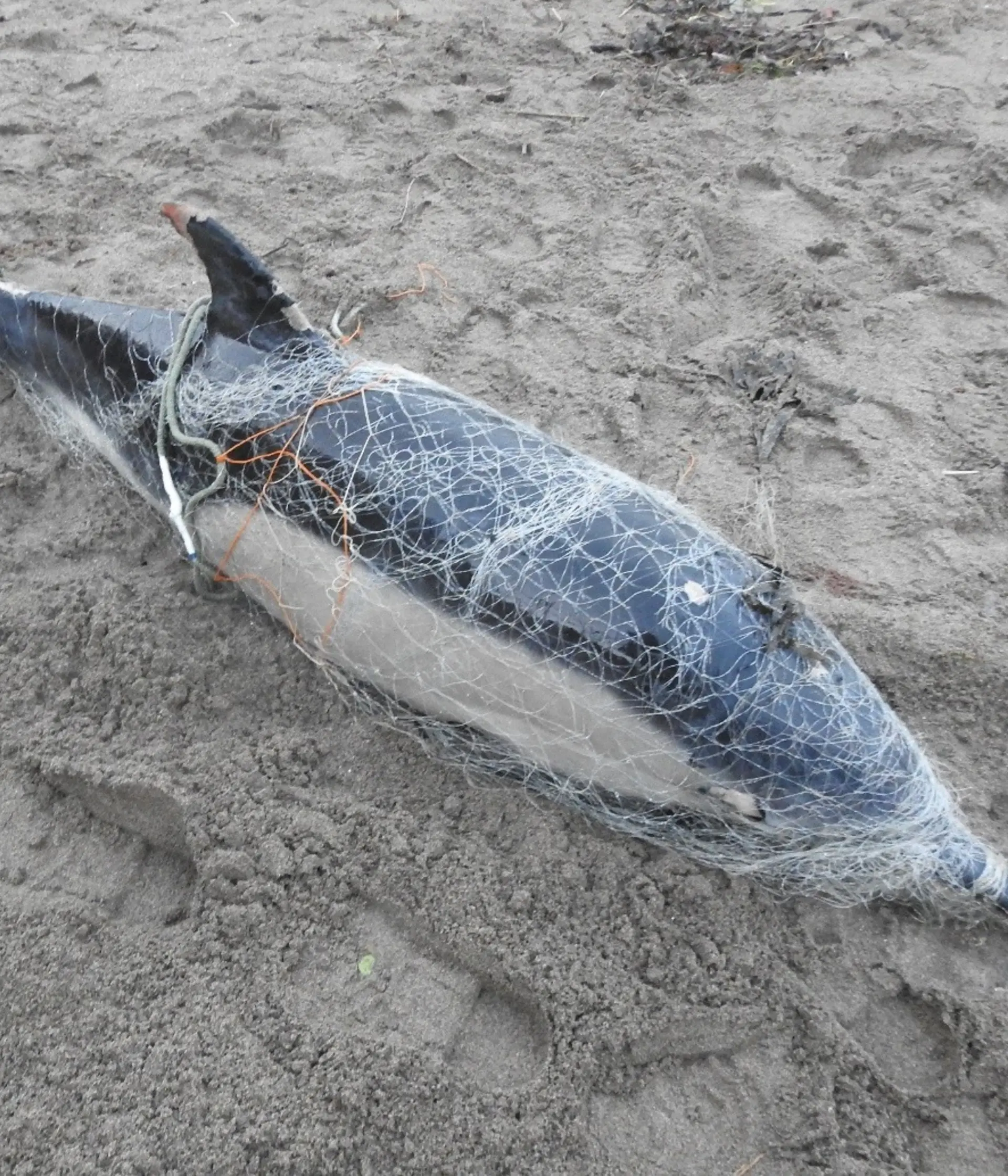
Common dolphin monofilament net marks
The welfare cost of bycatch
The numbers speak for themselves, and the potential threat to cetacean populations is clear. However, bycatch should not be viewed only as a conservation issue; it is also a serious animal welfare concern. The cases discussed above are examples of what we term ‘peracute underwater entrapment’ (PUE): the sudden entanglement and forced submersion of animals in active fishing gear, leading to death by asphyxiation over several minutes to hours. During this process, animals experience severe stress and may suffer serious injuries while trying to escape.
As many cetaceans live in tight-knit family groups, the welfare impacts of bycatch events can also extend beyond the individual animal, causing ripple-effects of disruption to the behaviour and social cohesion of surviving group members. A second paper published this summer (Dolman et al, 2026) provides an in-depth assessment of not only the welfare and behavioural impacts of PUE on the bycaught animal but also the potential knock-on effects on the social cohesion of marine mammal populations.
Chronic entanglement in fishing gear
Another important form of cetacean bycatch is the entanglement of whales in fishing rope or lines rather than in nets, an issue that has received particular attention in recent years for its impact on the critically endangered North Atlantic right whale. This small, vulnerable population, now numbering only a few hundred individuals in the western North Atlantic, was originally driven close to extinction by whaling before a global commercial moratorium was signed in Brighton in 1982.
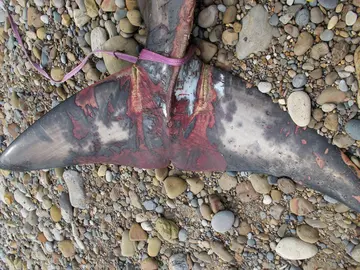
Today, the population is threatened both by vessel strikes and entanglement in ropes from lobster and crab pots, with the latter leading to tightly wrapped lines around the animal’s head, jaw and fins, occasionally causing death by drowning. However, most whales suffer from often serious injuries as a result of chronic entanglement, entangling ropes causing deep, infected wounds, restricting movement, and impairing diving, swimming, feeding, body condition, reproduction, immune function and, ultimately, survival (Knowlton et al, 2022). Animals may take months or years to die, so entanglement is not only a conservation threat but also a cause of prolonged suffering. Other whale species are affected too, with cases of chronic entanglement recorded in UK waters involving killer whales, sperm whales, beaked whales, minke whales and humpback whales, and acute entanglement leading to drowning in minke whales, northern bottlenose whales and Risso’s dolphins (data from the Scottish Marine Animal Strandings Scheme).
Why better monitoring matters
The examination of stranded animals can only tell you so much about the threats to our cetacean populations, providing as it does a snapshot of the causes of mortality in animals living off our coasts. The only way to get an accurate assessment of the true scale of the problem is through improved monitoring of fisheries bycatch through observer programmes that encompass the whole of our fishing fleet. Only then can we start to really understand the implications of this significant threat to cetaceans in UK waters and the steps we need to take to mitigate against this problem.
Cetaceans are just one part of a much larger story. A vast range of marine animals, from fish to sea turtles, seabirds to seals, are impacted. In oceans across the world, bycatch from fisheries is disrupting ecosystems and threatening populations of many species, demanding urgent attention, investment and action. Tackling this problem isn’t just about saving individual species, it is about safeguarding the resilience of marine ecosystems and securing a healthier future for our oceans.
About CSIP
The CSIP is a collaborative consortium, with ZSL the lead partner, working together with our partners at the Natural History Museum, Marine Environmental Monitoring, the Cornwall Wildlife Trust and the Cornwall Marine Pathology Team and is co-funded by Defra and Welsh Government. We also work closely with our partners in the Scottish Marine Animal Strandings Scheme, which coordinate strandings investigation in Scotland. Its current remit includes the investigation of strandings of cetaceans, seals, marine turtles and some elasmobranch species, with the current contract running to 2031.
This is the third in a series of blogs being released over the course of 2026, to coincide with ZSL’s 200th anniversary, and to also mark 35 years of work on strandings investigation by CSIP partners. Watch this space for more information on other blogs and events we hope to run through the year.
Join the fight to save our living world at ZSL
Climate change and human activity have pushed our precious planet to its limit, causing the devastating loss of so many habitats and species. From lab to field, hands on and behind the scenes, we’re leading the future of conservation, shaping agendas and influencing change to support better life, health and living for people and wildlife.