





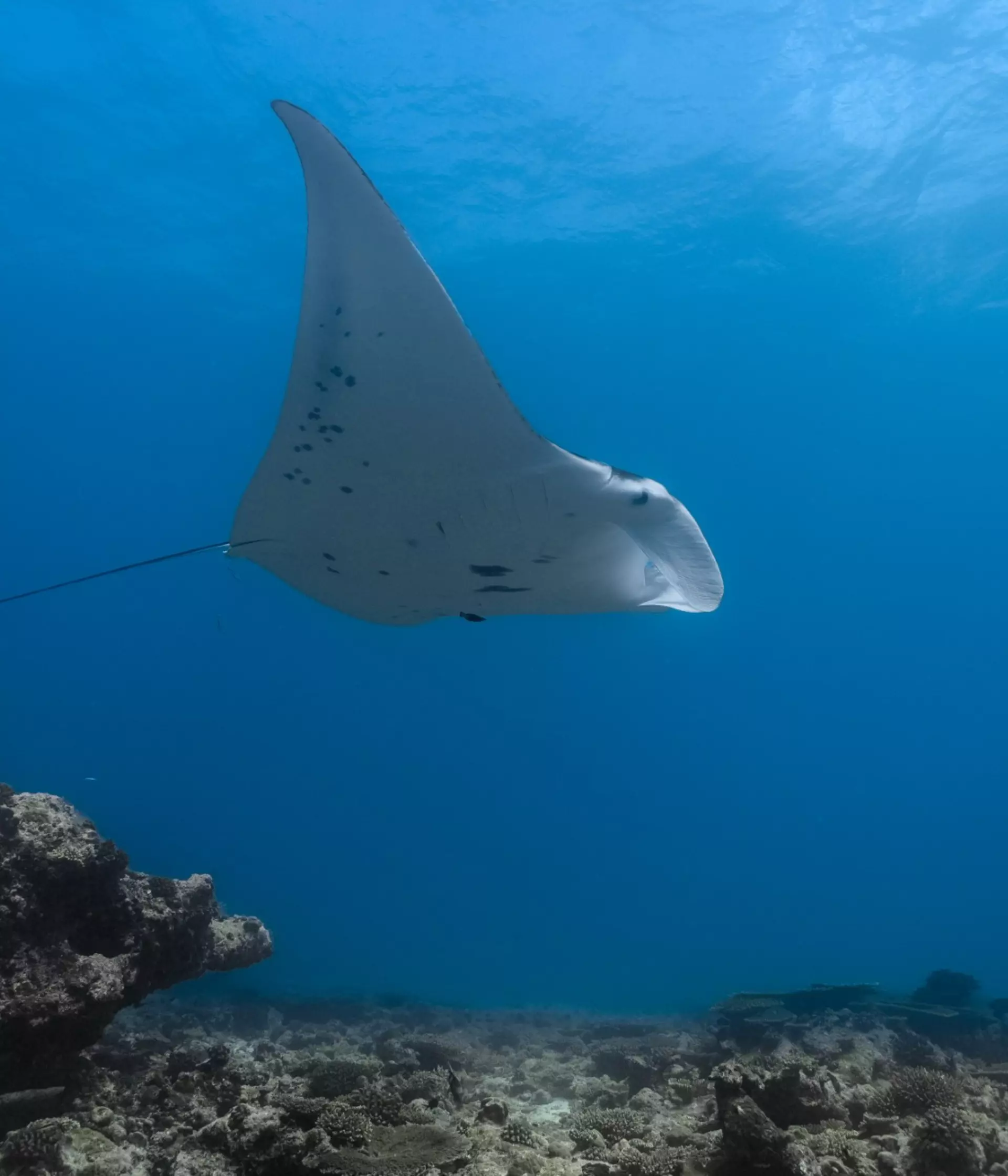
Reef manta rays are one of the largest ray species in the world, but new research reveals that their safe haven is under threat from a danger so small, it’s rarely visible to the human eye. ZSL’s Dr Jessica Savage, lead author of the paper, explains why we need international action now to tackle microplastics and protect wildlife globally.
Microplastic in the marine environment
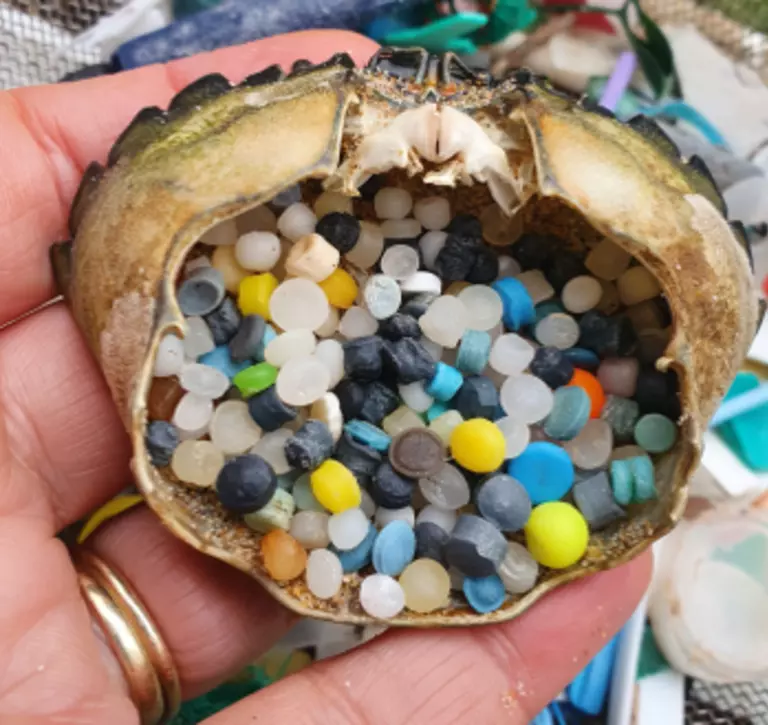
When we think about marine plastic pollution, the first things that might come to mind are plastic bottles bobbing along the ocean, or plastic straws lodged in the nostrils of a sea turtle. While these are an important part of the issue, the often-hidden side of plastic pollution are the trillions of microplastic particles that float alongside them, mostly invisible to the naked eye.
Microplastics refers to any piece of plastic that is smaller than 5 mm. They are either purposely designed to be this small, such as the microbeads sometimes found in cosmetics, or occur due to the result of larger items breaking down over time. These tiny particles are easily ingested by marine wildlife, and can have negative consequences on the wellbeing of these species - whether that’s from injuries caused directly by the plastic, or the leaching of toxic chemicals impacting fertility reproduction and development.
Remote islands are also contaminated by microplastics
One of the major challenges we face with tackling plastic pollution in the ocean is that it is a crisis that transcends borders – as highlighted by our recent study identifying alarmingly high levels of microplastics in the surface waters of a large remote marine protected area in the Indian Ocean, the Chagos Archipelago. The archipelago is home to a resident reef manta ray (Mobula alfredi) population, the world’s second largest ray species. Although typically threatened by fishing pressures, these Vulnerable fish are protected in this location.



Our collaborators at the University of Plymouth and Manta Trust established these manta rays aggregate and feed around the archipelago’s Egmont Atoll, a small group of tropical islands that lies on the edge of a coral reef, which has recently listed as an IUCN Important Shark and Ray Area, marking it as a critical habitat for these species. However, in this location we also found the highest concentrations of microplastics of the whole archipelago. This means the reef manta rays might be chronically exposed to the ingestion of these particles, potentially threatening their wellbeing and hindering their conservation in this location.
The origins of the microplastics
In such a remote, currently uninhabited location, the source of microplastics is difficult to assess. We found higher microplastic concentrations around the uninhabited atolls of the archipelago. This suggests the particles come from elsewhere in the Indian Ocean basin, either from fishing activities or from clothing. Indeed, black and blue fibres, the predominant type of particles found in the Chagos Archipelago, have also been found to be emitted from rivers and wastewater outflows in countries bordering the Indian Ocean basin. These particles can travel long distances to remote and protected islands, which is also known for larger plastic items like drink bottles.
The UK’s part to play in plastic pollution
Our study may have been looking at manta rays in the Indian Ocean, but plastic pollution is a global issue. We only have one ocean – and it’s a colossal body of water that connects the soft sands of Cornish beaches to mangrove forests in the Philippines.
As our work highlights, plastic in the oceans pays no regard to any boundaries that can be drawn on a map, and that means we need international action to tackle it.
While ocean currents mean microplastics released from clothes washing in the UK probably won’t be making their way all the way to the Chagos Archipelago any time soon, research has shown that just like plastic particles in the Indian Ocean, fibres from the UK is contributing to the build-up of microplastics in both waters around the British Isles and further afield.


Studies have found UK shark species – such as small-spotted cat sharks and spiny dogfish - with ingested microplastics, while remote islands in the North Atlantic are considered high-risks areas for marine species encountering plastic debris. On the Azores Archipelago, which lies 1,400km west of Lisbon, 99% of this plastic came from other countries bordering the Atlantic, including the UK. Microplastics in the seemingly crystal-clear waters surrounding these volcanic islands may be the result of washday in Birmingham, or a trip to the launderettes in Edinburgh.
Investing in tackling plastic pollution is as much about protecting human health as it is about protecting our planet’s precious ecosystems.
It’s not just marine life that is impacted by microplastics. Once these tiny plastics are in the ecosystem, they will gradually make their way up the food chain – including into food sources used by humans.
What we can do about microplastics
So what can we do? On one hand, in our own lives, there are certain changes we all make to reduce our possible emissions of microplastics, and in particular microfibres. It’s important to be conscious of the materials our clothing is made from, and within the boundaries of our own means, buy sustainable, good quality clothes, and choose to purchase second-hand over fast fashion. We could also be mindful of how often we wash our clothes, and add a washing machine filter to catch any particles before they make it out to the water systems.
Plastic pollution is a global problem, and the pressure to solve it can’t fall solely on individual consumers. We need more rules to ensure durability and recycling are woven into product design – clothing included.
This is a proposed development area for an international agreement to address plastic pollution – the Global Plastics Treaty - that is currently being negotiated by world leaders in the United Nations. We urge the UK Government to advocate for a strong plastics treaty at the next round of negotiations in August this year.
It is through this international action that we can solve the plastic pollution crisis and clean up our ocean for manta rays and people alike.


Climate change and human activity have pushed our precious planet to its limit, causing the devastating loss of so many habitats and species. From lab to field, hands on and behind the scenes, we’re leading the future of conservation, shaping agendas and influencing change to support better life, health and living for people and wildlife.