










Written by
Rob Deaville
CSIP Project Manager
17 February 2026
What can historic encounters with whales in the capital tell us about the present-day status of this group of marine mammals?
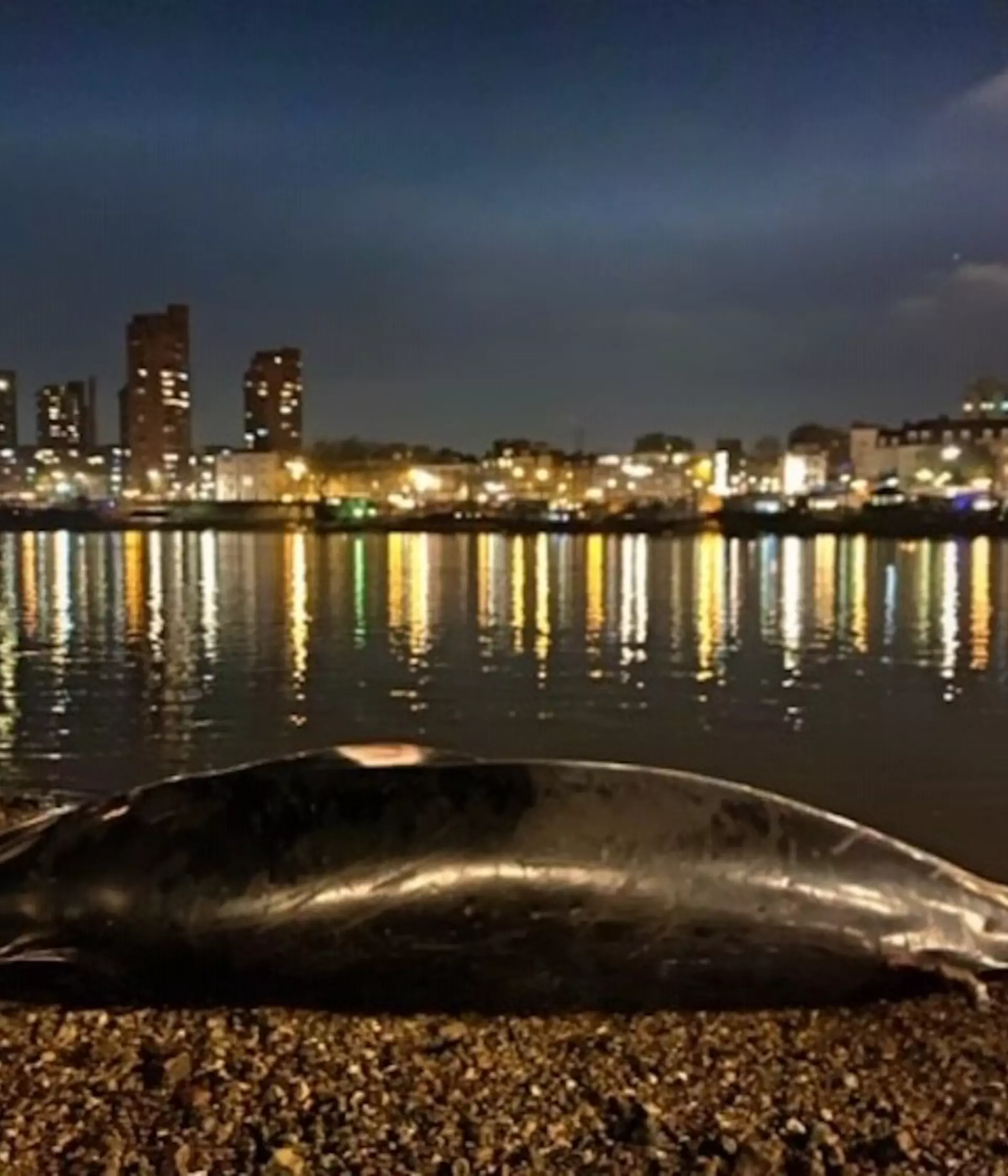
January 2026 marked the 20th anniversary of the Thames whale stranding, when a northern bottlenose whale was spotted in the inner Thames river in London, leading to one of the highest profile cetacean live stranding events, and subsequent rescue attempts, ever recorded.
As primarily deep diving, open-ocean mammals, whales are rarely found inland, especially not in metropolitan areas like our capital. But London's history with these animals doesn't just extend to those who accidentally find themselves in the city's iconic River Thames. In this blog, I'll put the stranding of the Thames Whale in context, by considering the fate of three whales that came to visit London.
An Atlantic Whale in Cromwell's England
In 1658 a north Atlantic right whale entered the Thames and was eventually harpooned and killed at Deptford by the local population. The diarist John Evelyn recorded the event, saying “after a long conflict, it was killed with a harping iron, struck in the head, out of which spouted blood and water by two tunnels; and after a horrid groan, it ran quite on shore, and died”.
The oil from the blubber was likely used for lighting around the streets of London, the baleen may have been used to make corsets for dresses, and the mandibles from the whale’s head formed an archway in nearby Chadwell for many years before disappearing in 1870.
In 2010, the partial skeleton of a north Atlantic right whale was found buried in mud in Greenwich. Missing its head, the orientation of the remains indicated it was likely dragged by the tail to shore. Given the location, researchers believe that this was almost certainly the same whale that was killed in 1658. The recovered bones eventually went to the Natural History Museum, where they now form part of the significant skeletal collection they maintain for research. During cleanup of the bones, conservators found saw marks and other damage, consistent with anecdotal reports of butchery of the whale after it was killed. The fate of this single whale puts the current species status in perspective; today, the north Atlantic right whale population numbers fewer than 400 individuals. Having been decimated by the impact of whaling, and again more recently by the modern impacts of entanglement in fishing gear and shipstrike, the London whale stands as testament to how long the species has faced challenges to its survival.
Whales on Wheels: Jonah, Goliath and Hercules
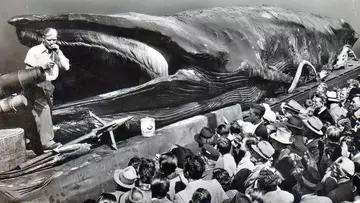
In 1954, excitement rippled through the crowd as ‘Jonah’ was unloaded at Dagenham docks, as seen in this fascinating Pathe news film from the time. Jonah was one of three fin whales killed in the Arctic whaling industry, now travelling not through oceans, but across Europe on the back of a lorry, fixed in vast amounts of formalin to prevent decomposition. Along with Goliath and Hercules, Jonah was driven from city to city across Europe as travelling spectacles to help promote the whaling industry. In London and the rest of the country, the public were charged a shilling for the privilege of standing in front of this giant of the sea or, astonishingly, to sit in its mouth. I dread to think about the risk of contact with all that formalin...
Rumour has it Jonah may still be around, with the last sighting allegedly in Belgium a few years ago after being stored in a warehouse for the last few decades. To think that these magnificent animals ended up as pickled exhibits, to help promote an industry that led to the near extermination of many whale populations, casts a long, sad shadow over the spectacle that drew such eager onlookers.
From morbid roadshows to rescue attempts
And then there was the 2006 Thames whale… I remember vast crowds lining the Thames not just at the stranding site, but all the way along our slow journey out to the mouth of the river. Even after we’d gone under the QE2 bridge, the sun had set and we were approaching the outer Thames, we could still hear faint cheers from the shoreline over a mile away, with the British public willing on the success of the rescue efforts to get the northern bottlenose whale back to deeper waters. Sadly, the whale didn’t survive, and after it had died, the barge carrying it slowly turned around and headed back the way we came.


The necropsy on the whale which we carried out the next day, under the aegis of the ZSL led and Defra funded Cetacean Strandings Investigation Programme (CSIP) found that the whale was severely dehydrated with no evidence of recent feeding and had muscle damage and kidney failure- this was all consistent with likely multiple strandings of an out of habitat young whale.
Although the rescue attempt led by our friends at British Divers Marine Life Rescue ultimately wasn’t successful, the response of Londoners and the worldwide audience that day was extraordinary. It is also possible that if this whale had swum up the Thames a few decades earlier, it may have been viewed as a shipping hazard, rather than a sentient, intelligent mammal that we had to try our utmost to help and that the world was moved by.
What can we learn from whales in the Thames?
I use these three London whales in many of my talks to students and the wider public in my role as Project Manager of CSIP, and the key message I try to draw out from them is to contrast how our relationship with whales has changed.
We have moved from being a nation that saw whales as something to be profited from through whaling, or objects of curiosity to gawk at, to becoming a nation of whale conservationists, in what has actually been a relatively short timeframe. And that has to be a good thing…
This is the first in a series of blogs being released over the course of 2026, to coincide with ZSL’s 200th anniversary, and to also mark 35 years of work on strandings investigation by CSIP partners. Watch this space for more information on other blogs and events we hope to run through the year.
Join the fight to save our living world at ZSL
Climate change and human activity have pushed our precious planet to its limit, causing the devastating loss of so many habitats and species. From lab to field, hands on and behind the scenes, we’re leading the future of conservation, shaping agendas and influencing change to support better life, health and living for people and wildlife.