



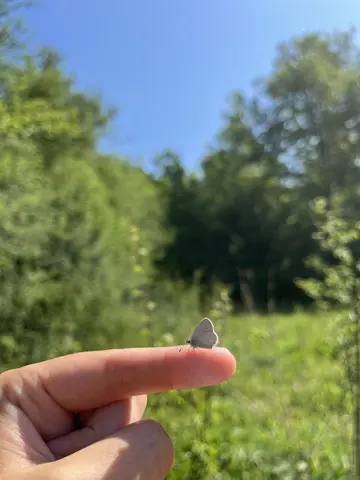
Exploring how AI can expand insect monitoring and contribute to novel ecological inference
Rosa's research investigates the ways that artificial intelligence can be used to enhance insect monitoring.
Insects are crucial for the functioning of most ecosystems, including providing important services to humans such as pollination of crops. Unfortunately, we are observing declines in many insects globally. Effective insect conservation depends on widespread population monitoring to understand the state of populations, drivers of declines, and to test the efficacy of conservation interventions.
Rosa's PhD investigates how AI-assisted identification of insects can be used to enhance insect monitoring, exploring the ways that AI can be applied in citizen science and academic fieldwork to address taxonomic, spatial and temporal shortfalls in insect monitoring. Building on her MPhil research on behavioural responses of butterflies to temperature, Rosa hopes to use new automated technologies to explore how moths respond to temperature in urban environments. Altogether, Rosa's work aims to explore how AI can expand insect monitoring and contribute to novel ecological inference.
Professional history
2025-Present: PhD Researcher, Institute of Zoology, ZSL
2024-2025: Research Assistant, Banking on Butterflies project - Insect Ecology Group, University of Cambridge
2024-2025: MPhil Zoology (by thesis), Behavioural responses of butterflies to temperature change, University of Cambridge
2021-2024: BA Biological Natural Sciences (Zoology), University of Cambridge
Publications
Pollard Smith, R.M., Hayes, M.P., Hitchcock, G.E., Hellon, J., Bladon, A.J. & Turner, E.C. (2026) Warmest spring on record in the United Kingdom provides insights into how a specialist spring-flying butterfly may respond to future climate change. Insect Conservation and Diversity, 19(4), 964–968. Available from: https://doi.org/10.1111/icad.70070