







Understanding the effectiveness and ecological impacts of wildlife disease management.
The risk of infectious disease to people, livestock and wildlife is increasing due to climate change, habitat fragmentation, urbanisation and increased movement of people and animals. Pathogens that spread between wildlife and people or livestock can present challenging human-wildlife conflicts, with potential conservation and welfare impacts on infected wildlife, welfare impacts for livestock and severe economic and emotional costs for stakeholders.
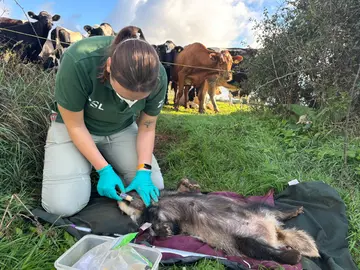
Olivia's current research centres on the management of bovine tuberculosis (bTB) in European badgers (Meles meles). While primarily a disease of domestic cattle, in the UK, badgers are the primary wildlife host for bTB, adding a layer of complexity to the management of the disease. In England, large-scale farmer-led badger culling formed the main part of badger management for bTB control from 2013-2026, with policy now moving away from culling towards a vaccination-led approach. Questions remain around how to scale badger vaccination effectively to contribute to the control of bTB in badgers and cattle.
Olivia's research at ZSL, in partnership with the National Farmers’ Union, focuses on understanding the effectiveness of badger vaccination for bovine tuberculosis under a range of vaccination schedules, including:
- Standard approach – annual vaccination over four years, following the current badger vaccination guidelines.
- Intermittent – vaccinate every other year (year one and three) with the aim of reducing delivery costs and enabling faster expansion.
- Targeted – reactive vaccination based on TB breakdown holdings and nearby farms.
By working in partnership with stakeholder organisations, Olivia and the team aim to deliver high-quality science and meaningful wildlife disease management strategies for the benefit of people, livestock and wildlife.
Professional history
2025-Present: Postdoctoral Research Associate, Institute of Zoology, ZSL
2024-2025: Postdoctoral Research Associate/Natural Environment Research Coordinator, National Trust
2022-2024: Scientific Project Manager (Impacts of culling on badger movement and social behaviour), Animal & Plant Health Agency
2021-2022: Postdoctoral Research Fellow, University of Exeter
2016-2021: PhD, The ecological impacts of Tasmanian devil Sarcophilus harrisii decline, University of Exeter
2012-2015: BSc (Hons) Biological Sciences (Zoology), University of Leicester
Publications
O. Bell, M.E. Jones, M Ruiz-Aravena, D.G. Hamilton, S. Comte, R. Hamer, R.K. Hamede, J. Newton, S. Bearhop, R.A. McDonald (2024) Habitat modification, not the decline of apex scavengers, drives isotopic niche variation in a carnivore community, Oecologia, 1-15
O. Bell, M.E. Jones, C.X. Cunningham, M. Ruiz‐Aravena, D.G. Hamilton, S. Comte, R.K. Hamede, S. Bearhop, R.A. McDonald (2021) Isotopic niche variation in Tasmanian devils Sarcophilus harrisii with progression of devil facial tumor disease, Ecology and Evolution, 11, 8038-8053
O. Bell, M.E. Jones, M. Ruiz‐Aravena, R.K. Hamede, S. Bearhop, R.A. McDonald (2020) Age‐related variation in the trophic characteristics of a marsupial carnivore, the Tasmanian devil Sarcophilus harrisii, Ecology and Evolution, 10, 7861-7871
A. Kuepfer, P. Catry, S. Bearhop, R.B. Sherley, O. Bell, J. Newton, P. Brickle, A. Arkhipkin, S.C. Votier (2023) Inter-colony and inter-annual variation in discard use by albatross chicks revealed using isotopes and regurgitates, Marine Biology, 170, 46
B.B. Phillips, S.L. Crowley, O. Bell, R.A. McDonald (2022) Harnessing practitioner knowledge to inform the conservation of a protected species, the hazel dormouse Muscardinus avellanarius, Ecological Solutions and Evidence, 3, e12198
D.M. Harper, E. Tebbs, O. Bell, V.J. Robinson (2016) Conservation and management of East Africa’s soda lakes, In: Soda Lakes of East Africa, 345-364