





Dr Chris Yesson is a senior research fellow and a marine biologist for our conservation charity. He studies how human activity affects seabed habitats around the world.
Chris's work spans everything from kelp forests and seagrass meadows in the UK to cold-water coral ecosystems in the Arctic.
He works on conservation projects in places like Greenland, Sussex, and the Thames Estuary, combining field research with close collaboration with fishers and policymakers. Through this work, he’s helped support trawling bans, protect vulnerable marine habitats, and drive practical restoration efforts, such as kelp, seagrass, and oyster recovery.
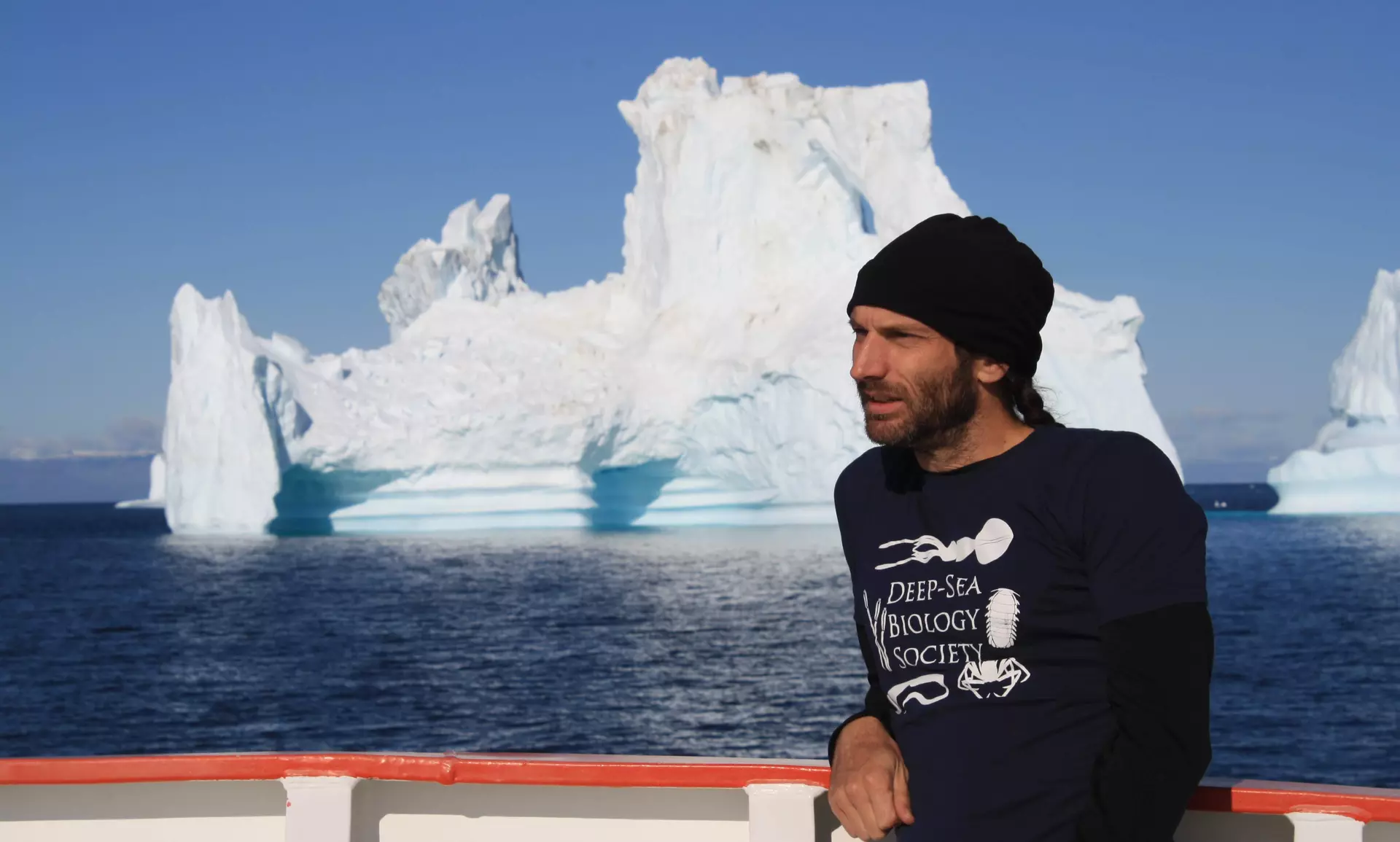
My name is Chris Yesson. I’m a Senior Research Fellow at the Institute of Zoology, which is our academic research department. I’ve been at ZSL since 2009, so about 17 years now, and my role is as a researcher. I’m a marine biologist, and much of my work focuses on human impacts on seabed habitats. That ranges from UK habitats such as kelp forests and seagrass meadows, through to Arctic environments, including cold-water coral habitats in Greenland. I’m also a course director on the Wild Animal Biology and Wild Animal Health MSc, which we co-run with the Royal Veterinary College.
I used to be a management consultant, so I spent five years trying to work out how to make banks earn more money. While it was fulfilling in some ways, it didn’t really have the feel-good factor. I went on a kind of conservation holiday to Madagascar, where I helped catch the fossa. I was like, “wow, you can do this as a job.” And that got me thinking, I'd really like to try and do something that makes me feel good about what I do. And that led me to a career change. I retrained, completed a master’s and then a PhD, and at the end of my PhD I was fortunate enough to be offered a job at the Zoo.
I’ve always lived in London and have long been interested in environmental organisations. Being on my doorstep, and a really cool place to work. It's like, wow, I'd really love to work here. And I've kind of felt that that was the completion of my transition from working in London as a management consultant to retraining and then getting a job in London, doing environmental science.
You see a lot of people who had shark posters on their wall since they were a kid, and have done that that their whole life. And for me, it was a very different route there. My PhD was in terrestrial botany and after my PhD, I couldn't get a job doing terrestrial botany. This job came up at the Zoo, employing the skills that I'd learned during my PhD and then applying it to a marine world. So, I had a massive amount of imposter syndrome. Working at the Zoo here with all of these people who've done their undergraduate degree in biology, had their shark or their cheetah posters since childhood. And for me, it was, it was very much a career change, and constantly feeling like, oh, I need to demonstrate my value.
At the moment, I’m working on three main projects. The one that I've been doing for the longest time here at ZSL is looking at seabed habitats in Greenland. I’ve been going back every year since 2012, and I’m very excited to be heading out again this coming summer. We’ll be putting a deep-sea remotely operated camera down to explore Greenland’s only hydrothermal vent field, the first time anyone has ever looked at it. Over the years, I’ve mapped habitats such as cold-water coral reefs and fed that information back to local fishers, helping them understand where vulnerable habitats are and how they can reduce their impacts. That work has been incredibly rewarding, building long-lasting, good relationships with fishers. We have a positive, sometimes difficult, but generally positive back and forth about habitat forming organisms that are really vulnerable to deep sea trawling activities and leading to positive conservation outcomes.
Another project I’m involved in is the Sussex Kelp Recovery Project. I became involved in 2019. There used to be a lot of kelp forests along the Sussex Coats, which stretched for about 30 kilometres from Bognor to Brighton, but they disappeared in the late 1980s and early 1990s. We don’t know the exact cause, likely a combination of fishing pressure, commercial trawling, environmental change, and temperature shifts. We're still trying to work that out. About five years ago, we had the conservation success of helping the local inshore fishery conservation authority introduce a ban on trawling in the area. Since then, we’ve been doing a lot of monitoring in the area. Seeing how have things changed, how the introduction of this conservation action impacted wildlife in the area, both the seabed habitat and the fish communities and, also general wellbeing. How are people relating to habitats in the area, spreading the knowledge, spreading the good word of there's lots of really cool habitats, even in the UK, which we think of as cold, not very hospitable, marine water. But there's lots of cool stuff there.
More recently, I’ve become involved in the Transforming the Thames project. Working with partners in ZSL’s conservation and policy teams, we’re carrying out active coastal habitat restoration across the greater Thames Estuary. This includes seagrass planting and laying oyster beds. We've got this ambitious five-year project to do active restoration in 16 to 18 different sites in the greater Thames Estuary, which is really exciting.
A typical working day is sitting at my computer, in meetings like everyone else, but those days are broken up with trips to the shore to carry out drone surveys, putting cameras in the water, helping my PhD students collect samples, or field trips to Greenland. It's very different days and that's one of the great things about working here and doing this kind of work. You get to do a whole variety of different things, and you get to go to a whole bunch of very different and very exciting places.
There are lots of highlights. A personal highlight for me is working with fishermen in Greenland and seeing the introduction of a protected area in the Arctic. In 2016, we carried out surveys in Melville Bay, northwest Greenland, and we saw sea pens – a very adapted corals that look like a flower. The local fishermen call them sea flowers. They can grow to one to two meters tall and live for 100 years. And these are quite sticky and they are easily caught in trolling nets. So, we were out there doing fishery survey and camera survey, and one of these nets brought up 100 of these 100 year old coral species. And it's like, well, okay, we've got to document this, and we've got to try and convey that we really don't want to be fishing in these areas. As a result of that work, presenting to the fishermen and seeing them engage in their policy, they introduced a ban in their area. So, 3000 square kilometres, about the size of the Isle of Wight, there's no trawling because of a survey that I was lucky enough to be part of in 2016. That was really rewarding to be able to say some of my actions have led to positive conservation outcomes.
The same is true of the work in Sussex, where we've been looking at the impact of the introduction of another trawling band. It's really great to be able to see on the ground practical cause positive conservation outcomes. Going back to the sites where we're planting sea grass and seeing that sea grass grow. We measure that sea grass, so we can say, yeah, we've planted here, and this worked, and we can see that this seagrass area has doubled in the last year. But also, to just learn. If we planted somewhere and it didn't work, we think, why didn't it work? Let's make sure that we learn from that experience and then get better at our conservation work. So those successes are really nice to be part of.
I’ve been here for 17 years and I’ve seen a lot of positive change. Organisationally, we treat our staff better - things like maternity and paternity leave. It's been great to see the gender pay gap go from substantial to nothing now. I can see the way that we've made such positive change to the way that we treat that animals. Animal welfare is something that we take really seriously. And we've seen in my lifetime, the large animals move out from London into Whipsnade. Working with keepers and seeing how they engage in better animal welfare, like creating water environments through playing the sound of thunder and dripping water. It’s amazing. It just something that I would never have thought of, just to see that's happening here, and to feel like I'm a part of that by running a course where our master students go and help the keepers in their welfare research. It's really nice to see that we're constantly striving to improve our standards and just make a better place for our animals and a better place for our staff.
We're very excited to come to the fifth anniversary of the introduction of the near shore trawling bylaw in Sussex, which was introduced in 2021. We're going to be holding a bunch of events this year to celebrate. We've got five years of monitoring data, putting a camera on the seabed, and then pulling along the seabed so we can see how the habitats have changed, and just documenting the wide variety of habitats that we have on the Sussex coast. We have coal patch habitats. We have these kind of beds of brittle stars. You see all these little fingers sticking up on the seabed, 10s of 1000s of them all sitting in the same place. And we go back there every year. It's really amazing.
It's nice to be able to see this project milestone, five years since the introduction of this trawling ban, and the way that things have changed. We've seen the expansion of muscle beds in the area. We've seen some recovery in in some shellfish. The Sussex dolphin project have seen more dolphins in the area we think is related to a trawling bylaw. I'm very excited.
I've got two PhD students who've been working on the Sussex project, and they're both due to finish this year. So, a nice coincidence with this anniversary that we also get to celebrate. Mary Ann Glasgow has been doing work looking at the eco toxicology of the way that chemicals impact growth of kelp. Maddie Bowden Perry has been doing historical ecology work, conducting interviews with local fishermen to see the history of fishing in kelp in the area. She’s been trawling through newspaper archives in the 1950s and the local headlines were “the scourge of kelp blights the coastline again”, as a big storm would wash two-meter-high drift of kelp on the shoreline. Then the sand flies would come in, and then the local tourism would be: Oh God, this stinks, and this is a blight on our tourism. The local council, even as recent as the late 80s, were investigating ways to remove the kelp habitat because they saw it as a problem. They trialled dragging chains across the seabed and they even investigated throwing explosives into the sea to try to get rid of the kelp habitats in the area. Just shows you the way that things have changed because the local council who were investigating this, are now part of the Sussex Kelps Recovery Project, and are helping us to try and recover kelp habitats in the area. So, a great way to see change over time and the changing attitudes. It's just really nice to be part of that project and to see the way that we've had a positive impact in our local environment.
With any institution, there are always challenges. We are a charity, and often a cash strapped charity. We can't do any of our conservation actions without first raising the money, so we are constantly working on a shoestring budget. I think sometimes that can be a good thing, because it helps us think about how do things more cost effectively. We try to bring our conservation and our conservation science to a wider audience by choosing to use low-cost equipment. So, we're just kicking off a new project that we're calling deep and cheap where we're trying to build low-cost cameras so that we can put a camera down to 1000 meters down, take a picture of the habitat as cheaply as possible. So, we have this ambition of trying to build a bunch of these cameras for £5000 and then give them away to people who've not been able to look at their deep-sea habitats around the world. So constantly fighting to find the money to do this work, but sometimes that can lead to positive outcomes where we just do things more efficiently and more cheaply.
Like so many people, I came here as a kid and loved to go and see the animals. When I first started my career change, transitioning from a management consultant into a conservation biologist, my wife bought me a present of keeper for the day here. So in 2007, almost 20 years ago now, whilst I was still trying to retrain, I came here and had this great experience of going to feed the tigers, and had a coati on my lap. I got to feed it and go to clean out the penguin pool, which was great when you see the penguins trying to attack your broom. It was a really, really great experience for me, and kind of made me feel like this is the place that I want to be, and it would be awesome to be working in this kind of environment with lots of people who really care about animals.
For a while now, I'd seen that there was this junior keeper for a day experience. I had the idea that I could try to give my daughter the same experience that I had almost 20 years ago. That was something that I'd always been looking forward to doing. One of the perks of working in the Zoo is you can bring your family in, and we come every year. But for a few years now, my daughter's been looking and she needed to be 12 years old to be able to do the junior keeper for a day experience. I think it was 12, maybe 11. And so, we've been waiting and waiting and waiting on that. And then she got to her 12th birthday last year, and we decided to do it for her birthday. So, I dug out my old keeper for a day t shirt, because I don't throw any clothes away. I brought that with me, and saw her being attacked by the penguins, who really loved the brooms. It was just such a heartwarming experience to be able to share that experience with my daughter, who now says she wants to come and work at the Zoo as well and wants to kind of follow in my footsteps, which is just like a brilliant experience for me, and a dream come true, to be able to see her have that same experience and enjoy it just as much as I did. It was just, just really, really lovely. That direct encounter with nature is really good for the soul.
I guess the other experience I'm really proud of working here is working with the keeper teams, and so I've been working with the aquarium team and with Paul Pierce, Kelly and Alex Cliff. Here we were using our genetics tools to try and help us identify the corals that we have in our tanks. We invented the word aquarium here at the London Zoo, and we've got a long collection of corals, but a lot of those written records were lost, meaning that we don't have provenance over some of the corals that have been growing in our tanks. And corals are really weird and wonderful creatures, but they will grow in completely different ways in a tank to in the wild and triggered by different environmental kind of triggers. And so, it's really hard to distinguish what species this is. And so to be able to help, we have a PhD student who's looking at the genetics of the corals in our collections and in different aquarium collections across the UK and Europe, and to be able to kind of directly impact the collections that we've got here and help us better understand what our collections are and the conservation value of those collections. It's really, really rewarding, and something that I'm very proud of. That's one of the great things about just the wide range of things that are going on here, that if you have the incentive and you have the enthusiasm, you do get to go and work with the aquarium team. You get to go and work with the conservation teams planting seagrass. And you do get to go and work with the supercomputer here. We can put things together and have some positive outcomes.
These archive recordings capture personal memories and perspectives. They reflect the way people remember events which may be shaped by time, or differ from other accounts.