






In the middle of the last century, London Zoo was ‘the beating heart of the community’ and the backdrop to Frank Hughes’ family history.
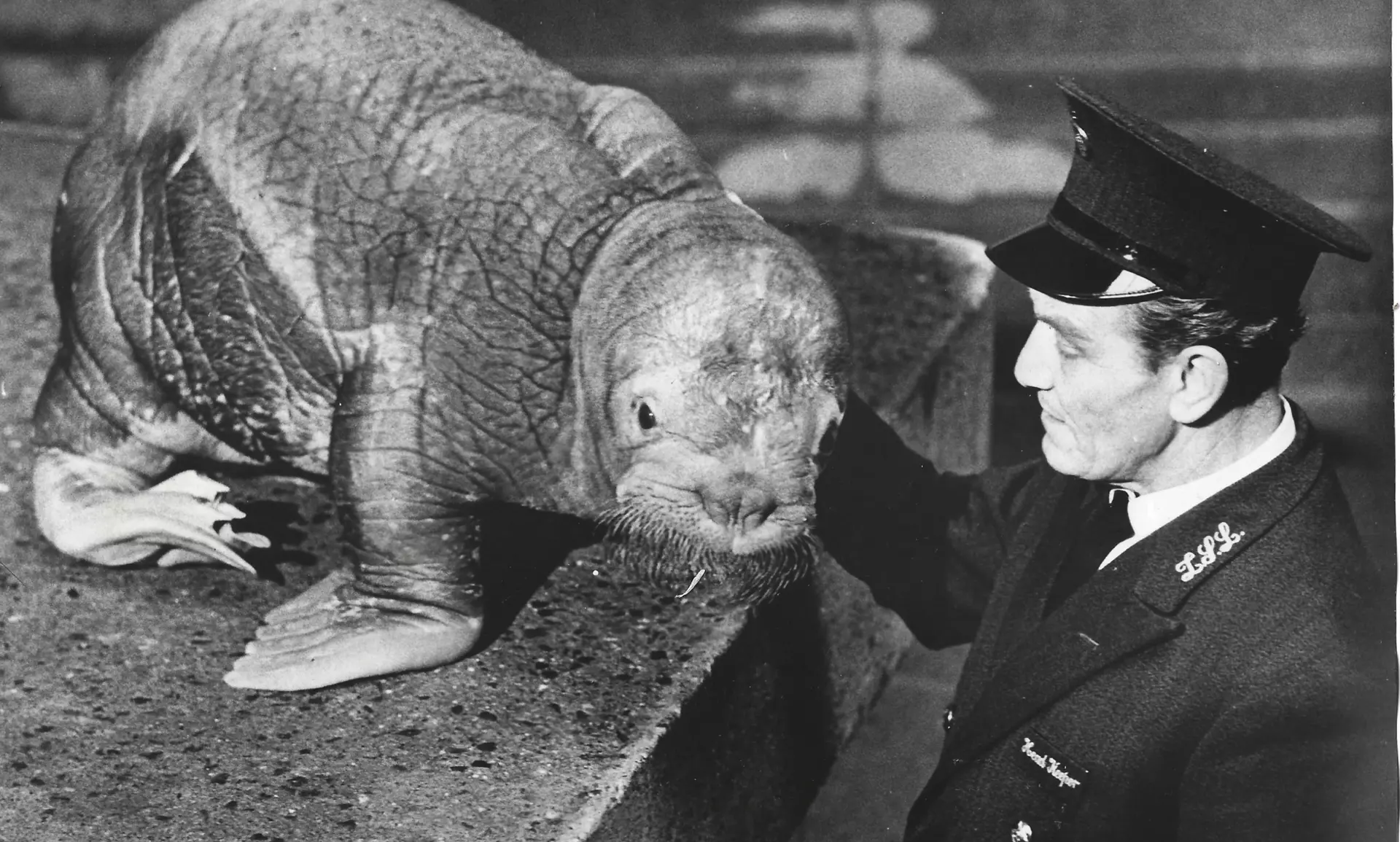
Frank’s father, George, joined the Zoo as a keeper in the 1930s, later becoming head keeper of the sea lions. It was during this time that he developed a very special relationship with the famous Alice the walrus.
Frank’s mother, Irene, worked as a waitress in the members’ restaurant, serving everyone from HM The Queen to the Beatles. Irene and George met in around 1950 at the Zoo Sports and Social Club and Frank himself joined his mother and father working at the Zoo for a few years at just 15-years-old.
Dad was born in 1911 and Paddington. He lived most of his life in and around Regent's Park. My mum was born 12 years later. She came from Islington, a large family, one of 10. They met around 49 or 50. They met at the Zoo Sports and Social Club, which is just literally just over the just over the canal from here, which is falling into disrepair now that building, but, yeah, coincidentally, the person who was playing the piano at that social evening was Violet Carson, who went on to become the famous Elsie Tanner in Coronation Street. So that was, that was their claim to fame. Anyway, yes. So I was born a couple of years later. When he started his career was as a bread baker but he started getting problems with this chest. So his doctor at the time recommended that he got an outdoor job. And this is around 1936 or 37, I think, which he did. He must have known somebody in the Zoo, I'm guessing, got him a job as a keeper in the Zoo, and he joined the giraffe house. So that was his first job in mid to late 30s. But he got found out by the authorities when war was declared, and they thought, what the heck are you doing here as a zookeeper? And sent him off to war. So that was him for the next few years. Then, as soon as the war was over, as soon as he was demobbed, he re-joined the Zoo. So that would be in about 4847-48 I guess. So there was a gap of a few years, and he worked.
Oh goodness. So the first job I remember him having when I was very young, about four, maybe he was in charge of the Shetland ponies. And he used to take the pony and trap out and doing all that running around with the kids in the trap. So that was his job. That was pretty cute. And as a boy, it was lovely being able to play with these gorgeous ponies. That was splendid.
Mom had a few jobs, she was a waitress. She was civil service waitress. So she had a few jobs over the years. But latterly, she must have been in her 40s. I'd say she got a job at the Members Restaurant in London, she spent many a year serving members like the Queen, The Beatles, you know, all sorts of people. You can imagine that the sort of people who become members of the ZSL, you do get some VIPs there. So, yeah. So she had an amazing career doing that. They also did sort of dinner dances, masonic dinner dances for upwards of 120 to 350 people, so a huge dinner dance. Sometimes they'd be three or four week these things. So the waitresses and waiters and bar staff were able to work overtime. Yeah. So that was, that was her career in the Zoo, and she worked here until she retired.
Dad died in 1975, having left the Zoo probably three or four years before that, I think that was the approximate timeframe. I joined the Zoo as a casual when I was just over 15. You had to be 15 years and three months. So yeah, so initially I got a job in the gate house just directly opposite the road here. That was where the keepers, etc, clocked on. They had one of this old fashioned clocking on, clocking off machines. And so the casuals, which included a few school kids like myself, and a lot of people who had fallen on hard times, a lot of people who were actually pretty well homeless. We all just hung about there in the mornings, at seven, eight o'clock, whatever it was. And a number of people got picked, maybe half a dozen, for the wash up, which was washing up for the Members Restaurant and the Regent Restaurant, which was the public equivalent in the main building, yeah, and our staff. Because everybody knew my mum, of course, I got a bit of gross favour there. So I didn't have to work in the wash up for too long before I got snaffled up and did bar work, which was a little less unpleasant. Yeah, so Crikey. So from the age of 15 till when I left home, I was 18-19, so yeah, three or four years I was supplementing my income with Zoo jobs, casual jobs, yeah.
So my dad, he went on, probably the longest time when he was the Head Keeper of sea lions. So he was the guy who was throwing the whiting. And there were other fish. But he used to throw the fish and the sea lions used to launch themselves off the rocks, and it was a great spectacle. Everybody loved it. So he got plenty of media publicity from that, from that sort of stuff. I think I mentioned one day he came home and said, I got a tricky one today. They said to me, George, you're going to get a walrus. He said, I've never seen a walrus. I wouldn't know what one would look like. Certainly, wouldn’t know how to take care of one. We've sorted that out. We’re sending you to Hamburg. Hamburg Zoo has got a walrus, and you'll spend a couple of weeks with them. You’ll learn the ins and outs of it, and that was it. So after he went to Hamburg, he had a nicer time than he had during the war in Germany. It was his first time back, so it was a bit weird for him. But yeah, he came back and the walrus was called Alice, for fairly obvious reasons - Alice in Wonderland. But then one day, one of their keepers came around on a Sunday morning and said, I’ve got some really bad news, she’s died, Alice just died overnight. So that broke his heart. He absolutely loved that. He loved that animal. So, so that was my dad's time with Alice the walrus. They were lovely, lovely times, beautiful, beautiful creature.
Then I think he did a couple more years in the end with the California sea lions and seals and that sort of thing. And then he did a stint, well, quite a long stint, actually. I think about five to 10 years as Head Keeper the antelopes. So many a time when I was a kid, I dealt with them on the weekends, Saturdays or Sundays or both. And I wasn’t fond of the mucking out process, but I was very fond of petting them basically. Beautiful, beautiful family-type creatures, you know, just cuddling them to death, really. It was wonderful times, wonderful times. So he did that.
He had another stint after. He did a stint in the Children's Zoo. So he had kangaroos and wallabies. They had goats, etc, and the kids had a petting corner and all that stuff. Probably the last job he had, I think, before he retired, when he was about 60 when he packed in.
Back in those days, so talking 60s, mostly, maybe 70s, the Sports and Social Club just over the canal, which I told you about, that was a real hive of Zoo people. And everybody went there. The alcohol was cheap. They had snooker tables. They had table tennis tables, and they did dances. And it was, it was a really fun place. And as young men, me and a lot of my colleagues, we would pop in there for a few beers, etc. This is the early days of the Beatles. Yeah. So that was the kind of centre that you know, that's the only place where everybody could meet from all echelons of the zoo.
Interviewer:
So how would you describe the role that the Zoo played in your life? Was it quite a kind of important place for your family?
Frank Hughes:
It was huge. Yeah, absolutely. I mean, the fact that various times, both my parents and I made our money from the Zoo, but I mean, for time, all three of us were working there. So it was, it was really that was totally central. Around that time in Primrose Hill, where I lived with my parents, it was a very working class area then, which you'd probably struggle with. Now there's a concept, but virtually everybody worked either at the zoo or on the railways. So it was a very, very close knit working class area. There was a school directly opposite where I lived. Many of the kids who went to school were kids of people who worked at the Zoo. So it was a it was a beating hear of the community, I think.
Interviewer:
And what are some of your earliest memories of coming to the Zoo? Do you have any favourite animals
Frank Hughes:
Well, the ponies I love, because I was able to spend time with them, ride them, groom them. I was very, very fond of them. But some of the animals over the years, I mean, chi, chi, the first giant panda that we ever got, it was just amazing. Because obviously they'd been the days when nobody went to China, you know. So you didn't really see many pandas around. So that was, that was extraordinary. But the large animals, obviously, the ones you think of, the rhinos, the elephants, the giraffes, just extraordinary. Even the snakes and the reptiles and the chimps. They used to have a thing called the Chimps Tea Party, which you may or may not have heard about, but I think that got banned because it was not not treating animals with due respect. But I was actually interviewed, and one of those, one of the episodes of Zoo Time, which was presented by a guy called Desmond Morris, not Johnny Morris, but Desmond Morris, back in the day, who went on to write the Naked Ape, quite a famous book, but yeah, so he interviewed me for about 30 seconds on that Zoo Time. That was my only claim to fame.
Interviewer:
So do you have any particular memorable experiences during your time working at the Zoo?
Frank Hughes:
I remember feeling very excited for my dad when he was made Head Keeper, because that was a promotion. I also remember when he became 1000 pound a year man when his but when his money went up to 20 pounds a week, he was very pleased. But my parents had made loads of friends at the Zoo over the years. You know, particularly living in the area. It was, as I say, it was the beating heart the community, really. You could almost not differentiate between Primrose Hill as an area and the Zoo, because there's so many people who are integrated as part of that wider machine, I suppose. But no, nothing really stands out.
Interviewer:
So you mentioned in your email about when the Queen and Duke of Edinburgh visited. Can you tell me a bit more about that? What was your dad's opinion of it?
Frank Hughes:
Oh, he loved it. he president at the time was Solly Zuckerman, who was the government's chief scientific advisor, or something like that, if that was his role in life. But he introduced the Queen and Philip to a line of Head Keepers. Basically shook hands. Had all been briefed to call her mam, not madam, or mad or anything. It had to be mam. So, you know, they felt the correct etiquette. Yeah. And over the years, I told you my mother was one of 10, and just every time we visited somebody, that photo would be on their wall, they were so proud of, you know, one of their close relatives actually having to meet them.
Interviewer:
Would you ay there any lessons or values that you learned from your parents in your own experience at the zoo?
Frank Hughes:
Almost goes without saying, but love of animals, of course. Always, always fond of animals. Wherever my wife and I go, we go to the zoo, we seek out particularly in far flung places, but we seek out species that are indigenous to that particular neck of the woods. And yeah, we just love it. We just love being with animals, even if they're donkeys or goats, it almost doesn't matter. They're lovely. We have four cats. So we share a lot of spiritual stuff with our animals. So that's when we started and actually seeing the sum of people who actually work in an organisation, a world famous organisation, like ZSL. It is a bit of a brotherhood. A close knit clan. I can only, have never been in the army, but I can imagine it's like a company or a regiment or something like that. Everybody shares the same overall values, you know? So that was interesting to witness, to be part of.
Interviewer:
And would you say that kind of the next generation of your family and descendants of your parents have continued having a relationship with London Zoo? Do you think it's kind of inspired there?
Frank Hughes:
It did with people my age, who were kids of zookeepers, etc, but I don't know how far that stretches.
I look at the keepers now, when I come to the Zoo, they're much younger than I ever envisaged. A long time here, keepers were all, I'm pretty sure they were all in the 30s, 40s, 50th, as I said, my dad could retire at 60, so, you know, you didn't have the youthful element that is more apparent now. So I think it's probably a young person's calling.
I do look at them and I envy them. I don't get the impression that it's just a job. I get the impression they are with their animal lovers, and they're following that calling. So I see a different breed, if you like, of zookeepers, than to the to those I was familiar with years ago.
Interviewer:
Would you say that you or your parents would have any particular advice to give anybody who was just starting working at the zoo?
Frank Hughes:
Just love it. You're working with beautiful animals who trust you. Some of them are wilder than others, of course, but they trust you. You feed them. You keep them healthy, you make sure they're in a healthy, clean environment. And I think that loves that animals can give to the people who care about them is invaluable, if I'm honest.
I do remember the keepers being in awe of their immediate superiors, who were called overseers in those days. And they wore a particular dark, very dark blue uniform. But when you saw the overseer coming, you pretty well snapped to attention. And they ruled with a rod of iron. And it was interesting to see these grown men, really quite nervous of the power these guys held.
These archive recordings capture personal memories and perspectives. They reflect the way people remember events which may be shaped by time, or differ from other accounts.