




David Styles shares three generations worth of personal stories from London Zoo.
David’s grandfather joined London Zoo in 1911, becoming Head Keeper of the Ungulates (animals with hooves). David’s father, Heathcote Walter Styles, followed him into the Zoo at just fourteen years old, starting work in 1924 and remaining there as Head Keeper of Small Mammals, aside from wartime service, until his retirement in 1970. David spent his childhood surrounded by animals, and his memories offer a window into a very different time in ZSL history.

My father, they lived in Highbury, only yards from the new stadium, the Highbury stadium, the Emirates. He had six sisters. I went to see his house a while ago. It was a very small house for that number of children. I'm not sure about my grandfather. I think he was born in Islington. Yes, I looked it up the other day; he was born in Islington. So they’d been Londoners all their lives. My grandfather had retired by the time I was born, but my father was a zookeeper from the time I was born right through till he retired in 1970. I used to go to the Zoo with him. One of the tales was that Guy the gorilla arrived a few months after I was born. Guy came in on the fifth of November, 1947, so I would have been only a few months old. My parents told me, when I was very young, I was actually allowed in with Guy the gorilla. Unfortunately, we haven't got a picture of me there, but I can’t imagine them allowing it these days. Of course, Guy would have only been three or four years old, a very young animal. That’s one of the tales of the Styles family, passed down through the years.
Dad had been a keeper, and by the time I can really remember him, he was head keeper of the small mammals. He would go from Cockfosters station, about a ten-minute walk from our house. He could catch the train there, probably change at King's Cross, and get off at Camden Town and just walk around the corner. I remember sometimes going in there with him. The points were always frozen in those days, so some days it was difficult to get into work because, as Cockfosters was the terminus, the sidings were frozen and they couldn’t get the trains out. He used to work every day except Tuesday, which was his day off, and he always worked Christmas Day as well. The Zoo was closed on Christmas Day and Boxing Day, but he used to say he did it for the young men who had children. I was a child as well, but he used to get out of the house, saving him from cooking or looking after me for a while, and he always managed to get back in time for Christmas dinner. That was a regular joke in the family.
I used to go to work with him from time to time. In those days, the small mammal house was really just a Victorian oblong structure with very high ceilings and very few windows. I think it was illuminated from the roof, though I might be wrong. The animals were positioned around three sides against the wall, and in the middle, there were cages on trestle tables, forming a complete square with just a door at one end for the keepers to access the back of the cages. We would start work at eight o'clock in the morning. They would prepare the food for the animals, cut up the food, and sit me down with their tea with condensed milk, which is a very sweet, sticky substance - great if you’re five years old. I was allowed to cut up some bananas and help apportion the food for the different animals.
My favourite was a mongoose, which I named Rikki-Tikki from The Jungle Book. I was allowed to pick it up. Mongooses have a very strong smell, and I can still remember it, even though I’ve lost my sense of smell now, can’t smell a rose. Dad would apportion all the food. I remember being upset when he got a mouse out of the dustbin to stun it and feed it to meat-eating animals. I didn’t like that part, but I could walk around the Zoo with him and see other animals. They had some wolves, and I seem to remember one looking like a young wolf that seemed to make friends with my dad. When my dad arrived, the wolves would start howling - they must have smelled him coming. Although he was a small mammal keeper, he knew all the animals.
He also got hold of porcupine quills, which they shed naturally, and used them as fishing floats. Dad didn’t like spending money, so a free float was excellent. Sometimes he would take animals home. Once we had a bush baby. A wealthy couple living near the Zoo went on holiday and asked dad to look after it. The bush baby would jump onto the pelmets or curtains and, well, do its business, which my mum didn’t like much. It was a lot of work getting it back into its cage. We had it for about two weeks, and as a mark of thanks, they gave dad a beautiful onyx cigarette case with gold edging.
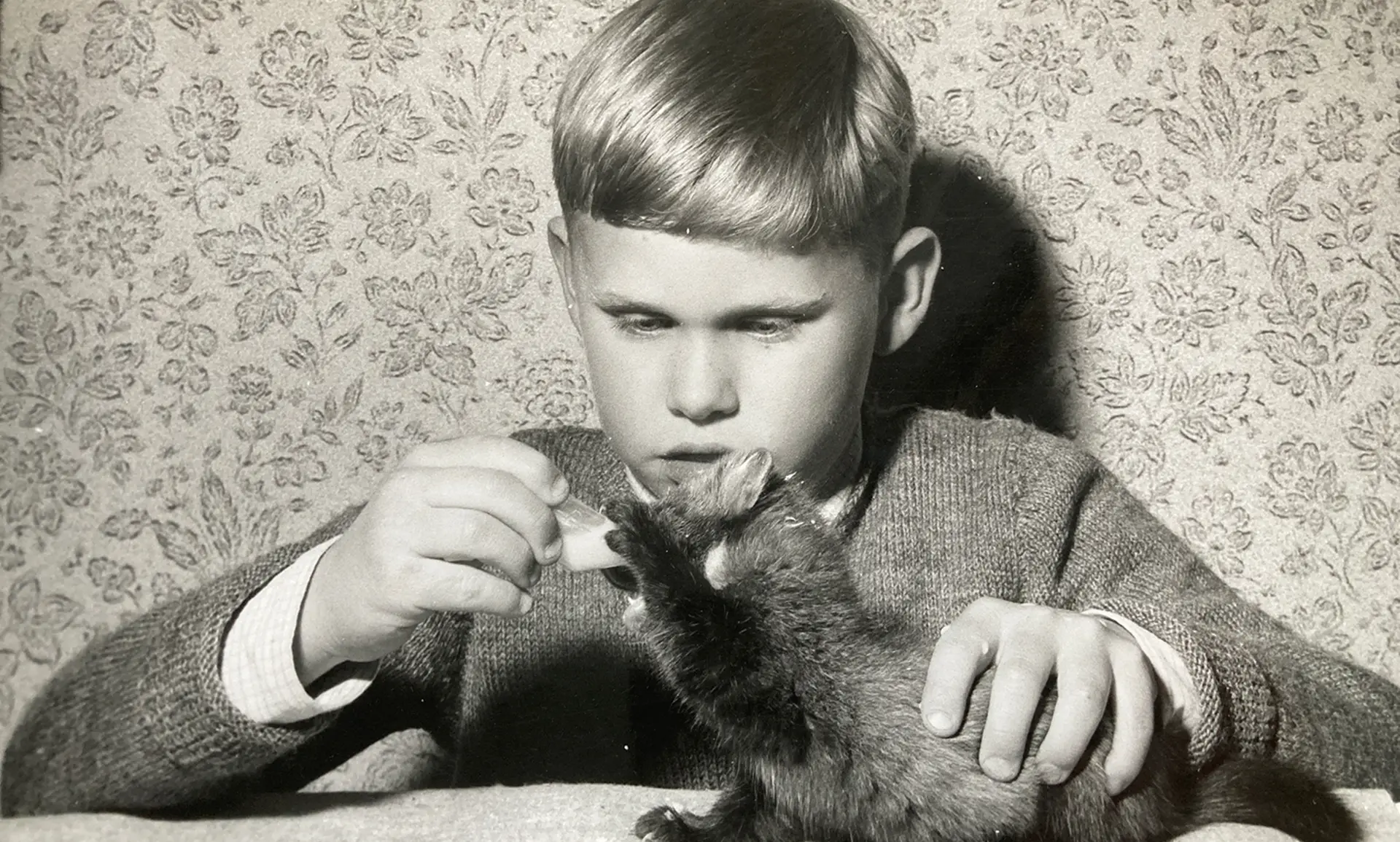
We also had some orphaned martins. The mother had died, so dad took them home, and we bottle-fed them. The Daily Express sent a photographer for publicity shots of my mum, dad, and me with the martins running around the back garden.
Dad was once offered a secondment to go to Borneo for six months to help relocate animals due to flooding, but mum didn’t want to go, so he turned it down. He did, however, take a small monkey to the Paris Zoo. He got into a cab at what is now Charles de Gaulle Airport. So, he's sitting there, and he's got the creature beside him, and he's sitting in the back, and the cab drivers driving through Paris, and he slows down past this building, and he says, “That’s a zoo; there are some right animals in there.” Dad looked over - it was actually the French Parliament. Don’t say Parisians don’t have a sense of humour.
My grandfather, after looking it up, became a keeper in his late 20s. One of my grandfathers was a glass beveler, which sounds impressive in Victorian times. He joined the Zoo in 1911 as a helper in the cattle shed. He worked his way up, retiring in 1948 as head keeper of the ungulates. My dad joined the Zoo around 1920 at age 14 and never left, apart from five or six years of war service, retiring in 1970. He was presented with a beautifully moulded plaque and a long-service Amiga watch. It's got the symbol of the Zoological Society of London, engraved HW Styles, 1924–1970.
One famous anecdote in our family involves the Lion House, built in Victorian times. The lions were kept mostly on concrete and the building stank. A keeper, not a stranger to drink, used to invite his friends round for a quick little tipple after the Zoo closed in the evening. One of the keepers recalls walking past to go home and hearing grunts from within, he looked in there, and apparently this head keeper of the lions had decided to show his friend in their inebriated condition, one of the lions, this old male lion. So, he'd open the cage door to look at the lion. And this lion lost all its teeth and it was arthritic. And the lion must have leant forward and started flopping out of the cage. Now, remember, this cage was chest height, so now you've got a lion weighing a lot, and it's flopping out of its cage. It's slowly sliding out of the cage because the arthritis means it hasn't got any strength left in its body, and the keepers tells a story of seeing these two men who are drunk with a lion on their back as they're trying with their backs to push this lion back into the cage. So, I don't think this guy ever let the lion out again after that. Whether it's true, I don't know, but that’s the Style story of the two drunks and the lion.
I wanted to be a zookeeper, but my dad said no and got me an apprenticeship as a compositor. I also wanted to be a vet but being a young man and lazy, I failed my 11-plus. My daughter became a veterinary nurse and has done extremely well.
As the Zoo got into the late 60s, they started rebuilding the Zoo. They rebuilt the elephant house, and it was a brutalist building. I mean brutalist as in the architectural term. I think it was probably by a famous architect, and they poured all this concrete, and the building had ribs all the way around it. Then one morning my dad goes into work and they're knocking these ribs out, because they wanted this look of broken concrete. They spent all this time pouring this concrete to get these ribs all the way around this circular building and there they were with a hammer and chisel knocking the tips off all these ribs.
At night, the keepers used to take the elephants inside house. Zoos had got moving away from where you had cages between you and the animal. So every designer would try to produce a means of viewing the animal without this obstruction. They worked out that if they put these very large aluminium posts, which must have been seven or eight foot high, in front of these animals, the public could walk into this building, and the elephants couldn't get through, because the posts were positioned were narrower than the elephants. So, you could look at the elephants while they were doing their thing, unobstructed by a cage. And what had happened is that they'd used aluminium, and no one had thought that an elephant is quite a strong beast and very intelligent. They obviously hadn't watched the David Attenborough films where they had elephants picking up huge trees. And these elephants worked out that the width between these posts was bottom size. So they backed themselves in with their bottoms and then twisted their bodies. And because it was aluminium, of course, it just went. The keeper came in the next morning, with elephants walking around inside the public area.
About 10 years later, one of the elephants was outside, and the public were encouraged to feed them, but the elephants would have to stretch from the bit of land which they were given to walk round over this moat. It was just a ditch in front of the public who were feeding them. And one of the elephants hadn't quite worked out that their trunk was long enough to flick towards the people that entertain them and the elephant slid into this ditch. So, you've got five ton of elephant stuck head first in this ditch, and no one knew how to get this poor creature out. Now you'd have thought the Zoo might have had some lifting equipment, but this went on for two or three days, and if memory serves, I think the animal died. I don't think they managed to actually heave this poor creature out. So that's some of the mistakes they make with designing these new houses.
My dad was a head keeper of the small mammals, and towards the end of his time, there Claw, a very wealthy man who donated some money to build a new, small mammal house. And as I said before, I think he was a Republican, but he made sure he was nice enough to be presented to the Queen when this house was opened. All his uniform was pristine, and his shirt and his tie was tied up properly, and everything else. And so, the house was opened. When they were building it, he expressed reservations about the design of this house. Now this time, their idea was to use a real moat. So, for some of the animals there were no cage at all. There was an open space, and in front of the open space was a trough of water, and then there were public behind that. I presume there might have been some kind of barrier between that so they couldn't get too close. And my dad expressed reservations about this. He said, that's dangerous to the animals. Unfortunately, his prediction was proved true. He came into work a few weeks or months after the house opened and there was animals, at least one, bobbing around in the water, dead. I think that might have been what finished my dad off with the Zoo.
By then, he had been offered, or at least a mild promise of promotion into senior management should be, let's face it, he'd been at the Zoo by then since the age of 14, and he was now 60. So apart from his time in the war, he had been there all his life. And I believe he was offered some position in management. And I think seeing this, I thought promoted him, and he retired at the age of 60, which is quite young, really, for his generation. My mum was still working. In fact, he got himself a job afterwards, delivering flowers for the couple of years between the time my dad retired and my mum retired. He certainly enjoyed it knocking on people's houses, presenting flowers for people. So that was it. So I don’t think he ever regretted leaving the Zoo.
I used to like the orangutans. I used to like where they just used to sit there, lay there, looking at everyone that was opposite. They were opposite the insect house at the time, in a very small cage. I wasn't allowed to touch any of the other animals. My dad was pretty strict on that, because obviously animals bite or they have disease. He knew a fair bit about diseases. We had a cat, Siamese cat, and one day, my dad looked at this cat, and he said, I think he's got TB. And he took some samples, took it up to the path lab here, and sure enough, yes, it had.
I remember the monkey's Tea Party, even as a young man used to horrify me. They used to have a monkey's tea party that was, strangely enough, on a piece of land opposite the restaurant at the time. You got the restaurant, and then you got the tunnel, and close to that, there was some spare land, and they used to lay out a table and chairs, and the monkeys used to make a mess of their dinner, much to everyone's amuse. I think they even used to charge people. I just think that was a strange thing to do. And they did camel rides. And if ever you picked an animal most unsuited to be close to young children is a camel. I mean, when you're on them, they sway. They call them the ships of the desert, don't they? I mean, they sway. They're nasty creatures. They spit all the time, and give a chance, they'll bite you. And there was little five year olds standing beside this camel, ready to be heaved up to sit on the camel's back, which they used to have some chairs on the top. No safety precautions at all. So that was a rather surprising thing to see.
You'd have these children programs, Animal Magic. And so often you see dad's arms in camera, holding this cute little creature. He wasn't the keeper who in the famous Blue Peter, where the baby elephant defecates, then decides he's going to go walk about with the poor, hapless keeper, holding on to it being dragged across the studio floor. That wasn't my dad, but yes, that was another thing he had.
So, dad had his new suit, shirt, tie, nicely pressed to be presented to the Queen. Unfortunately, we haven't got a picture of him being presented to the Queen, but I presume that must have happened. We weren't invited, so the usual speeches of the great and the good and they opened up the Zoo. I think there was a plaque on that claw pavilion which said the Queen opened it in 1969 or something like that. So, Dad, I'm pretty certain, was a Republican. He never had much truck with the royal family, but that day, he certainly made an effort. So clearly, even the royal family made an impression.
These archive recordings capture personal memories and perspectives. They reflect the way people remember events which may be shaped by time, or differ from other accounts.