









Restoring mangrove forests
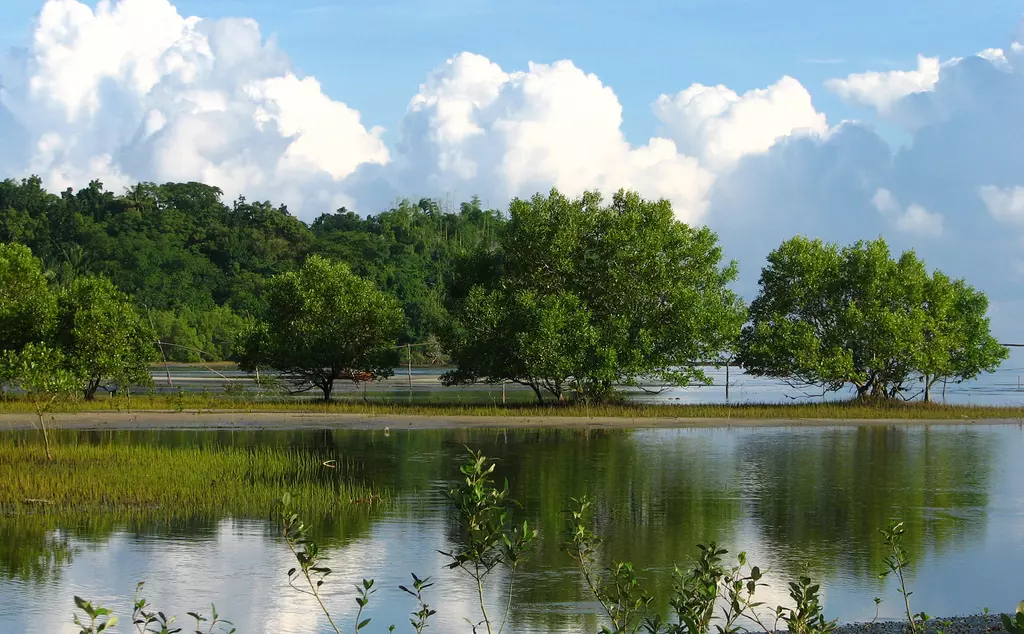
Mangrove forests are among the most threatened habitats on Earth. These dreamlike coastal jungles are hotspots for biodiversity. They’re some of our planet’s most incredible places – where fish swim among trees, and everything from big cats to kingfishers hunt amidst the webs of knotted roots, and dense, arching branches. But best estimates are that between a fifth and a third of the world’s mangrove forests are now gone.
For many people in coastal communities, mangrove forests provide their livelihoods, much of the food they eat, and crucial protection from storms and erosion. There’s also strong evidence that mangroves play an important role in maintaining the balance of our climate. They can absorb and store even more carbon than tropical rainforests, making them one of our greatest allies against climate change.
1,260
football pitches of abandoned fishpond mangroves have been restored so far by ZSL
6.4 billion
metric tons of carbon held by mangrove soil.
4
Mangrove forests have the ability to store up to 4 times as much carbon than other tropical forests.
More than one in six of the species they’re home to are at risk of extinction.
And more of these incredibly important habitats continue to disappear every year – wiped out by coastal developments that change and damage shorelines, and projects that convert mangrove forests to other uses.
We’re driving forward a journey of recovery in the mangrove forests, reviving these essential ecosystems and supporting the communities and species that call it home. By improving peoples co-existence with wildlife and safeguarding nature, we can create a healthier and more sustainable future for both people and wildlife.
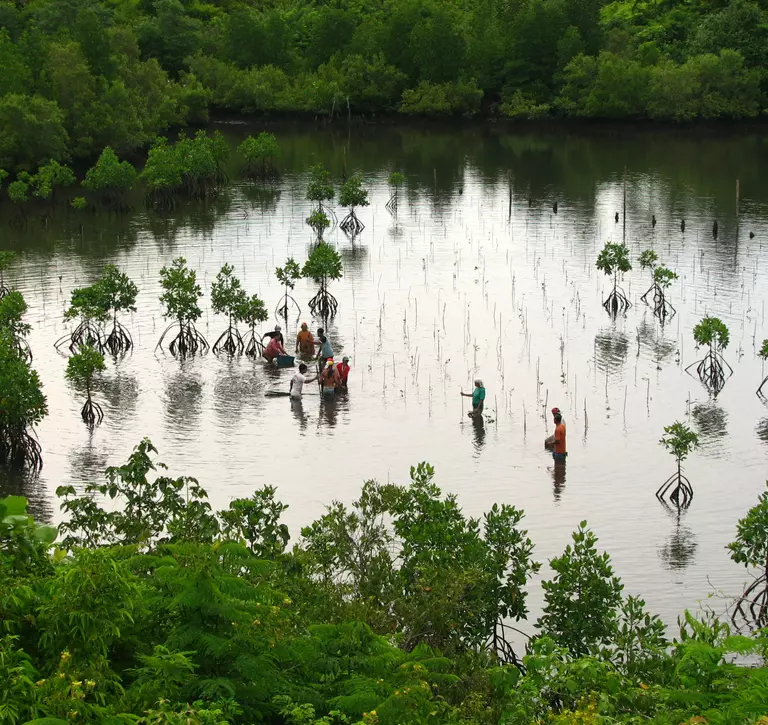
Our projects in the Philippines have restored and protected over 900 hectares of abandoned fishpond mangroves - around the size of 1,260 football pitches.
Mangroves are key to fighting the climate crisis
Mangrove forests are a nature-based solution to climate change, with the ability to store up to four times as much carbon than other tropical forests. A recent study found mangrove soil held 6.4 billion metric tons of carbon in 2000, that’s the equivalent of running over 6000 coal power plants for a year!
This means mangroves trees can be an important tool to tackle the climate crisis, and their restoration protects people, wildlife, and the planet.
Mangroves protect coral reefs from bleaching
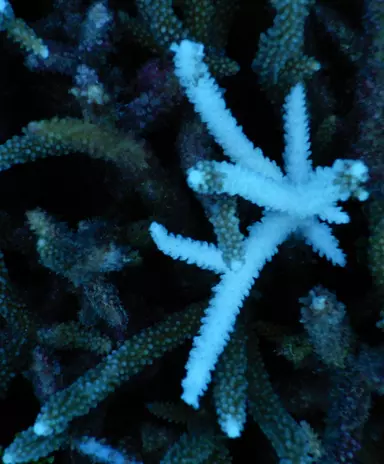
More than 90% of coral reefs are expected to die by 2050, but many rare corals are clinging on in mangrove forests. This is because mangrove trees provide crucial shade from the heat and uv rays of the sun.
Mangroves protect people
Mangroves forests provide important protection to communities that are vulnerable to sea-level rises and severe weather events caused by climate change. The deep network of tree roots holds the landscape together, and act as a shield that can potentially save lives from the extreme weather which has become common because of climate change.
Why are mangrove forests being lost?
Mangroves are being cleared at a staggering rate. There are many threats to the forests, including land development, pollution, deforestation for fuel and climate change. One of the biggest reasons for the loss of mangroves are to establish fishponds for aquaculture. Mangrove forests are being lost at around 1% per year. The last IUCN assessment highlighted that more than one in six mangrove species are currently under threat of extinction.
Our mangrove restoration work is currently focused in the Philippines, where over 50% of mangroves have been lost. The super-typhoon Haiyan (locally known as Yolanda) has highlighted the vital role mangroves play as nature’s bioshields for vulnerable coastal communities. We are working to protect the remaining mangroves and restore lost forests, especially through fishpond reversion, helping to ensure greater food security, improved protection against natural disasters and increased household incomes for local communities.
Philippines mangrove conservation
Our work in the Philippines couldn’t be more urgent: over half of the country’s mangrove forests have already been lost.
There are solutions. In the Philippines, many mangroves have been cleared to make way for ponds for farming fish, shrimp and other marine produce. But together with local people, we are showing the way forward.
Replanting mangrove forests
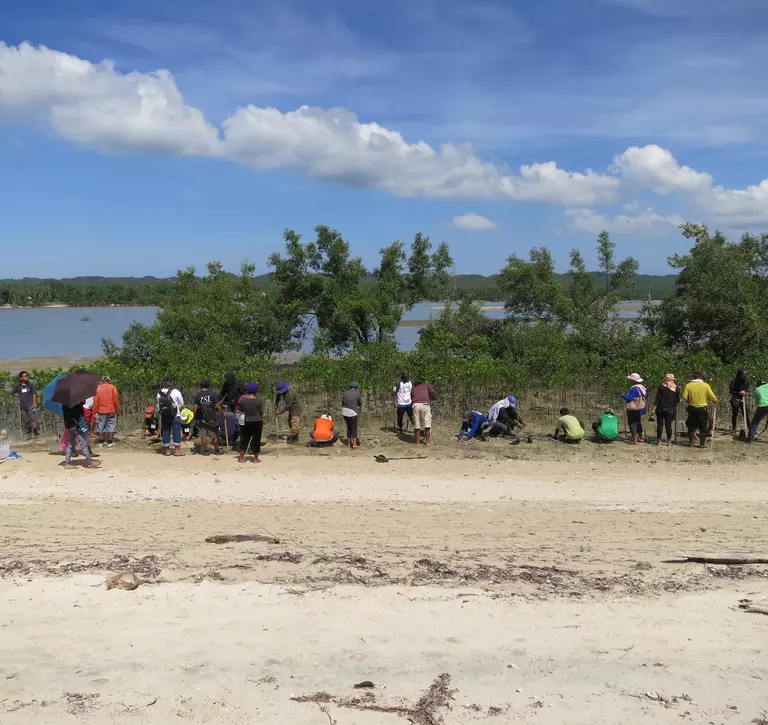
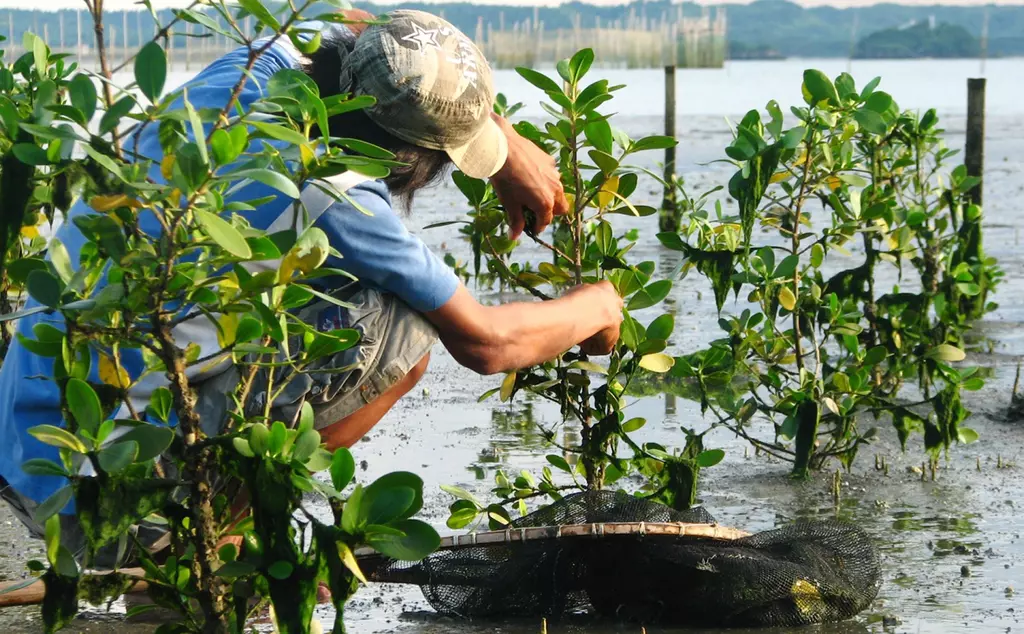
Working with local communities, we’ve replanted over a million mangroves on the sites of lost forests since we have started our work in 2007. These forests are now beginning to come back to life – an incredible thing to witness and be part of achieving! The project has deepened practical understanding of restoring mangroves and generated new replantation guides, so that its success can be replicated and multiplied.
Restoring mangrove forests
In the Philippines, most mangrove forests have been lost to fishponds for commercial fish and shrimp farming. But after a time, the fishponds are often abandoned – and by law they should be converted back to forests. And that’s where ZSL has been able to help.
We’re working with the Philippine government so that new healthy mangrove forests can be cultivated at abandoned fishpond sites. While our use of advanced remote sensing tech, like satellite technology, is deepening understanding of mangrove forest ecology and informing evidence-based conservation.
Protecting coastal habitats
One new approach is getting mangroves included in marine protected areas (MPAs). Currently, MPAs are largely focussed on coral reefs. So far, we’ve successfully brought mangroves under this umbrella of protection, together with coral reefs and seagrasses, across 12 MPA sites in Panay, Cebu, and Bohol.
Creating a future for mangrove forests and people
At the Katunggan It Ibajay eco-park in Panay, Philippines, visitors can experience the wonders of a mangrove forest, its wildlife and the ancient, awe-inspiring trees at its heart. It all helps raise awareness of the importance of mangroves, while providing valuable income for the local communities who manage the park. We helped set up this park and two other mangrove eco-parks in Panay island.
Our mangrove forest research
We created a new framework to assess mangrove forest ecosystems, which demonstrated the fragility of these precious ecosystems. By researching mangrove forests in Mozambique, we determined the that forests were most at risk to sea level rises and tropical storms. This research is helping shape conservation planning and management to fight back against of the climate crisis.
Stand up for nature
The pressures on mangrove forests are huge. But every action to protect them moves us towards a more balanced and vibrant world. By supporting ZSL you can help the recovery of incredible ecosystems and restore balance for wildlife, people, and the planet.
IUCN SSC mangrove specialist group
The IUCN SSC Mangrove Specialist Group, aims to support mangrove research and conservation projects by bringing together experts in the field to share their knowledge. Hosted by ZSL, the group aims to assess the conservation status of mangroves; identify, quantify and prioritise threats; and develop plans to conserve the most threatened species and habitats.
Public Perceptions of Mangrove Forests Matter for Their Conservation
This paper published our MSG members produced research on the public perceptions of mangrove forests, some of the misconceptions and why these are dangerous for the future of mangrove restoration. We also look at some possible way forward using social media and more nuanced methods of communication.
Pause Before You Plant
Our collaboration on the importance of evidence based approaches to planting trees in response to climate change. We highlight the importance of protecting the old growth forests we already have, of planting mangrove forests in the correct areas and of making sure that mangroves are planted with due care and consideration, as mismanaged or inappropriate planting of mangroves can lead to failure.
Conservation of small mangrove patches
Our conservation scientists from across the MSG wrote a letter published in Science addressing the accelerated loss of small mangrove patches globally and the combined effect this will have on the global status of these incredibly important species.
Dr David Curnick, Post-doctoral Researcher at the ZSL Institute of Zoology and member of the MSG said: “All too often mangroves are regarded as irrelevant swamps or wastelands – yet they’re incredibly important ecosystems. Globally, yes, mangrove conservation is being looked at, but it’s these smaller patches of mangroves in remote areas that need greater recognition. We need governments to move away from policy decisions that prioritise large areas and short-term local political gains, and instead adopt a more well-rounded long-term vision, ensuring the value of smaller mangrove patches are appreciated and safeguarded.”
Thank you to all our supporters who helped make this possible.
New Mangrove Restoration Potential Mapping Tool
TNC has partnered with IUCN to develop a global model and map of mangrove restoration potential to help practitioners prioritise areas, and support mangrove restoration projects globally.
Model results can be viewed in an online mapping and decision-support tool that can be used by environmental groups to show the extent of degraded mangroves, how much land is available for restoration, identify priority restoration areas, and kick-start opportunities for implementing restoration projects. The project is providing a modelled ecosystem service values for restored sites.
Mangrove and Beach Forest Training Course
ZSL-Philippines has built a solid track record of 64 training courses on mangrove and beach forest rehabilitation over the past 12 years, graduating more than 6,200 participants. Find out more about our courses:
Partners and sponsors
Department of Environment and Natural Resources; Bureau of Aquatic Resources
Kindly sponsored by: Big Lottery Fund; GIZ; ; Waterloo Foundation; Darwin Initiative; Turing Foundation; International Institute of Rural Reconstruction (IIRR); Forest Foundation Philippines, American Forests, Oxfam, German Federal Ministry for Economic Cooperation and Development, Globe Telecommunications, and Bestseller Foundation.