








Andrew Cunningham
Deputy Director of Science

Benjamin Tapley
Curator of Amphibians and Reptiles

Prof. Samuel Turvey
Professor at Institute of Zoology
Protecting Chinese giant salamanders
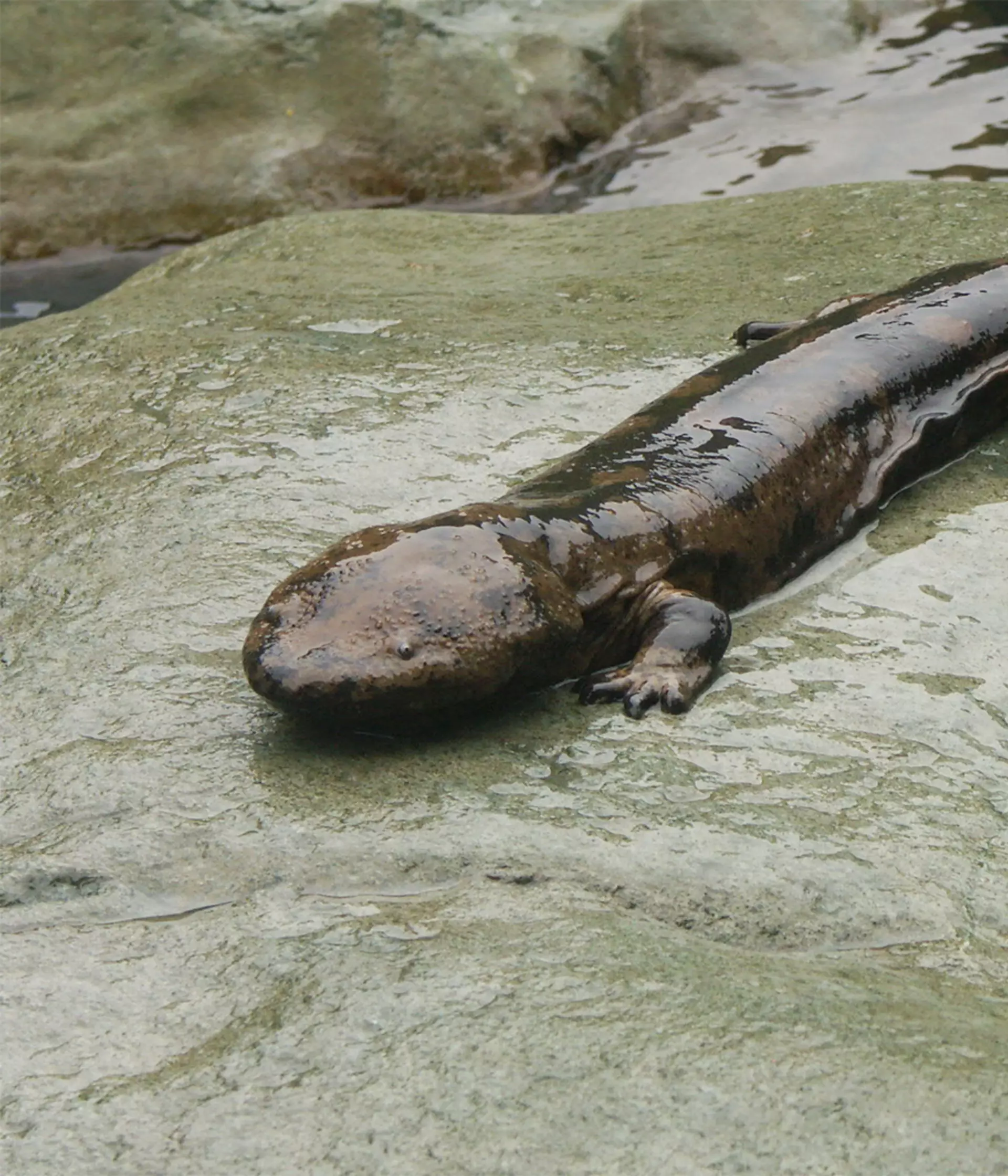
The Chinese giant salamander is the world’s largest amphibian, reaching lengths of more than 1.8m.
Chinese giant salamander facts
Where can I see a Chinese giant salamander?
We have our very own ambassador Chinese giant salamander at London Zoo, Professor Lew, who is helping raise awareness about the illegal wildlife trade after he was rescued by UK Border Force.
Chinese giant salamander threats
Chinese giant salamanders have been revered in Chinese culture for thousands of years, but overexploitation for the luxury food market as well as habitat loss has devastated wild populations.
They have been eaten historically by people across large areas of China, but this is now pushing the species to its limit. Our science-led conservation has established poaching as the overwhelming cause of their decline, helping to frame our approach to saving the surviving population.
Protecting the Chinese giant salamander
ZSL has been working to conserve the Chinese giant salamander since 2010, beginning with an assessment of its status and the threats posed by farming, trade and disease.
This included evaluating the impact of salamander farms, investigating the incidence and drivers of poaching, and analysing the effects of farmed salamander releases on the pathogens and genetic structures of wild salamander populations.
We carried out the largest ever wildlife survey in Chinese conservation history. We did this together with our partner organisations in China, including the Kunming Institute of Zoology, Shaanxi Normal University and Guiyang University, with financial support from the Darwin Initiative.
Ecological surveys were carried out at 97 sites in 16 of the country's 23 provinces over a four-year period. During these surveys, only 24 salamanders were found, and many, if not all, of these animals likely represent recent releases or escapes from farms.
Range-wide community interview surveys supported the findings of our ecological surveys; the average time of last giant salamander sighting was 19 years prior to the surveys being carried out.
Surveys of giant salamander farmers found that many farms were stocked by the illegal collection of giant salamanders from the wild.
Genetic analyses to understand the relationship between giant salamanders in different river systems and farms revealed that the Chinese giant salamander is actually not a single species but is comprised of several different species of giant salamander.
We raised, and continue to raise, awareness about the plight of Chinese giant salamanders and their cultural and ecological importance among key decision makers and the general public, both in China and internationally.
We are working with the IUCN to assess the conservation status of giant salamanders in China.
We have also strengthened the capacity of in-country partner organisations to undertake long-term conservation of these Critically Endangered species by training four Chinese EDGE Fellows in various aspects of Chinese giant salamander conservation.
Science-led conservation
We have shown that there are actually between 7 and 9 different species of Chinese giant salamander, four of which are now described.
New species of giant salamander is world's biggest amphibian
Our science-led conservation has framed our approach to protect remaining populations.
China’s government has supported releases of farmed giant salamander as a conservation measure. However, we have discovered that this approach is harmful to wild populations because it risks hybridising different Chinese giant salamander species and spreading pathogens that are killing farmed salamanders into the remaining wild populations.
Together our efforts to conserve these species play a critical role in protecting China’s ecosystems and the livelihoods of people who rely on freshwater resources. Beyond the giant salamander, ZSL is also engaged in breeding programmes for several CITES-listed amphibians and has developed guidance and training on managing amphibian pathogens in the context of wildlife trade.
We have been working with Green Camel Bell and local stakeholders to create a better future for Chinese giant salamanders culminating in an action plan, which was published in 2024.
People involved
Andrew Cunningham managed our Chinese Giant Salamander project
Benjamin Tapley - Curator of Reptiles and Amphibian
Samuel Turvey – Professor
EDGE Fellow Shu Chen coordinated our project 'A sustainable future for Chinese giant salamanders'
Partners and sponsors
Shaanxi Normal University
Kadoorie Farm and Botanic Gardens
Kunming Institute of Zoology.
Thank you to all our funders
The Darwin Initiative
The National Ministry of Education, P. R. China
The National Natural Science Foundation of China
Ocean Park Conservation Foundation, Hong Kong
Mohamed bin Zayed, Species Fund
USFWS - Amphibians in Decline Fund
European Association of Zoos and Aquariums (EAZA)
IUCN Save Our Species
Synchronicity Earth
Find out more about Chinese Giant Salamander Conservation and the threats EDGE amphibians face and keep up with the latest scientific research on the 'A sustainable future for Chinese giant salamanders' Facebook page.
Chinese giant salamanders have been taken from the wild at a staggering rate to stock farms and this has had a catastrophic effect on wild populations.
From lab to field, we’re working at the cutting-edge of giant salamander conservation to develop a route for recovery.