






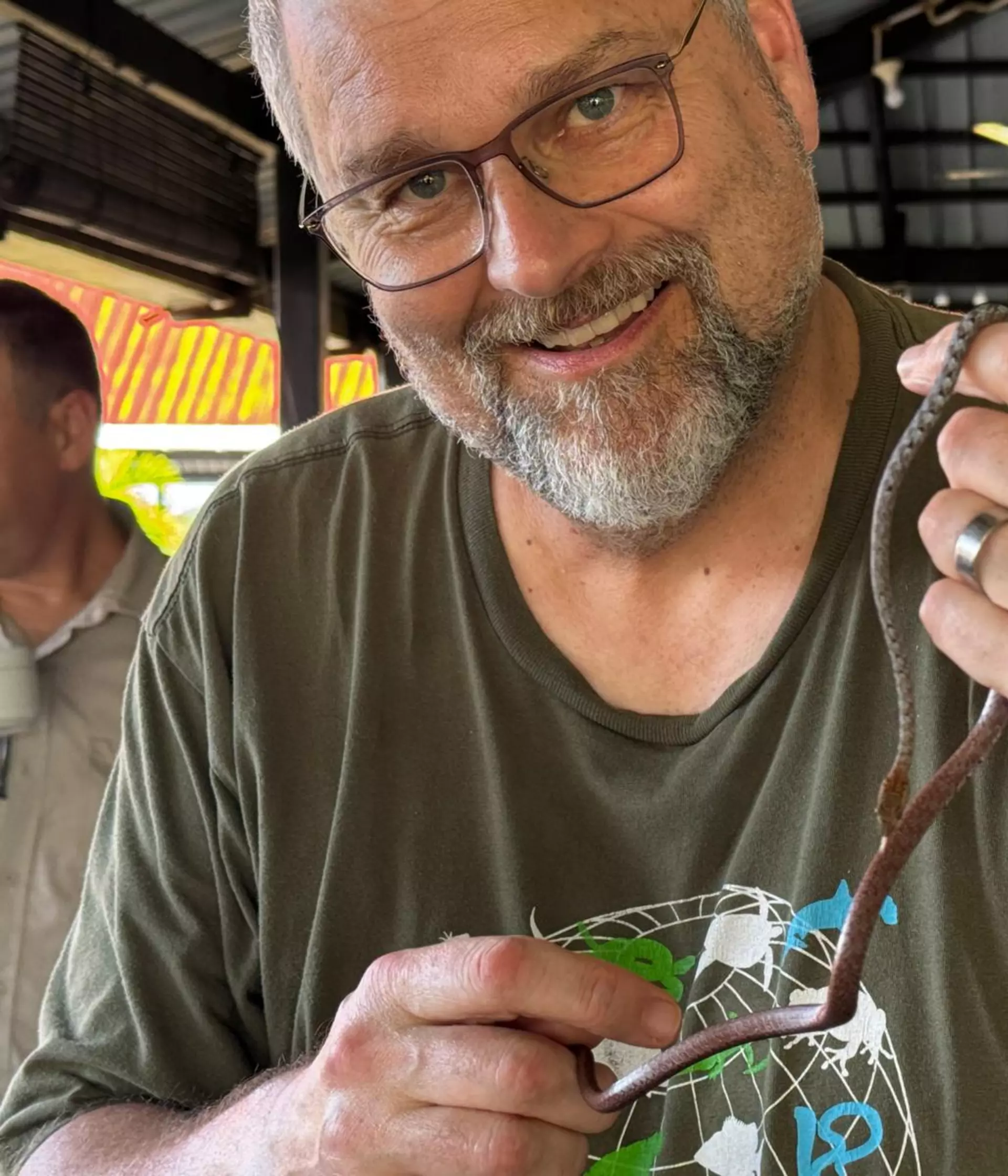
Broadly speaking, Trent's research has always contrasted biological conflicts with compatibilities.
His earlier research interests include polygynandrous mating systems, how they affect population genetic structure, and how demography affects mate choice.
His current research is predominantly focused on determining how parasites are maintained and incur costs in hosts, and how this may affect host or parasite population dynamics and persistence. He does this using several amphibian hosts, chytridiomycete fungi and ranaviruses. His work has been funded extensively by NERC, but he has also been generously funded by the EU BiodivERsA programme, the Morris Animal Foundation, BBSRC, the NC3Rs, the British Ecological Society, the Royal Society, the Leverhulme Trust, People’s Trust for Endangered Species and the Fundación General CSIC Proyectos Cero.
Ranaviruses and chytridiomycete fungi are internationally recognised as pathogens responsible for global amphibian decline. However, impacts of both pathogen groups in the wild can range from transient and mild infections through to catastrophic host population declines and losses. Work done in Trent's group and with collaborators use fieldwork, experiments, epidemiological modelling and various ‘omics approaches to understand under what conditions these pathogens threaten amphibian biodiversity and through this inform conservation efforts. We also directly develop methods to mitigate the impacts of amphibian infectious diseases and trial these experimentally and in amphibian populations and communities put at risk by ranaviruses and chytridiomycete fungi.
Trent still manages to participate in projects outside of the amphibian disease paradigm, including sexual selection, population and evolutionary genetics, invasion ecology and amphibian community ecology. More often than not these projects do have a conservation angle, but everything his group does is anchored in basic science and hypothesis testing. Irrespective of what the project is, the team aims to embed the best welfare and ethical practices in our work, and are working directly with the NC3Rs to ensure this is the case.
- 2017–present: Professor, Institute of Zoology, Zoological Society of London/UCL
- 2015–present: Extraordinary Professor, Department of Zoology, North-West University
- 2015–2017: Reader, Institute of Zoology, Zoological Society of London
- 2012–present: Adjunct Professor, Biology Department, Laurentian University
- 2011–present: Honorary Research Fellow, Department of Infectious Disease Epidemiology, Imperial College
- 2009–2014: Senior Research Fellow, Institute of Zoology, Zoological Society of London
- 2005–2010: Research Councils U.K. Research Fellow, Institute of Zoology, Zoological Society of London
- 2004–2005: Post doctoral Research Associate, Institute of Zoology, Zoological Society of London
- 2001–2004: Post doctoral Research Associate, Zoologisches Institut and Zoologisches Museum, Universität Zürich
- 1998–2001: PhD candidate, Zoologisches Institut, Universität Zürich
- 1994–1998: MSc candidate, Department of Biology, University of Victoria
- 1992–1994: BSc candidate, Department of Biology, University of Victoria
Catarina Dias Coutinho, with Gonçalo Rosa and Rui Rebelo (University of Lisbon)
Lucy Morgan with Richard Nichols (Queen Mary University of London) and John Ewen (Institute of Zoology)
Meg St Roas with Andy Fenton and Venera Tyukmaeva (University of Liverpool) and Louise McRae (Institute of Zoology)
Zhengxi Tang with Clare Stanley and Mat Fisher (Imperial College London) and Patricia Brekke (Institute of Zoology)
Eleanor Tinsley, with Jim Labisko (UCL) and Marcus Rowcliffe (Institute of Zoology)
Mia Williams with Mat Fisher (Imperial College London) and Charlie Outhwaite (Institute of Zoology)
Dr Sarah Ball
Kevin Hopkins
Chris Sergeant
Dr Siobhan Abeyesinghe, Royal Veterinary College
Professor Francois Balloux, UCL
Dr Kieran Bates, Oxford
Dr Rhys Farrer, Aberdeen
Dr Sally Faulkner, QMUL
Professor Andy Fenton, University of Liverpool
Professor Matthew Fisher, Imperial College
Dr Amber Griffiths, FoAM Kernow
Professor Richard Griffiths, University of Kent
Dr Xavier Harrison, University of Exeter
Dr Robert Jehle, University of Salford
Dr Robert Knell, QMUL
Dr Steve LeComber, QMUL
Professor Andrea Manica, University of Cambridge
Professor Richard Nichols, QMUL
Dr Silviu Petrovan, University of Cambridge
Dr Stephen Price, UCL
Dr Rob Puschendorf, Plymouth
Professor Alethea Tabor, UCL
Dr Lewis Campbell, USA
Dr Amanda Duffus, USA
Marco Favelli, IT
Professor Caren Helbing, CA
Professor David Lesbarrères, CA
Dr Ben Scheele, AU
Dr Giuseppe Sotgiu, IT
Dr Giulia Tessa, IT
Professor Che Weldon, RSA
2019
Brod S, Brookes L, Garner TWJ (2019) Discussing the future of amphibians in research. Report of the NC3Rs/ZSL Workshop on Amphibian Welfare. Lab Animal, 48, 16-18
Campbell LJ, Garner TWJ, Hopkins K, Griffiths AGF, Harrison XA (in press) Outbreaks of an emerging viral disease predict the composition of the skin microbiome of a wild UK amphibian. Frontiers in Microbiology
Duffus ALJ, Garner TWJ, Nichols RA, Standridge JP, Earl JE (in press) Modelling ranavirus transmission in populations of common frogs (Rana temporaria) in the United Kingdom. Viruses
Price SJ, Leung WTM, Owen CJ, Puschendorf R, Sergeant C, Cunningham AA, Balloux F, Garner TWJ, Nichols RA (2019) Temperature has been a key driver of an epidemic wildlife disease and future warming will increase its range and impact. Global Change Biology
Rosa GM, Bosch J, Martel A, Pasmans F, Rebelo R, Griffiths RA, Garner TWJ (2019) Sex-biased disease dynamics increases extinction risk. Animal Conservation
Saucedo B, Garner TWJ, Kruithof N, Allain SJR, Goodman MJ, Cranfield RJ, Sergeant C, Vergara DA, Kik MJL, Forzán MJ, van Beurden SJ, Gröne A (2019) Common midwife toad ranaviruses replicate first in the oral cavity of smooth newts (Lissotriton vulgaris) and show distinct strain-associated pathogenicity. Scientific Reports, 9, Article number 4453
Scheele BC, Pasmans F, Berger L, Skerratt LF, Martel A, Beukema W, Acevedo AA, Burrowes PA, Carvalho T, Catenazzi A, De La Riva I, Fisher MC, Flechas SV, Foster CN, Frías-Álvarez P, Garner TWJ, Gratwicke B, Guayasamin JM, Mirschfeld M, Kolby JE, Kosch TA, La Marca E, Lindenmayer DB, Lips KR, Longo AV, Maneyro R, McDonald CA, Mendelson III J, Palacios- Rodriguez P, Parra-Olea G, Richards-Zawacki CL, Rödel M-O, Rovito SM, Soto-Azat C, Toledo LF, Voyles J, Weldon C, Whitfield SM, Milkinson M, Zamudio K, Canessa S (2019) The aftermath of an amphibian fungal panzootic reveals unprecedented loss of biodiversity. Science, 363, 1459-1463
2018
Bates KA, Clare FC, O’Hanlon S, Bosch J, Brookes L, Hopkins K, McLaughlin E, Daniel O, Garner TWJ, Fisher MC, Harrison XA (2018) Bacterial community structure linked to enzootic versus epizootic dynamics across montane outbreaks of amphibian chytridiomycosis. Nature Communications, 9, Article number: 693
Bosch J, Fernández-Beaskoetxea S, Garner TWJ, Carrascal LM (2018) Long-term monitoring of an amphibian community after a climate change- and infectious disease-driven species extirpation. Global Change Biology, 24, 2262-2232
Campbell LJ, Garner TWJ, Tessa G, Scheele BC, Griffiths AGF, Wilfert L, Harrison XA (2018) An emerging viral pathogen truncates population age structure in a European amphibian and may reduce population viability. PeerJ, 6, e5949
Campbell LJ, Hammond SA, Price SJ, Sharma MD, Garner TWJ, Birol I, Helbing CC, Wilfert L, Buckling A, Griffiths AGF (2018) A novel approach to wildlife transcriptomics provides evidence of disease-mediated differential expression and changes to the microbiome of amphibian populations. Molecular Ecology, 27, 1413-1427
Daversa DR, Manica A, Bosch J, Jolles JW, Garner TWJ (2018) Routine habitat switching alters the likelihood and persistence of infection with a potentially pathogenic parasite. Functional Ecology, 32, 1262-1270
Fernández-Loras A, Martín-Beyer B, Garner TWJ, Bosch J (2018) Itraconazole and thiophanate-methyl fail to clear tadpoles naturally infected with the hypervirulent lineage of Batrachochytrium dendrobatidis. Diseases of Aquatic Organisms, 131, 73-78
Fisher MC, Ghosh P, Shelton JMG, Bates K, Brookes L, Wierzbicki C, Rosa GM, Farrer RA, Aanensen DM, Avarado-Rybak M, Bataille A, Berger L, Böll S, Bosch J, Clare FC, Courtois E, Crottini A, Cunningham AA, Doherty-Bone TM, Gebresenbet F, Gower DJ, Höglund J, James TY, Jenkinson TS, Kosch TA, Lambertini C, Laurila A, Lin C-F, Loyau A, Martel A, Meurling S, Miaud C, Minting P, Ndriantsoa S, Pasmans F, Rakotonanahary T, Rabemananjara FCE, Ribeiro LP, Schmeller DS, Schmidt BR, Skerratt L, Smith F, Soto-Azat C, Tessa G, Toledo LF, Valenzuela-Sanchez A, Verster R, Vörös J, Waldman B, Webb RJ, Weldon C, Wombwell E, Zamudio KR, Longcore JE, Garner TWJ (2018) Development and worldwide use of non-lethal, and minimal population level impact, protocols for the isolation of amphibian chytrid fungi. Scientific Reports, 8, Article number: 7772
Garner TWJ (2018) Commentary: A possible reservoir of Batrachochytrium dendrobatidis in Australia. Animal Conservation
O’Hanlon SJ, Rieux A, Farrer RA, Rosa GM, Waldman B, Bataille A, Kosch TA, Murray K, Brankovics B, Fumagalli M, Martin MD, Wales N, Alvarado-Rybak M, Berger L, Böll S, Brookes L, Clare F, Courtois EA, Cunningham AA, Doherty-Bone T, Ghosh P, Gower DJ, Hintz WE, Höglund J, Jenkinson TS, Lin C-F, Laurila A, Loyau A, Martel A, Meurling S, Miaud C, Minting P, Pasmans F, Schmeller D, Schmidt BR, Shelton J, Skerratt LF, Smith F, Soto-Azat C, Spagnoletti M, Tessa G, Toledo LF, Valenzuela-Sánchez A, Verster R, Vörös J, Wierzbicki C, Wombwell E, Zamudio KR, Aanensen DM, James TY, Gilbert MTP, Weldon C, Bosch J, Balloux F, Garner TWJ, Fisher MC (2018) A 20th Century Out-of-Asia Origin of a panzootic threat to global amphibian biodiversity (cover article). Science, 360, 621-627
2017
Ball S, Bovero S, Sotgiu G, Tessa G, Angelini C, Bielby J, Durrant C, Favelli M, Gazzaniga E, Garner TWJ (2017) Islands within islands: population genetic structure of the endemic Sardinian newt, Euproctus platycephalus. Ecology and Evolution, 7, 1190-1211
Daversa DR, Fenton A, Dell A, Garner TWJ, Manica A (2017) Infections on the move: the role of infection dynamics during transient phases of host movement in disease spread. Proceedings of the Royal Society of London, Series B, 284, 20171807
Duffus ALJ, Garner TWJ, Dean AW, Davis AR, Nichols RA (2017) Phylogenetic analysis of 24 Ranavirus isolates from English amphibians using two partial loci. Journal of Emerging Diseases and Virology, 3
Fiegna C, Clarke CL, Shaw DJ, Baily JL, Garner TWJ, Clare FC, Gray A, Meredith AL (2017) Pathological and phylogenetic characterization of Amphibiothecum sp. Infection in an isolated amphibian (Lissotriton helveticus) population on the island of Rum (Scotland). Parasitology, 144, 484-496
Leung WTM, Thomas-Walters L, Garner TWJ, Balloux F, Durrant C, Price SJ (2017) A quantitative-PCR based method to estimate ranavirus viral load following normalisation by reference to an ultraconserved vertebrate target. Journal of Virological Methods, 249, 147-155
Price SJ, Ariel E, Maclaine A, Rosa GM, Gray MJ, Brunner JL, Garner TWJ (2017) From fish to frogs and beyond: Impact and host range of emergent ranaviruses. Virology, 511, 272-279
Rosa GM, Sabino-Pinto J, Laurentino TG, Martel A, Pasmans F, Rebelo R, Griffiths RA, Stöhr AC, Marschang RE, Price SJ, Garner TWJ, Bosch J (2017) Impact of asynchronous emergence of two lethal pathogens on amphibian assemblages. Scientific Reports, 7, 43260
Tapley B, Bielby J, Böhm M, Brookes L, Capel T, Smiley Capon-Doyle J, Chen S, Cliffe A, Clifforde L, Couchman O, Cunningham AA, Felterer Y, Ferguson A, Flach E, Franklin M, Garner TWJ, Gill I, Gray C, Gumbs R, Guthrie A, Jaffe J, Jayson S, Harding L, Hudson M, Kane D, Korn J, Lawson B, MacIntosh H, Masters N, Maunders T, Molenaar F, Michaels CJ, Moxey T, Murray C, Owen N, Pearce-Kelly P, Rendle M, Sainsbury T, Sergeant C, Servini F, Sparrow S, Strike T, Thomas S, Turvey S (2017) Zoological Society of London: contributions towards advancing the field of herpetology through conservation, research, captive management and education. The Herpetological Bulletin, 139, 1-6
- Research Councils U.K. Research Fellowship (PI: 2005-2010) ‘Population and Immunocompetent Genetic Variaton: a Field-Based Study.’ Total budget: £125,000
- NERC Standard Grant (Co-I, 2007-2010) ‘Relationship Between Environmental, Ecological and Genetic Drivers of Emergence in Amphibian Chytridiomycosis.’ Co-applicants Dr. Matthew Fisher (PI) and Dr. Andrew Cunningham. Total budget: £383,610
- BBSRC Standard Grant (Co-I: 2007-2008) ‘Modelling the Amphibian Response to Infection by the Chytrid Batrachochytrium dendobatidis.’ Co-applicants Dr. Matthew Fisher (PI) and Prof. Christl Donnelly (Co-I). Total budget: £128,195
- EU BiodivERsA Programme (Project Partner: 2008-2012) ‘R.A.C.E. Risk Assessment of Chyridiomycosis to Europe’s Amphibians’. Co-applicants Dr Matthew Fisher (Project Coordinator), Dr Jaime Bosch, Dr Benedikt Schmidt, Prof Claude Miaud, Dr Dirk Schmeller and Prof Klaus Henle. Total budget: €1.5 million
- Leverhulme Trust Research Project Grant (PI: 2009-2011) ‘Parasitism and Host Behaviour.’ Co-applicant Dr Rob Knell. Total budget: £83,915
- Fundación General CSIC Proyectos Cero (Co-I: 2010-2014) ‘Disease Mitigation in Declining Amphibian Populations.’ Co-applicants Prof Jaime Bosch (PI), Dr Matthew Fisher and Dr Jon Bielby. Total budget: €224,355
- Morris Animal Foundation Experienced Researcher Grant (PI: 2011-2014) ‘Is the Trade in Ornamental Amphibians Introducing Batrachochytrium dendrobatidis to Wild Amphibian Populations?’ Co-Applicants Prof Tony Goldberg, Dr Matthew Fisher and Dr Frank Pasmans. Total budget: $116,645
- NERC Standard Grant (Co-I, 2014-2017) ‘The Spatial Epidemiology and Molecular Evolution of Panzootic Amphibian Chytridiomycosis.’ Co-applicant Prof. Matthew Fisher. Total budget: £591,550
- Morris Animal Foundation Grant for Wildlife/Exotics Research (PI: 2014-2016) ‘Is Mortality Caused by an Infectious Disease Leading to the Decline of Palmate Newts in Scotland?’ Co-applicants Prof. Anna Meredith, Dr. Darren Shaw, Dr. Nick Saville. Total budget: $135,000
- NERC Standard Grant (PI, 2015-2018) ‘Identifying the Genetic Mechanisms Facilitating Host Range and Virulence of a Viral Pathogen that Threatens European Amphibian Biodiversity.’ Co-Applicants Prof. Richard Nichols, Prof. Francois Balloux. Total budget: £675,215
- NERC Standard Grant (Co-I, 2016-2019) ‘Quantifying Host Species Contributions of Pathogen Transmission in a Multihost Community: The Case of Chytrid Fungus in Amphibian Communities.’ Co-applicants Prof. Andy Fenton (PI), Dr. Andrea Manica. Total budget: £633,945
- NERC Standard Grant (Co-I, 2018-2021) ‘Understanding Links Between Microbial Communities and Emerging Fungal Pathogens in Complex Ecosystems.’ Co-applicant Prof. Matthew Fisher (PI). Total budget: £612,705