






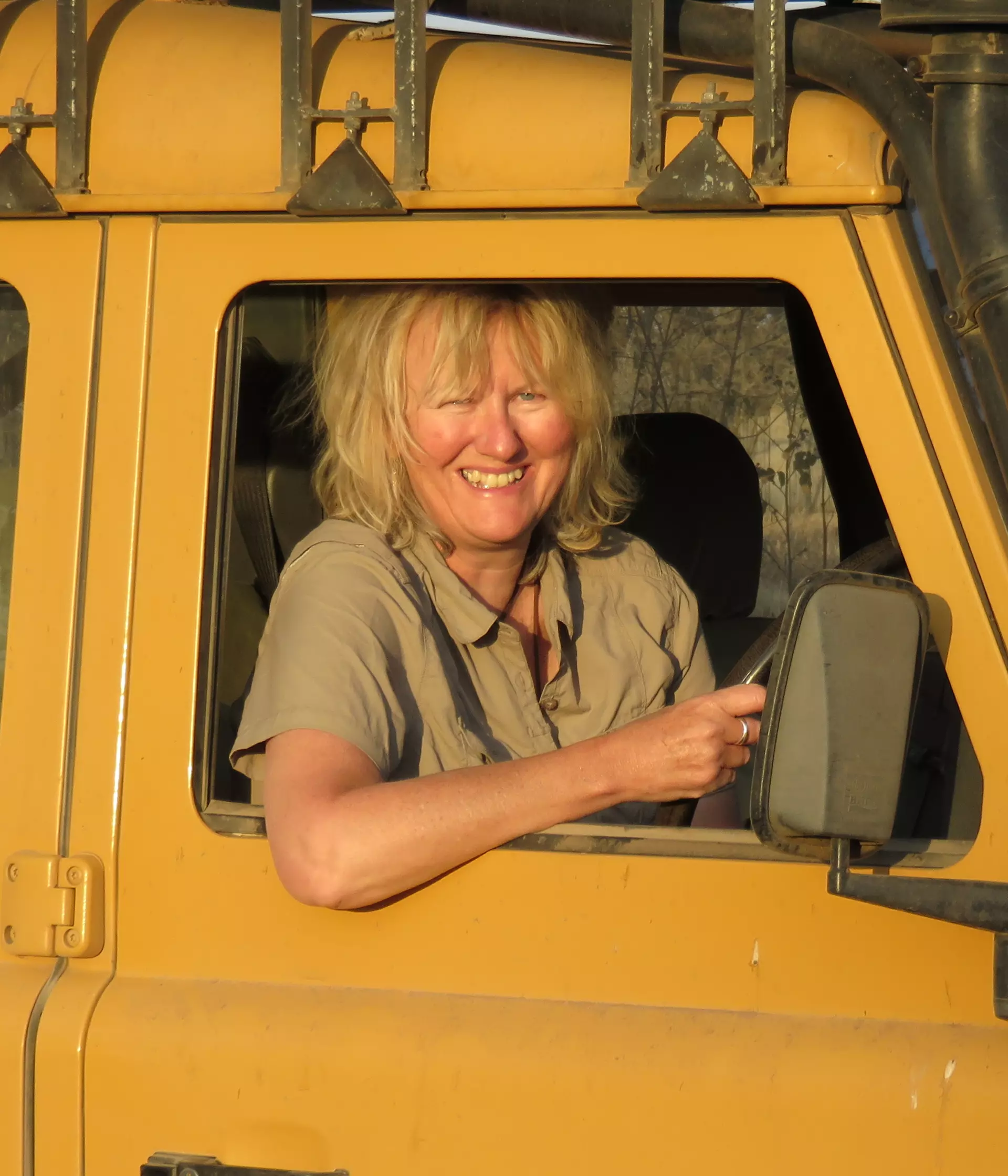

Sarah Durant is a research scientist and conservation practitioner.
Sarah is focused on delivering novel scientific research relevant to the conservation and management of large carnivores in Africa. Her research is focused on developing scientific solutions to conservation problems, informed by behavioural and population ecology, and with a strong interdisciplinary component. She is a Project Leader of the Serengeti Cheetah Project, the longest ongoing study of wild cheetahs since 1991. Sarah is a Program Leader of the African Range-wide Cheetah Conservation Initiative (previously the Range Wide Conservation Program for Cheetah and African Wild Dogs) since 2007.
Sarah has worked in Tanzania since 1991 where she continues to head the Serengeti Cheetah Project, which is the longest ongoing study of wild cheetah.
In 2002 she initiated the Tanzania Carnivore Program to establish and maintain national capacity for research and conservation of all carnivores in Tanzania. Later, in 2007, together with Rosie Woodroffe, she established the Range Wide Conservation Program (RWCP) for Cheetah and African Wild Dogs with the ultimate aim of halting the global decline in these species. She continues to head this program, which now includes a focus on establishing cheetah landscapes.
Sarah is also an Honorary Professor at University College London.
Professional history
- 2020-2022: Director of Science (acting), Institute of Zoology, Zoological Society of London
- 2019-present: Professor, Institute of Zoology, Zoological Society of London
- 2003-2019: Senior Research Fellow, Institute of Zoology, Zoological Society of London
- 1991–2003: Research Fellow, Institute of Zoology, Zoological Society of London
- 1991: PhD, University of Cambridge
- 1986: BA(Hons), University of Cambridge
IUCN Cat Specialist group, member 1994 to present
IUCN Pangolin Specialist Group 2012-present
National Geographic Explore
Publications
Marino, A, J Blanco, J Cortes-Vazquez, J López-Bao, A. Bosch & SM Durant 2022. Environmentalities of Coexistence with Wolves in the Cantabrian Mountains of Spain. Conservation and Society 20:345-357.
Durant, SM, Marino, A et al. 2022. Fostering Coexistence Between People and Large Carnivores in Africa: Using a Theory of Change to Identify Pathways to Impact and Their Underlying Assumptions. Frontiers in Conservation Science, 2 10.3389/fcosc.2021.698631 (Durant and Marino co-led paper)
O'Neill, HMK, Durant, SM, Strebel, S, Woodroffe, R 2022. Fencing affects African Wild Dog Movement Patterns and Population Dynamics. Oryx 1-9. doi:10.1017/S0030605320000320.
Powell, J, Axmacher, JC, Linnell, JDC, & Durant, SM 2021. Diverse Locations and a Long History: Historical Context for Urban Leopards (Panthera pardus) in the Early Anthropocene from Seoul, Korea. Front. Conserv. Sci., https://doi.org/10.3389/fcosc.2021.765911
Butler, JRA; Marzano, M; Pettorelli, N; Durant, SM; du Toit, JT; Young, JC; 2021. Decision-Making for Rewilding: An Adaptive Governance Framework for Social-Ecological Complexity. Frontiers in Conservation Science, 2, Article 681545. 10.3389/fcosc.2021.681545.
Schulte to Bühne, H, Tobias, JA, Durant, SM, Pettorelli, N 2021. Improving predictions of climate change–land use change interactions. Trends in Ecology and Evolution 36, 29-38 https://doi.org/10.1016/j.tree.2020.08.019.
O’Neill, HMK, Durant, SM & Woodroffe, R 2020 What wild dogs want: habitat selection differs across life stages and orders of selection in a wide-ranging carnivore. BMC Zool 5, 1 https://doi.org/10.1186/s40850-019-0050-0
Overton, JM, Elizalde Castells, D, Figueira Fernandes Elizalde, SR, Valério, HM, Zumbo, MNA, Groom, RJ & Durant, SM 2020. Endangered African wild dogs (Lycaon pictus Temm.) in Angola: Filling a 50‐year gap of knowledge with findings from two National Parks. Afr J Ecol.; 00: 1– 6. https://doi.org/10.1111/aje.12715
Hilborn A, Pettorelli N, Caro T, Kelly MJ, Laurenson MK, Durant SM 2018. Cheetahs modify their prey handling behavior depending on risks from top predators. Behavioral Ecology and Sociobiology 72:74. https://doi.org/10.1007/s00265-018-2481-y
Brito JC, Durant SM, Pettorelli N, Newby J, Canney S, Algadafi W, Rabeil T, Crochet PA, Pleguezuelos JM, Wacher T and others 2018. Armed conflicts and wildlife decline: Challenges and recommendations for effective conservation policy in the Sahara‐Sahel. Conservation Letters https://doi.org/10.1111/conl.12446
Pettorelli N, Barlow J, Stephens PA, Durant SM, Connor B, Schulte to Bühne H, Sandom CJ, Wentworth J & du Toit JT 2018 Making rewilding fit for policy. J Appl Ecol https://doi.org/10.1111/1365-2664.13082
Mkonyi FJ, Estes AB, Msuha MJ, Lichtenfeld LL & Durant SM 2017. Local attitudes and perceptions toward large carnivores in a human-dominated landscape of northern Tanzania. Human Dimensions of Wildlife, http://dx.doi.org/10.1080/10871209.2017.1323356.
Becker, MS, Durant, SM, Watson, FGR, Parker, M, Gottelli, D, M’soka, J, Droge, E, Nyirenda, M, Schuette, P, Dunkley, S & R Brummer 2017. Using dogs to find cats: detection dogs as a survey method for wide-ranging cheetah. Journal of Zoology
Durant , SM et al. 2017. The global decline of cheetah Acinonyx jubatus and what it means for conservation. Proceedings of the National Academy of Sciences 114, 528-533.
Durant, SM et al. 2015. Developing fencing policies for dryland ecosystems. Journal of Applied Ecology
Belbachir, F, Pettorelli, N, Wacher, T, Belbachir-Bazi, A & Durant, SM 2015. Monitoring Rarity: The Critically Endangered Saharan Cheetah as a Flagship Species for a Threatened Ecosystem. PLoS ONE 10.1371/journal.pone.0115136
Dickman, AJ, Hazzah, L, Carbone, C & Durant SM 2014. Carnivores, culture and 'contagious conflict': Multiple factors influence perceived problems with carnivores in Tanzania's Ruaha landscape. Biological Conservation 178, 19-27.
Scantlebury, DM, Mills, MGL, Wilson, RP, Wilson, JW, Mills, MEJ, Durant, SM, Bennett, NC, Bradford, P, Marks, NJ, & JR Speakman 2014. Flexible energetics of cheetah hunting strategies provide resistance against kleptoparasitism. Science 346, 79-81.
Woodroffe, R, Hedges, S & Durant, SM 2014. To fence or not to fence. Science, 344, 46–8.
Durant, SM et al. 2014. Fiddling in biodiversity hotspots while deserts burn? Collapse of the Sahara’s megafauna. Diversity and Distributions 20, 114–122.