






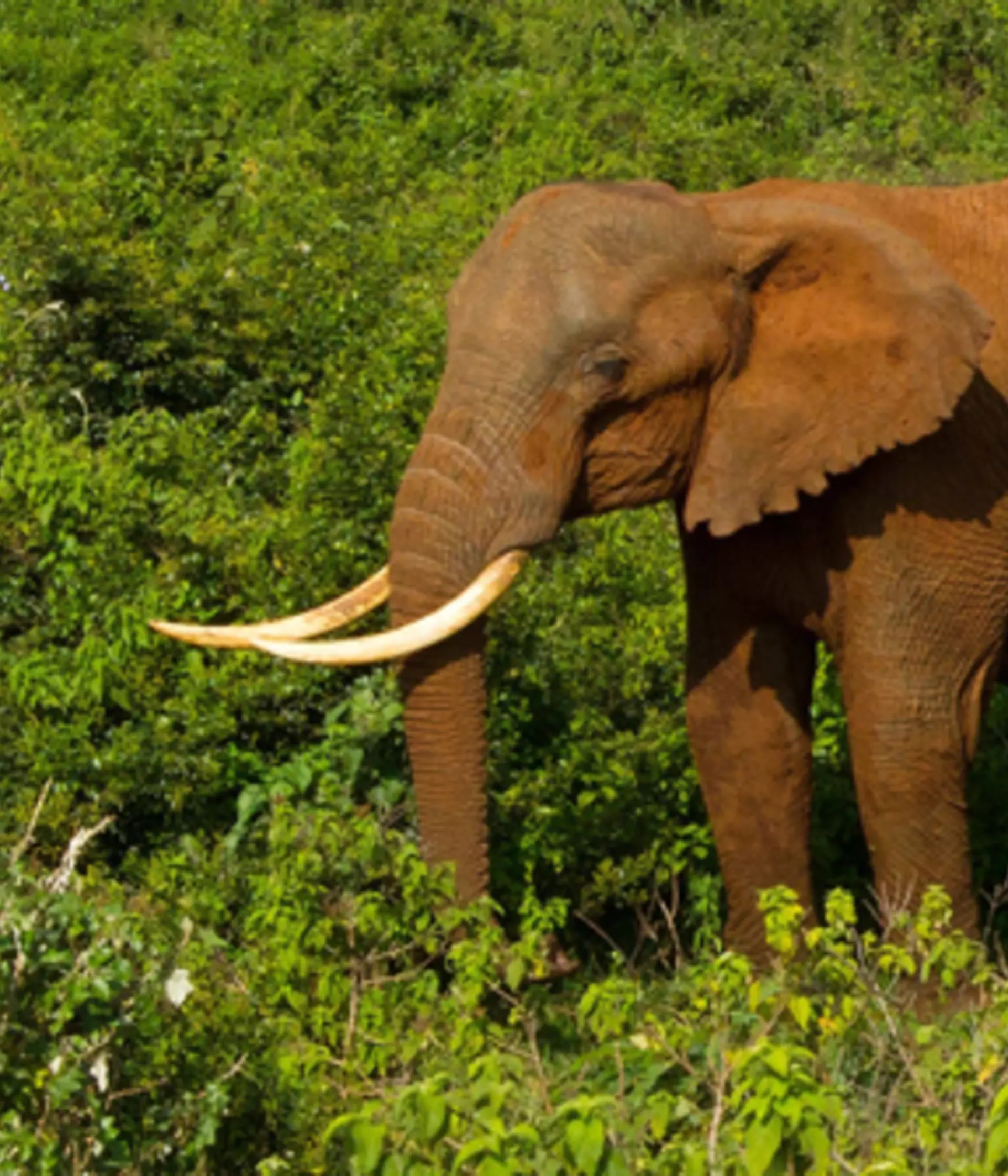
Forest elephants are Critically Endangered
As its name suggests, the forest elephant is a forest-dwelling African elephant which is smaller and darker than its savanna relative, with characteristically rounded ears and a hairy trunk. Due to its elusive nature and dense, forest habitat, the forest elephant has not been studied as extensively as the savannah elephant. The species is confined to the forests of West and Central equatorial Africa, particularly in the Congo basin.
Historically, African elephants were treated as one species, listed on the IUCN Red List as Vulnerable. However, in 2021, the IUCN announced that the African forest elephant (Loxodonta cyclotis) is a separate species from the African savanna elephant, following new research into the genetics of elephant populations. Following this, the African forest elephant was classed as Critically Endangered on the IUCN Red List, following population declines of over 86% over a period of 31 years.
Why are forest elephants under threat?
The severe decline of forest elephants in Central Africa is largely a result of the unprecedented levels of poaching for the illegal ivory trade in recent years. A recent study by Maisels et al showed that across Central Africa, forest elephant populations have suffered shocking declines, estimated to be in excess of 60% in the 10 years from 2002-2012. Furthermore, it is estimated that they inhabit just 25% of their historic range. Remaining elephant populations continue to face considerable pressure.
Although the species has vanished from around 30% of its range over this 10-year period, it is thought that adjacent parts of South East Cameroon, North East Gabon and the Northern Congo represent the last remaining strongholds for this large mammal. Protecting these populations is vital for the future of the species in Central Africa.
How we’re helping forest elephant conservation
ZSL conservationists are focussing on conserving forest elephants in Cameroon; specifically in the forest landscape of the Dja Biosphere Reserve. The Reserve itself is a UNESCO World Heritage Site surrounded by timber concessions and community-managed lands, which cover c. 15,000 square kilometres. This area is globally recognised as a conservation priority for elephants and other threatened wildlife.
Over 2021 and 2022, ZSL has worked to increase the protection of forest elephant populations in key protected areas within the TRIDOM landscape. As part of this project, a full wildlife inventory was completed in the Dja Faunal Reserve and two other smaller protected areas within the landscape, during which 16 teams walked 518 1km transects.
Data collection from these transects allowed for the estimation of population for three main species; African forest elephants, chimpanzees and gorillas. In addition to this, 95 camera traps were deployed to monitor elephant presence within protected areas and movements through wildlife corridors. During the inventory, the teams also collected 107 elephant dung samples to be used for genetic analysis, which is currently underway.
Key Species
African forest elephant, (Loxodonta cyclotis) – Critically Endangered
People involved
Andrew Fowler, the West and Central Africa Regional Manager oversees ZSL’s work on the forest elephant in Cameroon.
Partners & Sponsors
Ministère des Forêts et de la Faune de la République du Cameroun (MINFOF); the UK Government’s Darwin Initiative and IWT Challenge Fund; USFWS; IUCN SOS Fund; Rufford Foundation; European Union and UNESCO; TRAFFIC; African Wildlife Foundation; Société Pallisco; Société Forestière et Industrielle de la Doumé (SFID).
Related projects
Read about our Dja conservation complex project, which supports the management of the Dja Biosphere Reserve and its periphery to prevent poaching of forest elephant and other vulnerable species.
Publications
Urgent action to stop the devastation of critical species and habitats by helping people and wildlife live better together, is the only way to save the natural world we love and depend upon. That’s where ZSL comes in, and where you can play your part.